
 By Azzam Bilal Chamdy
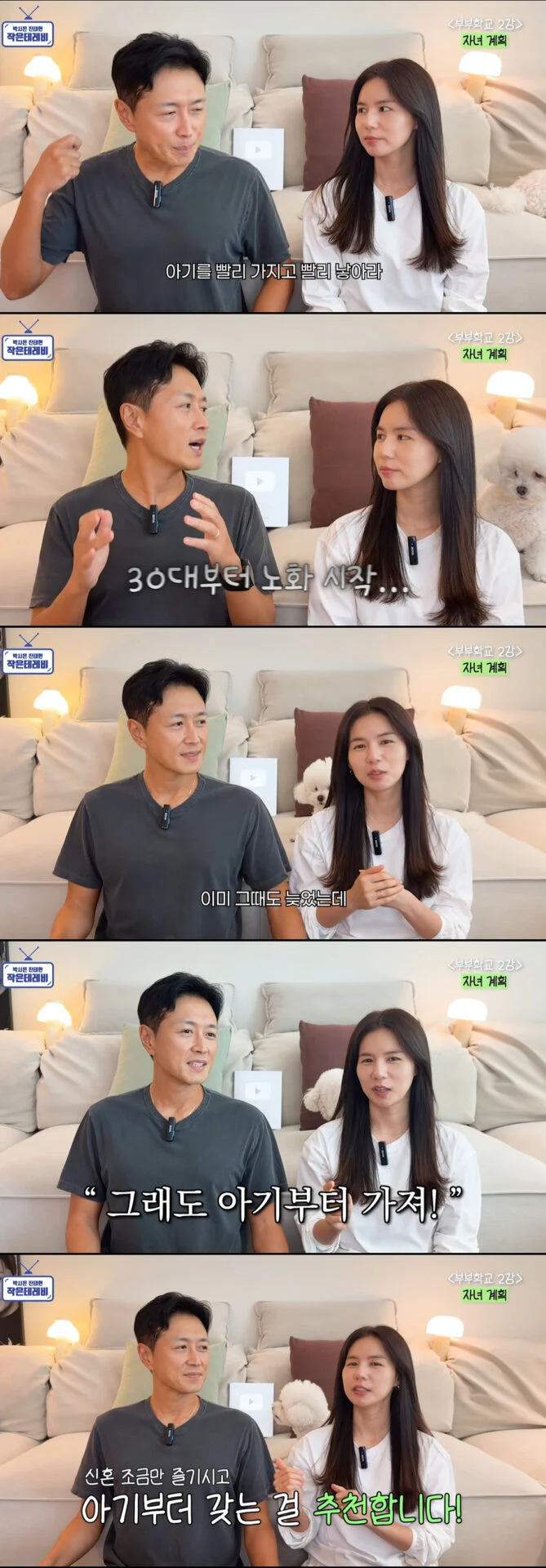
In a poignant and candid disclosure that has resonated deeply with couples worldwide, beloved South Korean actors Park Si Eun and Jin Tae Hyun have shared deeply personal advice on family planning, drawing from their own arduous journey through multiple miscarriages and profound loss. Their recent video, titled “Couples School by Park Si Eun and Jin Tae Hyun Lecture 2: The Sooner, The Better – Responsible Child Planning,” posted on their YouTube channel on October 30th, serves not merely as a personal reflection but as a crucial public health message underscored by their lived experience. The couple, known for their transparency and resilience, urged viewers to consider the biological realities of fertility and childbearing, advocating for earlier family planning decisions based on their heartbreaking experiences.
A Decade of Love, Loss, and Lessons Learned
Park Si Eun and Jin Tae Hyun, who tied the knot in 2015, have cultivated a public image built on sincerity and an unwavering commitment to each other and their family. Their journey into parenthood began uniquely in 2019 when they adopted a college-aged daughter, a testament to their expansive view of family. However, their path to biological parenthood was fraught with immense challenges, marked by repeated heartbreak. Prior to their most recent and devastating loss, the couple had already endured two miscarriages, each event a significant emotional blow. The most recent tragedy struck in 2023 when, after a successful pregnancy that brought them immense hope, they lost their unborn child a mere 20 days before the due date, a late-term miscarriage that brought unimaginable grief and tested their fortitude. It is against this backdrop of persistent sorrow and profound personal struggle that their advice takes on an added layer of gravity and authenticity. Their decision to openly discuss such a sensitive topic on a public platform reflects a deep desire to transform their personal pain into a valuable lesson for others, hoping to spare fellow couples similar anguish.
The Urgent Call for Early Family Planning
In their YouTube lecture, Jin Tae Hyun did not mince words, delivering a direct and emphatic message about the timing of childbearing. "If you’ve decided not to have kids, then don’t. It’s okay if just the two of you are happy," he stated, acknowledging diverse life choices. However, he quickly pivoted to their core advice for those who do desire children: "but speaking from our experience, do it early. Have kids quickly and raise them quickly." This seemingly straightforward counsel is deeply rooted in the biological realities of human fertility, a topic often overlooked or underestimated in modern society.
Jin Tae Hyun elaborated on the biological imperative, stating, "You have to have a baby in your twenties to give birth to a truly healthy child." He recognized the contemporary societal shift where individuals in their thirties often feel and appear youthful, but cautioned against equating perceived youth with biological vitality. "These days, society has changed, so even in your thirties you feel young, but your body is aging. From your forties, it’s a struggle against youth. It’s definitely better to have children as soon as possible." His words highlight a critical disconnect between societal perceptions of age and the physiological timeline of reproductive health.

Park Si Eun echoed her husband’s sentiments with a poignant reflection on their own delayed start. "I was 36 and Tae Hyun was 35 when we got married. Our starting point was already very late," she confessed. Despite their relatively advanced age for starting a family, they initially succumbed to the common desire for an extended newlywed period. "Still, during our newlywed life, we didn’t think much about having children. We thought we’d enjoy our newlywed period a bit longer before having kids. Even though it was late, we were immature. We only started preparing for kids in our forties. It was too late." Jin Tae Hyun interjected with a self-deprecating joke, "We were crazy," underscoring their regret.
Park Si Eun further recalled sage advice from their seniors that, at the time, went unheeded. "Even then, our seniors told us, ‘If you get married, have a baby first. Jobs will come even if you want to focus on them, but have a baby first.’" This wisdom, often passed down through generations, emphasizes the transient nature of peak fertility compared to career opportunities. "At the time, it didn’t really resonate with me, but now I understand why they said that. Having a newlywed period of about a year is okay, but we highly recommend having children sooner." Their candid admission serves as a powerful cautionary tale, urging younger couples to learn from their experience rather than repeat their perceived mistakes.
The Science Behind the Advice: Fertility and Age
The advice offered by Park Si Eun and Jin Tae Hyun is firmly supported by extensive medical and scientific research on human reproductive biology. Female fertility, in particular, begins to decline significantly after the age of 30, with a more rapid decrease after 35 and a sharper drop after 40. This decline is primarily due to a reduction in both the quantity and quality of eggs. Women are born with a finite number of eggs, which gradually deplete over time. As eggs age, they are more prone to chromosomal abnormalities, increasing the risk of miscarriage and genetic disorders in offspring.
According to data from the American College of Obstetricians and Gynecologists (ACOG) and other global health organizations, the probability of conception each month (fecundity) is approximately 20-25% for women in their late 20s and early 30s. By age 40, this percentage drops to about 5%, making natural conception much more challenging. The risk of miscarriage also increases with maternal age. For women in their 20s, the miscarriage rate is around 10-15%; in their early 30s, it’s 15-20%; by age 40, it can be as high as 30-40%; and for women over 45, it can exceed 50%. These statistics underscore the biological window for optimal reproductive success, aligning directly with Jin Tae Hyun’s emphasis on conceiving in one’s twenties or early thirties.
While male fertility is often perceived as less age-dependent, research indicates that paternal age also plays a role. While men typically produce sperm throughout their lives, sperm quality can decline with age, leading to an increased risk of miscarriage, certain birth defects, and conditions like autism and schizophrenia in children born to older fathers. Therefore, while the primary focus of fertility discussions often centers on women, the concept of "responsible child planning" ideally encompasses both partners’ biological clocks.
The Profound Impact of Miscarriage and Late-Term Loss

The couple’s willingness to share their miscarriages, particularly the devastating late-term loss just weeks before the due date, sheds light on a rarely discussed aspect of reproductive health. A late-term miscarriage, often referred to as stillbirth when it occurs after 20 weeks of gestation, is an incredibly traumatic experience. Unlike early miscarriages, which can sometimes be processed more privately, a late-term loss involves a fully formed baby, often with names chosen, nurseries prepared, and expectations deeply set. The emotional, psychological, and even physical toll on parents is immense, comparable to losing an infant. Studies show that parents who experience stillbirth often suffer from prolonged grief, depression, and anxiety, requiring significant emotional support and, in many cases, professional counseling.
By bringing this personal tragedy into the public eye, Park Si Eun and Jin Tae Hyun contribute to breaking the silence and stigma often associated with pregnancy loss. Many couples suffer in isolation, feeling that their grief is not fully acknowledged or understood. Their story validates the pain of countless others and encourages a more empathetic societal response to those navigating such profound sorrow.
Societal Trends and Demographic Implications
The advice from Park Si Eun and Jin Tae Hyun comes at a critical juncture, particularly in South Korea, which faces one of the lowest birth rates globally. The country’s fertility rate plummeted to an all-time low of 0.72 in 2023, far below the 2.1 needed to maintain a stable population. This demographic crisis is driven by a complex interplay of factors, including intense career competition, high costs of living and raising children, evolving gender roles, and a growing trend of delayed marriage and childbearing.
Many young South Koreans, both men and women, prioritize education, career advancement, and financial stability before considering marriage or children. The average age of first marriage and first childbirth has been steadily rising for decades. While this reflects greater autonomy and opportunities for individuals, it also puts them in direct conflict with biological fertility windows. The couple’s advice directly addresses this societal phenomenon, suggesting that while individual aspirations are valid, they must be weighed against biological realities if parenthood is a goal. Their message subtly challenges the societal pressures that often push individuals to delay family formation, prompting a re-evaluation of priorities in light of biological constraints.
The Power of Celebrity Advocacy and Public Discourse
The decision by Park Si Eun and Jin Tae Hyun, prominent figures in the entertainment industry, to share such a sensitive and private aspect of their lives holds significant weight. Celebrities often serve as powerful conduits for public information and social change. By speaking openly about their struggles with infertility and miscarriage, they normalize these experiences, reduce stigma, and encourage open dialogue among ordinary couples. Their candidness can empower others to seek information, discuss family planning more proactively with partners and healthcare providers, and make informed decisions about their reproductive timelines.

Their "Couples School" series on YouTube exemplifies a growing trend of celebrities using their platforms for educational and advocacy purposes, moving beyond mere entertainment to address critical social and health issues. This initiative can foster a greater understanding of reproductive health challenges and potentially influence public policy discussions surrounding fertility support, parental leave, and childcare in South Korea, all of which are crucial in addressing the nation’s demographic challenges.
A Holistic Approach to Family Planning
While the couple’s advice strongly emphasizes the biological timing of childbirth, it is also important to acknowledge that family planning is a multi-faceted decision. Factors such as emotional readiness, financial stability, relationship strength, and personal aspirations all play significant roles. The ideal scenario involves a balance where couples are both biologically prepared and personally ready for the responsibilities of parenthood.
However, the core message from Park Si Eun and Jin Tae Hyun serves as a vital reminder that while many aspects of life can be delayed or rescheduled, the biological clock for human reproduction is largely inflexible. Their painful experiences underscore the reality that delaying too long can close the window of opportunity, leading to regret and heartbreak. Their advocacy encourages couples to be proactive, informed, and realistic about their family planning goals, considering both personal desires and biological realities.
In conclusion, Park Si Eun and Jin Tae Hyun’s heartfelt and courageous disclosure transcends mere personal anecdote. It is a powerful call to action, deeply rooted in personal tragedy, urging couples to prioritize responsible and timely child planning. Their message, bolstered by scientific evidence and delivered with raw honesty, contributes significantly to a crucial public discourse on fertility, loss, and the future of family formation in an aging society. Their hope is that by sharing their pain, they can help other couples navigate the complex journey of parenthood with greater awareness, preparedness, and ultimately, a more joyful outcome.

