
 By Evan Lee Salim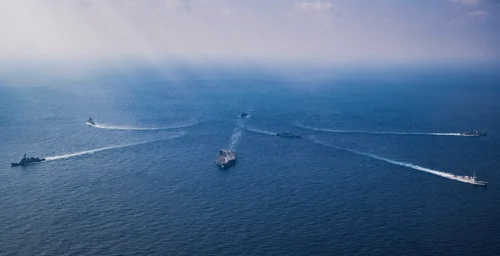
By Global Security Desk
The South Korean Joint Chiefs of Staff (JCS) officially announced on Friday that the United States, South Korea, and Japan are set to commence their annual “Freedom Edge” trilateral military exercise next month. Spanning five days from September 7 to 11, the multi-domain drills are scheduled to take place in international waters southeast of Jeju Island.
The announcement serves as a significant signal of regional commitment to deterrence, particularly as the exercise aims to fortify defenses against the escalating nuclear and missile capabilities of the Democratic People’s Republic of Korea (DPRK). This year’s iteration of Freedom Edge arrives during a complex geopolitical window, occurring just weeks after U.S. President Donald Trump made headlines for scaling back a separate large-scale drill—a move that sparked intense debate regarding the administration’s shifting stance on security commitments in the Indo-Pacific.
The Core Objective: Multi-Domain Deterrence
The Freedom Edge exercises are designed to be comprehensive, integrating air, sea, and cyber domains to ensure the three nations can operate in a unified, interoperable capacity. According to the South Korean JCS, the drills remain strictly defensive in nature.
“The exercise is a drill defensive in nature conducted annually by South Korea, the U.S., and Japan to counter North Korea’s nuclear and missile threats and safeguard peace and stability in the region,” the JCS stated in its press release.
By focusing on multi-domain integration, the exercise aims to synchronize the distinct naval and aerial assets of the three allies. This includes tracking simulated ballistic missile launches, conducting anti-submarine warfare (ASW) maneuvers, and engaging in electronic warfare drills. The proximity to Jeju Island is strategically significant, as it positions the combined forces to monitor and respond to maritime activity originating from the Korean Peninsula’s southern coast while maintaining a presence in vital shipping lanes.
A Chronology of Cooperation and Contradiction
To understand the significance of the upcoming September drills, one must look at the recent evolution of trilateral cooperation.
- 2023 Trilateral Pivot: The Camp David Summit in August 2023 served as the foundational moment for this era of cooperation. President Joe Biden, President Yoon Suk-yeol, and Prime Minister Fumio Kishida formalized a commitment to annual, regularized trilateral exercises, moving away from ad-hoc training.
- November 2024 (Freedom Edge II): A major display of force occurred in November 2024, when the USS George Washington carrier strike group operated alongside South Korean destroyers (ROKS Chungmugong Yi Sun-sin and Seoae Ryu Seong-ryong) and Japan’s JS Haguro. This established the template for the high-level coordination required for Freedom Edge.
- August 2026 (The Trump Intervention): In a move that signaled a potential recalibration of U.S. regional military posture, President Trump recently ordered the curtailment of a large-scale military drill, citing the need to prioritize diplomatic flexibility and cost-efficiency. This decision led to immediate speculation regarding the long-term viability of high-intensity exercises.
- September 2026 (Freedom Edge III): The upcoming exercise now serves as a litmus test. By confirming the drills will proceed, the three governments appear to be signaling that while political rhetoric may fluctuate, the underlying security architecture—built on the necessity of countering DPRK aggression—remains firmly in place.
Supporting Data: The North Korean Threat Landscape
The necessity of the Freedom Edge exercises is underscored by the rapid maturation of Pyongyang’s arsenal. Over the past 24 months, the DPRK has shifted its focus from simple missile testing to the development of tactical nuclear capabilities and submarine-launched ballistic missiles (SLBMs).
1. Missile Sophistication
North Korea’s recent testing cycles have demonstrated a move toward solid-fuel engines, which allow for rapid deployment and shorter launch-detection windows. These developments directly challenge the existing Aegis-based missile defense systems operated by the U.S. and its regional allies.
2. The Nuclear Threshold
While the DPRK has not conducted a nuclear test since 2017, international intelligence agencies have noted significant activity at the Punggye-ri test site. The integration of tactical nuclear warheads into the KPA (Korean People’s Army) frontline units necessitates a more robust and responsive air-sea defense shield, which the Freedom Edge exercises are specifically designed to rehearse.

3. Cyber and Non-Kinetic Threats
The “multi-domain” aspect of the upcoming exercises is not merely a buzzword. It addresses the reality of North Korean state-sponsored cyber-attacks, which target South Korean financial institutions and critical infrastructure. The drills will include defensive cyber-hardening exercises to ensure that command-and-control (C2) links between Tokyo, Seoul, and Washington remain resilient under stress.
Official Responses and Diplomatic Tensions
The announcement of the exercises has elicited a predictably harsh response from Pyongyang. The state-run Korean Central News Agency (KCNA) has frequently characterized these exercises as “rehearsals for invasion” and a “provocation against the sovereignty of the DPRK.”
In Washington, the response has been more nuanced. While the Trump administration has emphasized a desire for direct negotiations with Kim Jong Un, the Department of Defense continues to stress the importance of “integrated deterrence.” Pentagon spokespeople have maintained that the scaling back of previous exercises was a strategic decision meant to leave room for diplomacy, whereas Freedom Edge is viewed as a foundational necessity for alliance maintenance.
In Seoul, the government of President Yoon Suk-yeol faces a delicate balancing act. While the South Korean public remains supportive of a strong alliance with the United States, there is growing anxiety regarding the “Trump factor.” If the U.S. administration continues to reduce the scale of drills, South Korea may be forced to look toward Japan for deeper bilateral integration, potentially creating friction with internal political factions that remain wary of Tokyo’s historical footprint.
Implications: The Future of the Indo-Pacific Security Architecture
The decision to proceed with the September drills has several long-term implications for the regional order:
1. Institutionalizing the Alliance
By standardizing the Freedom Edge drills, the three nations are attempting to "Trump-proof" the alliance. If these drills become an ingrained part of the military calendar, it becomes increasingly difficult for any single administration—in Washington or Seoul—to unilaterally dismantle the security structure without causing significant geopolitical shockwaves.
2. The Japan-South Korea Rapprochement
Perhaps the most significant implication is the continued warming of ties between Tokyo and Seoul. Historically, historical disputes have hampered military cooperation. However, the external threat posed by Pyongyang’s nuclear program has served as a catalyst for unprecedented intelligence sharing and operational synchronization. The success of the September exercises will further cement this pragmatic, if not always warm, partnership.
3. Signaling to Beijing and Moscow
While the exercises are aimed at North Korea, they serve as a secondary signal to Beijing and Moscow. As China increases its naval presence in the East China Sea and Russia deepens its military-technical cooperation with Pyongyang, the United States, Japan, and South Korea are demonstrating that they can project a unified, capable force. This "minilateral" approach is increasingly becoming the preferred method for the U.S. to manage security in the Pacific, supplementing the traditional “hub-and-spoke” alliance model.
4. A Template for Crisis Management
Finally, these exercises provide the critical "muscle memory" required for a real-world contingency. Whether the scenario involves a missile launch, a maritime blockade, or an accidental collision in the Yellow Sea, the ability of Japanese and South Korean commanders to communicate through U.S.-led channels is the difference between a managed crisis and a catastrophic escalation.
Conclusion
As the September 7 start date approaches, the eyes of the international community will be on the waters off Jeju Island. The Freedom Edge exercise is more than just a collection of naval maneuvers; it is a manifestation of a regional security consensus that refuses to be deterred by the shifting winds of international politics. By maintaining this commitment, the United States, South Korea, and Japan are sending a clear message: the nuclear and missile threats of the DPRK will be met with a synchronized, high-tech, and unified defense, regardless of the political challenges that may arise on the horizon.


 Layla Zulfa
  Pevita Pearce
  Basiran
