
 By Ammar Sabilarrohman
SEOUL — Tensions along the world’s most heavily fortified border have reached a dangerous new zenith after a landmine explosion in the Demilitarized Zone (DMZ) left several South Korean soldiers injured. In a swift and aggressive response, Kim Yo Jong, the powerful sister of North Korean leader Kim Jong Un, issued a blistering statement on Wednesday denying Pyongyang’s involvement in the incident and warning of “merciless” retaliation should South Korean forces escalate their tactical response.
The incident, which occurred earlier this month, has prompted a flurry of diplomatic and military activity, further destabilizing an already fragile peace on the Korean Peninsula.
Main Facts: The Border Incident and the North Korean Rebuttal
The core of the current crisis stems from a landmine detonation within the DMZ, an area nominally governed by the 1953 Armistice Agreement. According to South Korean military officials, the explosion resulted in multiple casualties among ROK (Republic of Korea) personnel conducting routine operations.
Pyongyang’s response, delivered via the state-run Korean Central News Agency (KCNA) under the title “Those Behind the Provocation Should Be Prepared to Pay the Price for Their Self-Staged Farce,” serves as a stark escalation of rhetoric. Kim Yo Jong, who frequently acts as the primary mouthpiece for the North’s hardline foreign policy, categorically dismissed allegations that North Korean troops were responsible for planting the devices.
Instead, Kim framed the incident as a “self-staged farce” by the South Korean government. Her statement contained explicit "action guidelines" for North Korean border units, instructing them to move beyond defensive posturing. Specifically, she mandated that if South Korean troops move beyond initial warning fire and engage in direct offensive action, North Korean units are authorized to “retaliate immediately and mercilessly” without awaiting further instructions from Pyongyang.
Chronology: A History of Recent Border Instability
To understand the gravity of the current situation, one must look at the gradual erosion of trust and security protocols along the 155-mile border.
- Early 2024: Following a breakdown in communication channels, the North Korean military began fortifying positions along the DMZ, ostensibly to counter what they term the “provocative military exercises” of the United States and South Korea.
- Mid-2024: Repeated violations of the 2018 Comprehensive Military Agreement (CMA) by both sides—including the re-arming of guard posts—signaled a return to Cold War-era hostility.
- August 2025: A series of reconnaissance drone incursions led to heightened patrols by both ROK and DPRK (Democratic People’s Republic of Korea) forces.
- September 2026 (The Current Incident): A landmine detonation inside the DMZ injures South Korean soldiers. Seoul launches an investigation into the origin of the device, prompting the immediate war of words from Pyongyang.
This chronology highlights a clear pattern: the degradation of the "buffer zone" concept, which has historically served as a critical shock absorber for military accidents.
Supporting Data: The Strategic Landscape
The DMZ, while only 2.5 miles wide, remains one of the most dangerous flashpoints on the planet. Data from the Korea Risk Group and various international security think tanks suggest that the density of landmines—estimated in the hundreds of thousands—makes any movement in the zone inherently volatile.
Military Capabilities and Readiness
The current posture of the Korean People’s Army (KPA) reflects a shift toward "active defense." Intelligence reports indicate that North Korean border units have recently been equipped with upgraded surveillance technology, allowing them to monitor South Korean movements with greater precision. Conversely, the South Korean military has maintained its "right to self-defense" doctrine, ensuring that any perceived encroachment by North Korean forces is met with immediate, proportionate force.
The Breakdown of Communication
The most alarming data point is the complete lack of a functional "hotline" or crisis management mechanism. Without reliable direct communication between the two militaries, a localized incident—such as an accidental mine blast—is significantly more likely to spiral into a broader kinetic conflict.
Official Responses: Seoul and Washington
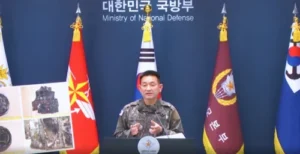
The reaction from the ROK Ministry of National Defense has been one of measured defiance. Officials in Seoul have characterized the landmine blast as a “deliberate act of sabotage” and have called for an independent investigation, a request that Pyongyang has already rejected as a "political ploy."

The Seoul Position
South Korean authorities have underscored their commitment to the safety of their personnel. A spokesperson for the Ministry of Defense stated, “We will not be intimidated by threats of ‘merciless’ retaliation. Our troops are under orders to maintain a posture of firm readiness. Any violation of our sovereignty or threats to our soldiers’ lives will be met with a decisive, multi-layered response.”
The View from Washington
The United States, as a treaty ally to South Korea, has maintained a stance of “ironclad support.” While Washington has urged both sides to exercise restraint, the presence of U.S. forces in the region remains a stabilizing factor that deters full-scale aggression. U.S. State Department officials have expressed concern over Kim Yo Jong’s latest statement, viewing it as a deliberate attempt to test the resolve of the new administration in Seoul.
Implications: The Risks of Escalation
The implications of this standoff are profound, touching on both regional security and global geopolitics.
1. The Risk of Miscalculation
In a climate where warnings are issued with such frequency and vitriol, the risk of miscalculation is at an all-time high. If a South Korean patrol fires warning shots, and a nervous North Korean unit interprets this as an initial assault, the resulting exchange of fire could escalate far beyond the DMZ.
2. The Collapse of the Armistice
The 1953 Armistice is essentially a "gentleman’s agreement" that requires constant maintenance. By openly stating that they will bypass traditional command hierarchies in the event of an encounter, North Korea is effectively signaling that they no longer recognize the standard rules of engagement that have governed the border for decades.
3. Diplomatic Stagnation
For the international community, this incident represents a setback for any potential resumption of denuclearization or peace talks. The focus has shifted from long-term stability to short-term crisis management. Diplomatic channels, already thin, are now effectively frozen as both sides adopt a "wait-and-see" approach to military posturing.
4. Domestic Political Pressure
In South Korea, the incident is putting immense pressure on the administration to respond in a way that satisfies public demand for security without triggering a war. The opposition, meanwhile, is criticizing the government for its failure to prevent the breach of the DMZ, turning the security crisis into a significant domestic political liability.
Conclusion: A Precarious Future
As this developing story continues to unfold, the international community remains on high alert. The language used by Kim Yo Jong—specifically the threat to act without central oversight—suggests a transition toward a more decentralized and, therefore, more unpredictable military structure on the border.
The coming days will be critical. Whether through back-channel diplomacy or a de-escalation of military exercises, both Seoul and Pyongyang face a choice: to allow the situation to spiral toward a catastrophic confrontation or to re-establish the communication protocols necessary to ensure that a single landmine does not become the catalyst for a second Korean War.
For now, the soldiers on the front lines remain in a state of high alert, staring across the concrete markers of the DMZ, waiting to see if the next sound they hear will be a warning shot or the opening salvo of a much larger conflict.
This report is based on ongoing monitoring of KCNA statements and reports from the ROK Ministry of National Defense. Further updates will be provided as new information becomes available.

 Pevita Pearce
  Nana Wu
  Lina Irawan
