
 By Asep Darmawan
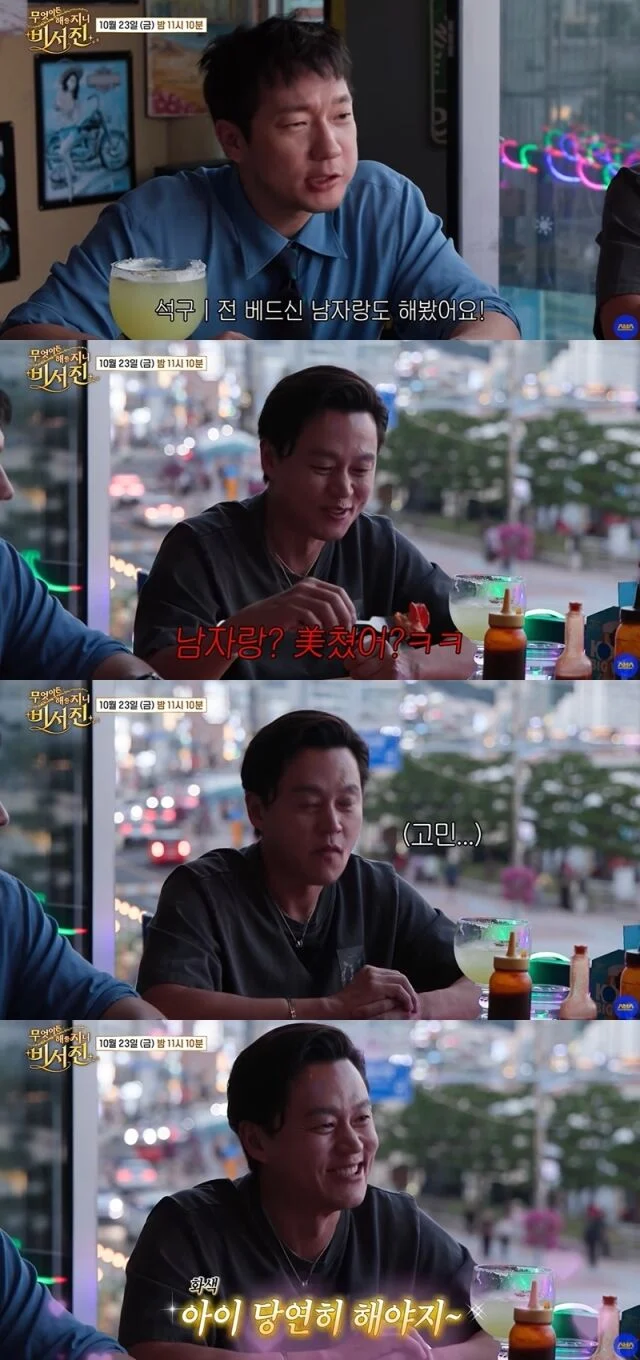
The entertainment landscape was recently set abuzz following a candid discussion on the SBS Friday entertainment show My Genie Secretary, where prominent actor Lee Seo Jin humorously yet definitively outlined his condition for participating in a male-on-male kiss scene. The revelation came during a segment featuring actor Son Suk Ku, who shared his own past experience with a male bed scene, prompting a lively and unexpected exchange that underscored both the evolving boundaries of K-content and the perennial influence of commercial considerations in the industry. This incident, while played for laughs, offered a subtle commentary on the shifting dynamics of representation and the pragmatic decisions faced by actors in an increasingly globalized media environment.
The Unscripted Revelation: A Candid Exchange Unfolds
The segment in question aired on October 23rd, coinciding with the buzz of the Busan International Film Festival (BIFF), where actor Son Suk Ku was present and receiving attention from the show’s hosts, Lee Seo Jin and Kim Kwang Kyu. Son Suk Ku, known for his versatile and often intense roles, made a surprising confession that set the stage for the subsequent discussion. "I have even filmed a bed scene with a man," he stated, elaborating on the technical aspects of the shoot. He revealed, "It was shot in one long take lasting seven minutes, but in the final cut, it was about 20 seconds." This frank disclosure, coming from a mainstream actor, immediately piqued the interest of his fellow panelists and the production team, highlighting a growing willingness among K-drama and film practitioners to explore more diverse narratives, even if the final edit might be condensed.
Following Son Suk Ku’s revelation, veteran actor Kim Kwang Kyu, known for his comedic timing and direct questioning, turned to Lee Seo Jin and posed a provocative question: "Can you kiss a man?" Lee Seo Jin, whose public persona often balances suave charm with a hint of gruffness, initially responded with unwavering firmness. "I wouldn’t do it even if they gave me an Academy Award," he declared, a statement that initially seemed to draw a clear line in the sand regarding his professional boundaries. His response underscored a traditional perspective, where certain roles or intimate scenes might be perceived as outside an actor’s comfort zone or established image, regardless of artistic recognition.
However, the conversation took a distinctly humorous turn when Kim Kwang Kyu pressed further, introducing a significant financial incentive into the hypothetical scenario. "Would you do it if they gave you 100 million dollars?" he inquired, raising the stakes considerably. The immediate shift in Lee Seo Jin’s demeanor and response sparked widespread laughter. Without a moment’s hesitation, he retorted, "Of course I would," instantaneously reversing his previous staunch refusal. This comedic pivot highlighted the often-unstated reality within the entertainment industry: while artistic integrity and personal preference are important, financial compensation, particularly at such a monumental scale, can be a powerful determinant in career choices.
The production team, seizing on the comedic gold, further escalated the hypothetical offer, specifying a figure in Korean Won. "If you were given ₩150 billion KRW (about $113 million USD), would you kiss Kim Kwang Kyu too?" they asked, directly challenging Lee Seo Jin with a specific co-star. The magnitude of the sum, equivalent to over a hundred million U.S. dollars, was designed to test the limits of his resolve. Lee Seo Jin paused briefly, a moment of theatrical hesitation, before ultimately confirming his willingness: "I would do it." The segment reached its comedic climax when Kim Kwang Kyu, having initiated the entire exchange, playfully declined, stating he wouldn’t participate. Lee Seo Jin’s quick-witted retort, "What do you have to lose by doing it with me?" turned the entire scene into a "sea of laughter," showcasing the camaraderie and quick humor characteristic of popular Korean variety shows.
Background and Context: Pillars of Korean Entertainment
The lively exchange on My Genie Secretary is best understood within the context of the involved personalities and the broader Korean entertainment landscape.
Lee Seo Jin, the central figure in this particular anecdote, is a seasoned actor and beloved variety show personality. Debuting in 1999, he gained recognition for roles in dramas like Damo (2003) and Phoenix (2004), establishing himself as a charismatic leading man. In recent years, he has found immense success and broadened his appeal through popular reality-variety shows produced by Na Young Seok, such as Three Meals a Day, Youn’s Kitchen, and Jinny’s Kitchen. These shows have showcased a different facet of his personality – a pragmatic, often grumpy yet ultimately caring figure, a persona affectionately dubbed "tsundere" by fans. His quick wit and dry humor, as displayed in the My Genie Secretary segment, are hallmarks of his public image, making his conditional acceptance of a same-sex kiss scene for a massive sum entirely consistent with his entertainment persona. He is known for his candidness and his ability to blend sincerity with comedic timing, making him a perfect catalyst for such a viral moment.
Son Suk Ku, whose initial confession sparked the discussion, represents a newer generation of Korean actors who are increasingly challenging conventional boundaries. Having gained significant recognition for his compelling performances in projects like My Liberation Notes (2022) and the blockbuster film The Roundup (2022), Son Suk Ku has cultivated an image as a versatile and intense actor unafraid of complex roles. His openness about filming a male bed scene, even if edited down, signals a subtle but important shift in the industry, where actors are perhaps more willing to engage with diverse themes and portrayals, moving beyond traditional romantic archetypes. Such willingness, especially from a rising star, contributes to a broader conversation about artistic freedom and representation.

Kim Kwang Kyu is a veteran actor, often seen in supporting roles across numerous dramas and films, frequently providing comedic relief or a grounded, relatable presence. His role as a co-host on My Genie Secretary allows him to leverage his experience and informal style to engage guests in spontaneous and entertaining conversations. His direct questioning of Lee Seo Jin is characteristic of his role as an interviewer and comedian, skillfully guiding the segment towards its humorous conclusion.
SBS My Genie Secretary itself is an entertainment program that typically combines elements of travel, reality, and variety, often featuring celebrities interacting in relaxed, unscripted settings. These shows are popular in South Korea for offering viewers a glimpse into the off-screen personalities of their favorite stars, fostering a sense of intimacy and relatability. The format encourages candid discussions and playful banter, making it an ideal platform for spontaneous, viral moments like the one involving Lee Seo Jin. The casual, conversational tone allows for a degree of freedom not always present in more scripted dramas or talk shows.
The Busan International Film Festival (BIFF), where Son Suk Ku’s appearance took place, is one of Asia’s most significant film festivals. It serves as a crucial platform for promoting both established and emerging talent, fostering international collaborations, and showcasing diverse cinematic works. The atmosphere of a film festival, often characterized by creative discussions and a celebration of cinematic artistry, can also lend itself to more open and unconventional conversations about the craft and business of acting, providing a fitting backdrop for Son Suk Ku’s initial revelation.
Broader Implications: LGBTQ+ Representation and Industry Evolution
The humorous exchange, while primarily comedic, touches upon significant underlying currents within the Korean entertainment industry, particularly concerning LGBTQ+ representation. Historically, mainstream Korean media has been largely conservative in its portrayal of non-heteronormative relationships, with overt depictions often censored or relegated to niche independent productions. For decades, LGBTQ+ characters were either absent, depicted stereotypically, or their stories were only hinted at, reflecting societal norms that were slow to embrace diversity.
However, the landscape has been gradually shifting. Over the past decade, there has been a noticeable increase in the production and consumption of Boys’ Love (BL) dramas, primarily for streaming platforms and online audiences, both domestically and internationally. While these often cater to a specific fan base and may not always achieve mainstream recognition in the same way as traditional K-dramas, their growing popularity indicates a demand for more diverse narratives. Furthermore, some mainstream productions have begun to incorporate LGBTQ+ characters and themes with more nuance, though still cautiously.
In this evolving context, Son Suk Ku’s candid admission of filming a male bed scene, even if brief in the final cut, is noteworthy. It suggests a professional willingness to engage with such roles, indicating a potential broadening of artistic scope for actors in the industry. For a prominent actor to openly discuss such an experience on a mainstream variety show, regardless of the scene’s length, signals a step towards normalizing these portrayals within the public discourse.
Lee Seo Jin’s conditional acceptance, while a punchline, also carries a subtle layer of commentary. His initial firm refusal ("not even for an Academy Award") represents a traditional stance, perhaps reflecting lingering discomfort or perceived career risks associated with such roles for male actors in mainstream Korean entertainment. However, his immediate reversal for an exorbitant sum ("Of course I would" for $100 million) humorously underscores the ultimate power of commercial viability in the entertainment world. It suggests that while artistic boundaries or personal preferences might exist, they are often negotiable when faced with astronomical financial incentives. This highlights a pragmatic reality: even if broader societal acceptance for certain portrayals lags, market forces and global demand for diverse content can eventually push boundaries. The humor allows for the discussion to occur without directly challenging deeply ingrained societal norms, yet it still plants the seed for further consideration.
The fact that such a conversation could even take place on a major broadcast network’s variety show, even if presented as a comedic hypothetical, indicates a degree of openness that might not have been possible even a few years ago. It suggests that discussions around diverse sexual orientations and relationships are slowly, albeit cautiously, entering mainstream dialogue, often initially through the safe space of humor.
Economic Context: The Price of Artistic Flexibility
The hypothetical sum of ₩150 billion KRW (approximately $113 million USD) is an extraordinary figure in any film industry, especially for a single actor’s scene fee. To put this into perspective, major blockbuster Korean films typically have budgets ranging from ₩10 billion to ₩20 billion KRW ($7.5 million to $15 million USD). A top-tier Korean actor might command several hundred million to a few billion KRW per drama episode or film project. Therefore, an offer of ₩150 billion KRW for a single kiss scene is not merely a large sum; it is an amount that would fundamentally alter an actor’s financial future and could potentially finance multiple high-budget productions.

This exaggerated figure serves a dual purpose in the comedic context: it highlights the absurdity of the hypothetical situation while also subtly underscoring the immense financial pressures and temptations that can exist within the global entertainment industry. In an era where streaming giants are investing billions in content creation and vying for global audiences, the value of unique, boundary-pushing content—or even just viral moments—can be immense. While purely hypothetical, the "condition" raises questions about what kind of projects or global platforms might be willing to offer such sums for truly groundbreaking or highly anticipated scenes, especially as K-content increasingly targets international markets with diverse audience expectations.
The exchange also implicitly comments on the "value" of an actor’s image and willingness to step outside their comfort zone. For some, maintaining a specific public image is paramount, while for others, the potential for an unprecedented payday could justify almost any artistic endeavor. Lee Seo Jin’s immediate acceptance at the sight of such a figure humorously encapsulates this pragmatic side of show business, where the art often intertwines with commerce in complex ways.
Analysis of Inferred Reactions and Broader Impact
While direct official statements or widespread public reactions beyond the immediate broadcast were not detailed in the original report, several inferences can be drawn regarding the incident’s impact.
Audience Reception: The segment was undoubtedly met with laughter and amusement, particularly from fans familiar with Lee Seo Jin’s straightforward and often money-minded variety show persona. His abrupt shift from artistic integrity to pure commercial pragmatism is a running gag that resonates with his established character. For many viewers, it would be perceived as a classic moment of Lee Seo Jin being himself – candid, humorous, and unafraid to expose the transactional nature of certain aspects of the entertainment industry. Some viewers, especially those more open to diverse content, might also appreciate the subtle nod towards LGBTQ+ representation, even if it was framed comically.
Industry Perception: Within the industry, the exchange likely served as a lighthearted reminder of the financial realities that underpin artistic decisions. Actors, directors, and producers are constantly weighing creative vision against commercial viability. The "₩150 billion KRW" condition, while exaggerated, humorously articulates that for a sufficiently high reward, many boundaries—personal, artistic, or societal—can be reconsidered. It also subtly acknowledges the growing discussions surrounding diverse casting and representation, even if the immediate context is comedic. It signifies that such topics are no longer entirely taboo for public discussion, at least in a jocular fashion.
Role of Variety Shows: This incident further highlights the crucial role of variety shows in contemporary Korean entertainment. They serve as platforms for actors to break free from their scripted characters, reveal more authentic (or at least, carefully curated "authentic") versions of themselves, and engage in unscripted banter that often generates viral content. These shows allow for a degree of conversational freedom that can sometimes push boundaries or introduce sensitive topics in a more palatable, humorous manner, thereby slowly broadening public discourse.
In conclusion, Lee Seo Jin’s conditional agreement to film a male-on-male kiss scene, spurred by Son Suk Ku’s initial revelation on My Genie Secretary, was a moment of television gold that skillfully blended humor with a subtle undercurrent of industry pragmatism and evolving cultural norms. While played for laughs, the exchange provided a glimpse into the ongoing dialogue surrounding LGBTQ+ representation in K-content, the immense financial incentives that shape artistic decisions, and the unique role of variety shows in fostering candid discussions among public figures. It underscored that in the dynamic world of Korean entertainment, where global reach and commercial success are increasingly paramount, even long-held boundaries can become negotiable, especially when the price is right.

