
 By Ali Ikhwan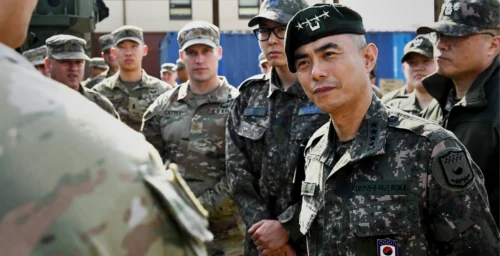
In a move that signals a pivot toward deeper integration with the United States and a modernization of its military infrastructure, South Korean President Lee Jae Myung has nominated retired four-star General Kang Shin-chul as the nation’s next Minister of National Defense. The appointment, announced this Sunday, arrives at a critical juncture for the Korean Peninsula, characterized by volatile relations with the North and an impending shift in the architecture of the ROK-U.S. alliance.
Kang, 58, brings to the cabinet a resume deeply entrenched in the mechanics of the U.S.-ROK Combined Forces Command (CFC). Having served as the deputy commander of the CFC, he is uniquely positioned to navigate the complex diplomatic and military requirements of the transition of wartime operational control (OPCON) from Washington to Seoul.
The Appointment: A Focus on "Self-Reliant Defense"
Presidential Chief of Staff Kang Hoon-sik unveiled the nomination, emphasizing that the administration’s priority is to "strengthen South Korea’s self-reliant defense capabilities to prepare for future warfare." The administration aims to balance this self-reliance with a "rock-solid ROK-U.S. alliance," a dual-track strategy that has become the hallmark of the current administration’s security policy.
If confirmed by the National Assembly, Kang will succeed outgoing Minister Ahn Gyu-back. His mandate is expected to be expansive, covering everything from the modernization of high-tech defense assets to controversial internal reforms, such as the proposed integration of the nation’s prestigious military academies.
Chronology of a Security Shift
The nomination of General Kang is the culmination of a series of strategic maneuvers within the Lee Jae Myung administration, occurring in the context of an increasingly provocative North Korean posture.
- February 2024: General Kang Shin-chul is documented during a high-level briefing at the U.S. 2nd Infantry Division, signaling his deep involvement in the operational side of the alliance during his tenure as CFC deputy commander.
- December 2025: The South Korean government announces a 7.5% increase in the military budget, signaling a shift toward indigenous defense technology and autonomous surveillance capabilities.
- July 2026: The administration faces public and political scrutiny regarding the proposed overhaul of South Korea’s military academies. Critics raise concerns about the transparency and long-term impact of these structural changes.
- August 2026: President Lee Jae Myung formally nominates Kang Shin-chul for the defense portfolio, citing his experience and his alignment with the administration’s "defense innovation" vision.
Supporting Data: The Defense Landscape
The nomination of a career military officer like Kang is not merely symbolic; it reflects the stark reality of the current security environment. Recent data indicates that Seoul is under immense pressure to modernize its forces to counter North Korea’s asymmetric threats, including nuclear-capable missiles and cyber-warfare capabilities.
Budgetary Priorities
The recent 7.5% increase in defense spending highlights a trend toward "Self-Reliant Defense." This financial commitment is intended to fund:
- Indigenization of Defense: Reducing dependency on foreign military components, particularly for air and naval assets.
- Technological Integration: Investing in AI-driven reconnaissance and automated response systems to address the demographic decline in active-duty personnel.
- OPCON Preparedness: Funding the administrative and operational transition required for South Korea to assume wartime command, a process that necessitates a high degree of interoperability with U.S. forces.
Official Responses and Political Implications
The nomination has elicited a mixed, though generally pragmatic, response from the political establishment. While supporters of the administration praise Kang’s tactical acumen and his familiarity with U.S. military brass, opposition figures have raised questions regarding his capacity to oversee sweeping institutional reforms.
The Military Academy Controversy
Central to the debate is the proposed integration of military academies. The plan, which has remained somewhat opaque, aims to consolidate training programs to create a more unified officer corps. Critics argue that such a move could disrupt the traditional rivalries and specializations that have historically defined the branches of the ROK military. General Kang’s task will be to balance these internal institutional interests with the administration’s desire for efficiency.

Alliance Management
For Washington, the appointment of a known quantity like Kang is likely to be viewed as a stabilizing factor. His history at the CFC suggests that the transition of OPCON—a process that has been delayed multiple times due to security concerns—will be handled with caution. The White House and the Pentagon have consistently stated that the transfer depends on the ROK meeting specific conditions, and Kang’s deep knowledge of these benchmarks makes him an ideal interlocutor for the U.S. Department of Defense.
Strategic Implications: The Path Ahead
The ascension of Kang Shin-chul to the defense ministry represents a broader trend in Northeast Asian geopolitics: the professionalization of security policy in response to rising regional threats.
1. The OPCON Transfer Challenge
The transfer of wartime control is the "holy grail" of South Korean sovereignty. It requires not only technical military improvements but also a massive psychological shift in how the ROK military views its autonomy. Kang must satisfy domestic nationalists who demand full control while maintaining the confidence of the U.S. military, which remains the backbone of the region’s deterrence against the North.
2. North-South Deterrence
With the North simultaneously naming new top brass, the Korean Peninsula is witnessing a "generational turnover" in military leadership. Both Seoul and Pyongyang are entering a phase of high-stakes maneuvering. Kang’s background in intelligence and combined operations suggests that Seoul will likely favor a strategy of "active deterrence"—a posture that combines robust defensive capabilities with a high state of readiness for pre-emptive response.
3. Institutional Reform as a Legacy
Kang’s ability to push through the military academy integration will define his legacy. If he succeeds, he will have streamlined the command structure of the future. If he fails, he risks alienating the military establishment at a time when cohesion is most needed. His success depends on his ability to convince the brass that these changes are not meant to weaken their distinct identities, but to forge a modern, agile force capable of 21st-century warfare.
Conclusion: A New Chapter for Seoul
As South Korea faces an uncertain future, the selection of General Kang Shin-chul is a calculated move to ensure that the defense ministry is led by someone who understands the intricacies of the U.S. alliance and the realities of the North Korean threat. The coming months will be a test of his ability to transition from a soldier’s soldier to a political operator capable of managing both the legislature and the complex requirements of national defense.
The administration of President Lee Jae Myung is clearly betting on the idea that in an era of volatility, the most effective defense is a blend of veteran leadership and structural modernization. Whether General Kang can navigate the treacherous waters of military reform and geopolitical tension will determine the security posture of the Korean Peninsula for years to come.
As the National Assembly prepares for his confirmation hearings, the international community will be watching closely to see if Seoul’s new defense chief can indeed deliver on the promise of a more self-reliant, yet firmly aligned, South Korea. The stakes could not be higher.

 Raul Delapena Setiawan
  Jia Lissa
  Pevita Pearce
