
 By Iffa Jayyana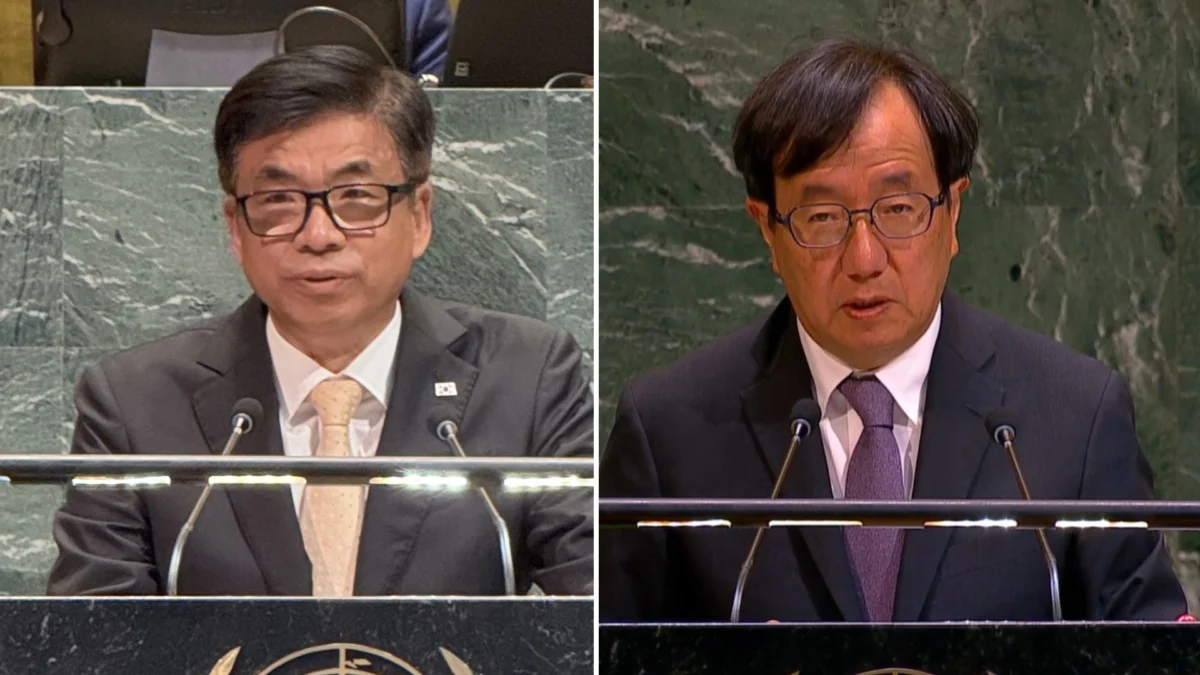
NEW YORK — The United Nations General Assembly became the stage for a sharp diplomatic confrontation this week as South Korea and Japan mounted a coordinated offensive against the deepening military alliance between Moscow and Pyongyang. During a high-stakes debate regarding the status of Russian-occupied territories in Ukraine, representatives from Seoul and Tokyo issued stern warnings, characterizing the burgeoning Russia-North Korea partnership as a direct threat to both European security and the stability of the Indo-Pacific.
The session, held on September 1, 2026, underscored a growing international anxiety: the realization that the war in Ukraine has evolved from a regional conflict into a nexus point for global authoritarian cooperation.
Main Facts: The Nexus of Conflict
The primary impetus for the diplomatic outcry was the reported escalation in “unlawful military cooperation” between the Kremlin and the Democratic People’s Republic of Korea (DPRK). South Korean Ambassador to the U.N., Jihoon Cha, did not mince words, labeling the exchange of ballistic missiles and the deployment of North Korean personnel to the front lines of Ukraine as a violation of multiple U.N. Security Council resolutions.
Ambassador Cha’s address to the General Assembly focused on the “unabated” nature of this collaboration. According to intelligence briefings cited during the debate, the partnership has moved beyond mere rhetoric. It now encompasses:
- Ballistic Missile Transfers: The provision of North Korean short-range ballistic missiles (SRBMs) used by Russian forces to strike Ukrainian infrastructure.
- Troop Deployments: The presence of North Korean military engineers and specialized personnel assisting in the maintenance and operation of Russian systems within occupied Ukrainian territories.
- Technological Quid Pro Quo: Evidence suggesting that in exchange for munitions, Russia is providing the DPRK with critical technologies related to space-launch vehicles and advanced nuclear delivery systems.
Chronology: From Isolated Pariahs to Strategic Partners
To understand the gravity of the current situation, one must look at the rapid maturation of the Moscow-Pyongyang axis over the past 24 months.
- September 2023: Kim Jong Un travels to the Vostochny Cosmodrome in Russia’s Far East, meeting with Vladimir Putin. This summit signaled the beginning of a “new era” of cooperation, breaking the long-standing post-Cold War distance between the two nations.
- Early 2024: Intelligence agencies from the U.S., South Korea, and Japan begin documenting the movement of shipping containers between the North Korean port of Rajin and Russian ports, later confirmed to contain millions of artillery shells.
- June 2024: A formal Treaty on Comprehensive Strategic Partnership is signed in Pyongyang, which includes a mutual defense clause, effectively resurrecting the military alliance structure of the Cold War era.
- Late 2025 – Early 2026: Reports emerge of North Korean personnel entering occupied Ukraine, initially in advisory capacities, which later evolve into logistical and tactical support roles.
- September 1, 2026: South Korea and Japan formally register their dissent at the U.N. General Assembly, demanding an immediate halt to the transfers.
Supporting Data: The Cost of Proliferation
The data provided by international monitoring groups and intelligence consortiums paints a grim picture. The North Korean contribution to the Russian war machine is not merely symbolic; it is a force multiplier.
According to military analysts, the North Korean KN-23 and KN-24 ballistic missiles have proven particularly effective in penetrating Ukrainian air defenses due to their quasi-ballistic flight paths. The influx of these weapons has allowed Russia to maintain a high tempo of strikes against Ukrainian energy grids and urban centers, even as Russian domestic production faces supply chain bottlenecks.
Furthermore, the economic dimension cannot be overlooked. The DPRK, historically crippled by sanctions, has found a lifeline in the Russian market. Reports indicate that North Korean workers in Russian-occupied areas are helping to bypass labor shortages, while the influx of Russian grain, oil, and currency provides a buffer against the North’s chronic food insecurity.
Official Responses: A Divergence of Strategy
The reaction to the Seoul-Tokyo initiative at the U.N. was polarized, highlighting the fragmented nature of modern global diplomacy.

The ROK and Japan
Ambassador Jihoon Cha (ROK) and Ambassador Kazuyuki Yamazaki (Japan) framed the issue as a challenge to the rules-based international order. For Seoul, the threat is existential; the transfer of advanced aerospace technology to Pyongyang could drastically accelerate the DPRK’s ICBM program. For Tokyo, the concern lies in the regional security architecture, as a emboldened North Korea—backed by a permanent member of the U.N. Security Council—becomes increasingly difficult to deter.
The United States Position
Notably, the U.S. representative adopted a more measured tone. While acknowledging the destabilizing nature of the Russia-North Korea ties, the U.S. envoy stopped short of the harsh condemnation leveled by Seoul and Tokyo. Instead, the U.S. focused on the broader objective: a ceasefire. This approach reflects a delicate diplomatic balancing act, as the U.S. seeks to avoid further escalating tensions with Moscow while maintaining pressure on Pyongyang. The U.S. stance suggests a desire to keep communication channels open for potential future de-escalation talks, a move that some analysts argue could be perceived as a lack of resolve by frontline allies.
The Kremlin and Pyongyang
Russia and the DPRK have largely dismissed these accusations as “fabrications” designed to distract from the “illegal expansion of NATO” and the “hostile policies” of the U.S.-led alliance. Moscow maintains that its cooperation with Pyongyang is “entirely consistent with international law,” a claim that has been flatly rejected by the majority of the General Assembly.
Implications: A New Cold War Reality
The events at the U.N. underscore a profound shift in global geopolitics. We are witnessing the emergence of a “revanchist bloc” that views the current international order as a hurdle to be dismantled.
1. The Erosion of Sanctions
The blatant cooperation between Moscow and Pyongyang has effectively rendered existing U.N. sanctions against North Korea toothless. If a permanent member of the Security Council—Russia—is willing to openly trade with a sanctioned regime, the global enforcement mechanism for non-proliferation loses its credibility.
2. Escalation in the Indo-Pacific
The “technological quid pro quo” has immediate consequences for the security of Japan and South Korea. As the DPRK gains access to Russian satellite technology and reentry vehicle guidance systems, the window of time for regional missile defense systems to react is shrinking. This is expected to trigger a new arms race, with Seoul likely feeling compelled to enhance its own conventional strike capabilities and potentially reconsider its nuclear non-proliferation commitments.
3. The Crisis of Multilateralism
Perhaps the most significant implication is the paralysis of the United Nations. With the Security Council effectively gridlocked by Russia’s veto power, the General Assembly has become a theater of performative diplomacy rather than a venue for conflict resolution. The inability of the U.N. to prevent the active, large-scale military cooperation between two member states against a third suggests that the post-1945 international architecture is in urgent need of reevaluation.
4. A Divided Western Alliance
The subtle friction between the U.S. approach and the firmer stance of Japan and South Korea reveals cracks in the broader coalition. As the conflict in Ukraine drags into its third year, the diverging priorities of those directly threatened by the Russia-DPRK pact and those managing the global strategic landscape are becoming more apparent.
Conclusion
The condemnation delivered by South Korea and Japan at the U.N. was a necessary articulation of the risks posed by the Russia-DPRK alliance. However, as the rhetoric in New York settles, the reality on the ground in Ukraine and on the Korean Peninsula remains unchanged. Without a unified, multilateral response that transcends mere rhetoric, the Moscow-Pyongyang axis is likely to continue its expansion, further eroding the security framework that has governed the post-Cold War era. The question remains: can the international community find a way to re-impose order, or is the era of global cooperation being permanently replaced by a return to bloc-based confrontation?
 Lina Hope
  Pevita Pearce
  Suro Senen
