
 By Ammar Sabilarrohman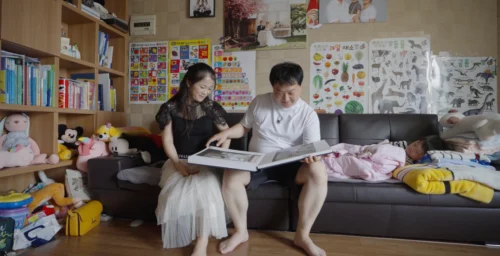
For decades, the Korean Peninsula has been defined by its rigid borders, ideological walls, and the profound trauma of division. Yet, amidst the geopolitical posturing and the harsh realities of the Demilitarized Zone, a curious cultural trope has persisted: namnam buknyeo—a traditional saying suggesting that the most handsome men hail from the South, while the most beautiful women originate from the North. It is a romanticized, almost whimsical notion of a "perfect" complementary union.
However, a new documentary, North South Man Woman (남남북녀), directed by Sun Kim and Morten Traavik, dares to peel back the layers of this idealized trope. Rather than focusing on the political theater of unification, the film trains its lens on the intimate, often grueling, and frequently humorous realities of North Korean escapees attempting to integrate into South Korean society through marriage and domestic life.
The Human Face of Geopolitics: Main Facts
North South Man Woman is not a film about policy; it is a film about people. By shadowing the lives of North Korean escapees, particularly women, as they navigate the landscape of modern South Korean courtship and matrimony, the film interrogates the survival mechanisms of those who have crossed the most dangerous border on Earth.
The documentary moves beyond the headline-grabbing nature of "escapee stories" to explore the intersection of gender roles, cultural identity, and the heavy burden of "starting over." When a North Korean defector enters the South, they are not merely changing countries; they are undergoing a total transformation of social existence. The film highlights how the patriarchal structures of both societies clash, forcing escapees to adopt new identities to survive in a hyper-competitive, capitalist environment that often views them as "others."
A Chronology of Integration: The Escapee Experience
To understand the scope of the film, one must look at the timeline of the North Korean diaspora in the South.
- The Early Years (1990s–2000s): Following the "Arduous March" in North Korea, the first major wave of defectors reached South Korea. These individuals were largely isolated, struggling to overcome the "double trauma" of famine and political persecution.
- The Era of Adaptation (2010s): As the number of escapees rose, so did the societal demand for assimilation. The "matchmaking" industry began to flourish, sometimes predatory in nature, promising lonely South Korean men the "pure" and "traditional" women of the North—a direct exploitation of the namnam buknyeo trope.
- The Current Context (Present Day): North South Man Woman captures the current generation of escapees who are no longer just "refugees," but active participants in the South Korean economy. The film documents how these individuals navigate the digital age, dating apps, and the profound disconnect between their upbringing under a totalitarian regime and the individualistic, high-pressure society of Seoul.
Supporting Data: The Disparity of Experience
The friction observed in the documentary is supported by a growing body of sociological data regarding the North Korean exile experience:
- Gender Imbalance: Demographic data from the South Korean Ministry of Unification consistently shows that roughly 70% to 75% of North Korean defectors are women. This creates a specific social dynamic where women are more likely to seek stability through marriage, yet face significant discrimination in the workplace.
- Marriage Trends: Studies suggest that while unions between South Korean men and North Korean women are frequent, the divorce rate in these households is often higher than the national average. The film provides the qualitative "why" behind these statistics: the clash of domestic expectations, the lingering PTSD from the North, and the struggle to communicate the reality of their past to partners who cannot possibly fathom the lived experience of the DPRK.
- Integration Metrics: While the South Korean government provides resettlement subsidies, the "invisible" costs—such as the loss of social networks and the psychological barrier of being a "North Korean" in a corporate environment—remain the primary hurdles to long-term integration.
Official Responses and Societal Discourse
The release of North South Man Woman has reignited a necessary conversation in Seoul. Critics and social workers have praised the film for its refusal to treat defectors as mere "victims" or "political symbols."
In recent years, the South Korean government has faced pressure to move away from viewing the defector population as a tool for anti-North Korean propaganda. Instead, advocacy groups argue for a focus on the human security of these individuals. When asked about the challenges of integration, officials from the Ministry of Unification have often pointed to the "social distance" between the two populations—a distance that this film explicitly measures through the intimate lens of marriage.
However, some conservative voices in the South argue that films like this may inadvertently discourage defection or portray the South in a negative light by highlighting the inherent difficulties of life in a democratic, capitalist society. Despite this, directors Kim and Traavik maintain that their work is intended to foster empathy, not division.

Implications: The Future of the "Divided" Family
The implications of North South Man Woman extend far beyond the cinema screen. By highlighting the friction of everyday life, the film posits that the "division" of Korea is not merely a matter of statecraft—it is an internal, psychological state.
1. The Re-evaluation of Gender Roles
The documentary forces viewers to confront how outdated patriarchal ideals are used to commodify North Korean women. It challenges the South Korean audience to move past the namnam buknyeo myth and see their partners as complex, independent agents who are negotiating a new life, not just "filling a void" in a traditional family structure.
2. The Limits of Assimilation
The film suggests that true integration is not about the North Korean defector becoming a "perfect" South Korean citizen. It is about the ability of both parties to bridge a gap created by seventy years of total separation. The "friction" documented in the film is not a failure; it is the sound of two worlds colliding and attempting to forge something new.
3. A New Narrative of Unification
If unification ever comes, it will not happen in a government office; it will happen in the living rooms of families like those featured in the film. The documentary suggests that our understanding of "oneness" must be rooted in the messy, unglamorous, and deeply human work of living together.
Conclusion
North South Man Woman is a vital addition to the discourse on the Korean divide. By stripping away the romantic veneer of the "ideal match," Sun Kim and Morten Traavik have provided a sobering, yet deeply moving, account of what it means to belong to two Koreas at once.
As the film moves through the daily struggles of its subjects—the arguments over money, the misunderstanding of cultural nuances, and the persistent, haunting memories of life in the North—it achieves something rare: it makes the macro-political issue of Korean division feel intimately, urgently personal.
For the viewer, the takeaway is clear: the most significant bridge between North and South is not built with steel or policy, but with the quiet, persistent, and often difficult work of understanding one another across the divide. The documentary serves as a mirror for a society that has spent so long looking at the border that it has forgotten to look at the person standing right in front of it.
Whether the namnam buknyeo trope holds any truth is ultimately irrelevant. What matters is the reality of the people living it—a reality that is far more challenging, far more resilient, and far more human than any proverb could ever capture.


 Layla Zulfa
  Neng Nana
  Nila Kartika Wati
