 By Neng Nana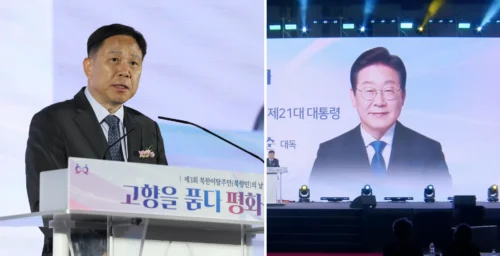
By Editorial Staff
July 15, 2026
In a symbolic shift that signals a potential pivot in Seoul’s approach to inter-Korean relations, South Korean President Lee Jae Myung has formally adopted the terminology "North Korean-born citizens" to describe defectors residing in the South. The move, championed by the Unification Ministry, seeks to reframe the narrative surrounding those who have fled the North, moving away from labels centered on "defection" and toward an emphasis on shared national identity and future integration.
The declaration came during the third annual ceremony dedicated to the plight and success of these individuals, held at the Korea International Exhibition Center (KINTEX) in Goyang on Tuesday. Represented by Second Deputy National Security Director Lim Woong-soon, President Lee used the occasion to articulate a vision of a Korean Peninsula defined not by the shadow of war, but by the promise of coexistence.
Main Facts: A Shift in Language and Strategy
The core of the recent policy update lies in the nomenclature. By referring to defectors as "North Korean-born citizens," the current administration is attempting to humanize and integrate a demographic that has historically occupied a precarious political and social space in South Korea.
During the ceremony, President Lee’s message was clear: the South Korean government recognizes these individuals not as political outliers, but as integral members of the broader Korean family. This linguistic shift is intended to foster a sense of belonging for the thousands of North Koreans who have crossed the border, potentially easing their path toward economic and social integration.
The event, hosted by the Ministry of Unification, serves as a high-profile platform for the administration to signal its broader geopolitical intentions. President Lee’s vow to "establish lasting peace" is not merely rhetorical; it is a calculated attempt to soften the rigid ideological boundaries that have characterized the last decade of inter-Korean relations. By focusing on "coexistence and cooperation," the administration is testing a strategy that emphasizes soft power and humanitarian support over purely militaristic deterrence.
Chronology: The Road to the 2026 Commemoration
To understand the weight of this week’s event, one must look at the recent timeline of the ROK’s North Korea policy:
- May 2022: The inauguration of a new political era in Seoul, which initially maintained a hardline stance toward Pyongyang following years of missile testing.
- July 2024: The inaugural annual ceremony for North Korean defectors is established, marking the first time the state officially institutionalized a day of recognition for this population.
- January 2026: The Ministry of Unification begins a series of internal policy reviews aimed at rebranding the settlement process for those fleeing the North, with a specific focus on social integration programs.
- June 2026: Preparations for the third annual ceremony begin with a focus on "mutual prosperity" rather than "defection," setting the stage for President Lee’s speech.
- July 14, 2026: The third annual ceremony is held in Goyang, where the administration officially adopts the term "North Korean-born citizens."
This timeline illustrates a gradual maturation of Seoul’s policy—from a focus on national security and surveillance to a more nuanced, citizen-centric approach that views the diaspora as a bridge rather than a burden.
Supporting Data: The Demographic Challenge
The success of the "North Korean-born citizens" initiative depends heavily on the government’s ability to address the practical realities faced by this community. According to data provided by the Unification Ministry, the settlement process remains fraught with challenges.
Economic Disparities
Statistics indicate that North Korean-born citizens in the South face a persistent wage gap compared to their South Korean counterparts. While the government provides initial settlement funds, long-term economic integration is hampered by a lack of specialized training and the social stigma that still surrounds those from the North.
Educational Integration
The Ministry of Education has noted an increase in the number of children born to North Korean defectors who are now entering the South Korean school system. These "second-generation" individuals represent a unique demographic that requires specific support to navigate a culture that is, in many ways, foreign to their parents.
Mental Health and Social Well-being
Longitudinal studies conducted by the Unification Ministry suggest that nearly 40% of defectors report symptoms of PTSD related to their journey across the Tumen River or their life under the DPRK regime. The shift in language is intended to be the first step in a broader, more robust mental health support program that moves away from "defection-focused" therapy toward "community-integration" wellness.

Official Responses: A Divided Political Landscape
The administration’s shift in terminology has drawn a spectrum of responses from the political establishment in Seoul.
The Administration’s Stance:
Proponents within the Unification Ministry argue that the term "defector" (or talbukja) carries a stigmatizing weight that suggests a criminal or political act of abandonment. By labeling them "North Korean-born citizens," the government claims it is acknowledging their inherent rights as Koreans, thereby preparing the ideological groundwork for a future, unified peninsula.
Opposition Perspectives:
Conservative lawmakers have expressed caution, warning that such linguistic shifts could be perceived as "softening" the government’s stance toward the regime in Pyongyang. There is a palpable fear in some political circles that by reframing the status of these individuals, the government might inadvertently undermine the legal arguments for their status as refugees fleeing persecution.
Defector Advocacy Groups:
Many community leaders within the defector population have expressed cautious optimism. "If this is more than just words, it will be a major change," said a representative for a prominent NGO representing North Korean migrants. "But changing the name is the easy part. Changing the employment statistics and the social bias is where the real work begins."
Implications: A New Era for the Peninsula?
The decision to rebrand the identity of those fleeing the North has profound implications for the future of the Korean Peninsula.
1. Reconceptualizing Sovereignty
By asserting that these individuals are "citizens," Seoul is implicitly rejecting the legitimacy of the barriers that prevent free movement between the North and South. It is a subtle, yet firm, assertion that the ROK maintains a responsibility—and a claim—to all people of the Korean Peninsula.
2. The Prospect of "Soft" Integration
Should this policy succeed, it could serve as a pilot program for eventual reunification. If the government can successfully integrate a small, continuous stream of "North Korean-born citizens," it builds the administrative muscle required to handle a much larger integration process should the political situation on the peninsula shift dramatically.
3. Diplomatic Repercussions
Pyongyang has yet to issue an official statement regarding the ceremony, but historical precedent suggests they will view the language as a provocation—an attempt by the South to lure their citizens away. The diplomatic fallout will likely manifest in rhetoric, though it remains to be seen if it will impact the already tense inter-Korean communication channels.
4. The Social Fabric of South Korea
Ultimately, the success of this policy rests on the South Korean public. Can a society that has spent decades viewing the North through the lens of threat and division accept these individuals as fellow citizens? The administration’s speech in Goyang is a call to action for the South Korean public to broaden their definition of "us."
As President Lee’s representative stated during the ceremony, "Building mutual understanding and trust in a new community will help lay the foundation for a future of coexistence." Whether this is the beginning of a genuine thaw or merely a semantic exercise in a long-standing stalemate remains to be seen. However, by changing the vocabulary of the conflict, the administration has set a new trajectory for how South Korea views its neighbors, its refugees, and its own future.
The task ahead is immense, but the pivot to a more inclusive, citizen-centered narrative marks a significant departure from the status quo—one that will undoubtedly be watched closely by observers in Washington, Beijing, and Pyongyang alike.


 Nana Wu
  Layla Zulfa
