
 By Azzam Bilal Chamdy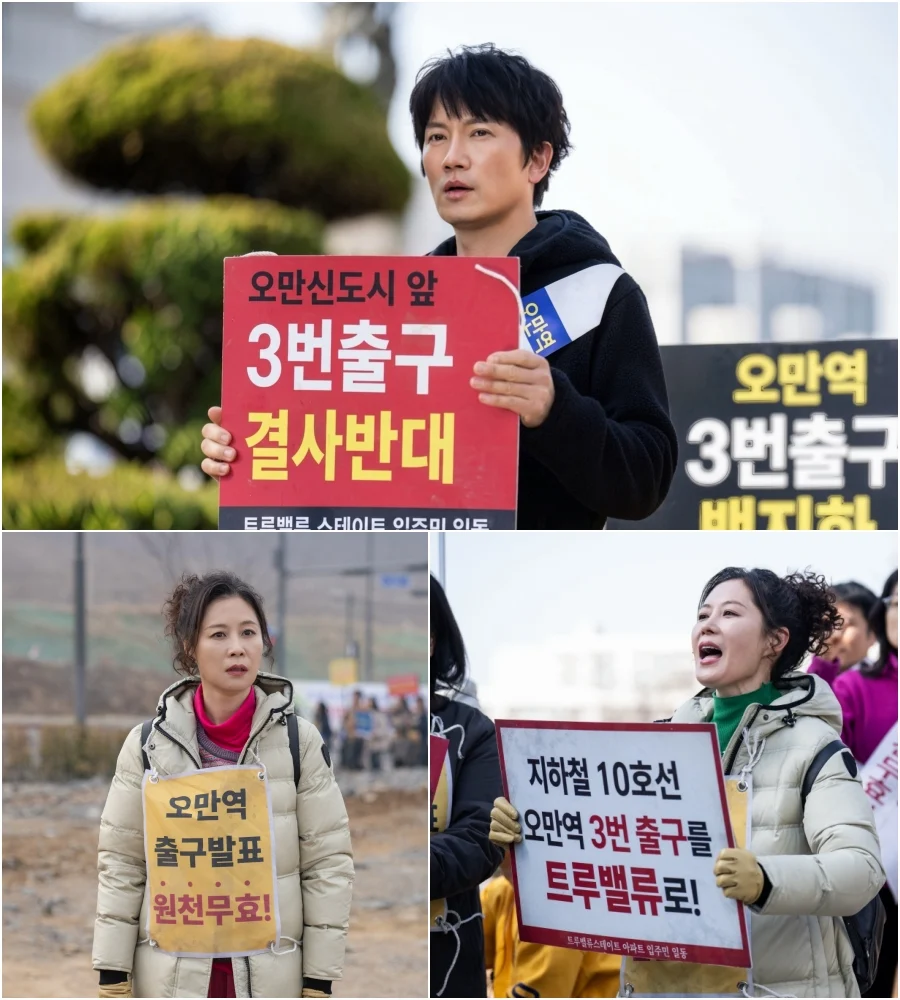
Seoul, South Korea – JTBC’s highly anticipated drama, "The Apartment Job," is set to deliver a compelling narrative of political maneuvering and community strife, with new stills offering a tantalizing glimpse into a pivotal protest scene featuring lead actors Ji Sung and Moon So Ri. The images reveal a stark contrast in their characters’ engagement with a public demonstration, hinting at underlying tensions and complex alliances that will drive the unfolding plot.
The drama centers on Park Hae Kang, portrayed by the versatile Ji Sung, a former gang boss who, against all odds, embarks on a campaign to become the president of his apartment complex’s resident council. His ulterior motive: to seize control of a substantial, hidden reserve fund. However, his ambitious plan takes an unexpected turn as he finds himself entangled with his fellow residents, forging an unlikely alliance to unearth and expose the deep-seated corruption plaguing their community.
The Unveiling of a Hidden Fortune and Emerging Rivalries
The narrative trajectory of "The Apartment Job" has been meticulously laid out in previous episodes, building suspense towards the current dramatic revelations. A significant turning point occurred when Park Hae Kang confirmed the existence of a substantial hidden reserve fund, earmarked for long-term repairs, amounting to a staggering 17.8 billion won (approximately $12 million USD). This discovery immediately ignited his pursuit of power within the apartment complex. To bolster his electoral prospects, Hae Kang orchestrated a calculated move: a sham marriage with Kang Ha Ri, played by Ha Yun Kyung, and the formation of a fabricated family unit, all in preparation for the fiercely contested resident council election.
Simultaneously, Jang Sook Jin, a character brought to life by the formidable Moon So Ri, emerged as a formidable opponent. Her keen and unusually intense interest in the daily affairs of the apartment complex signaled her strategic involvement. In a powerful display of her political aspirations, Sook Jin was seen honing her campaign speech, articulating her vision with unwavering conviction: "If I’m elected as a residents’ representative, I’ll create an apartment community where common sense prevails." This declaration not only underscored her commitment to her cause but also unequivocally set the stage for a direct and intense rivalry between her and Park Hae Kang.
A Protest of Opposites: Ji Sung’s Reluctance vs. Moon So Ri’s Passion
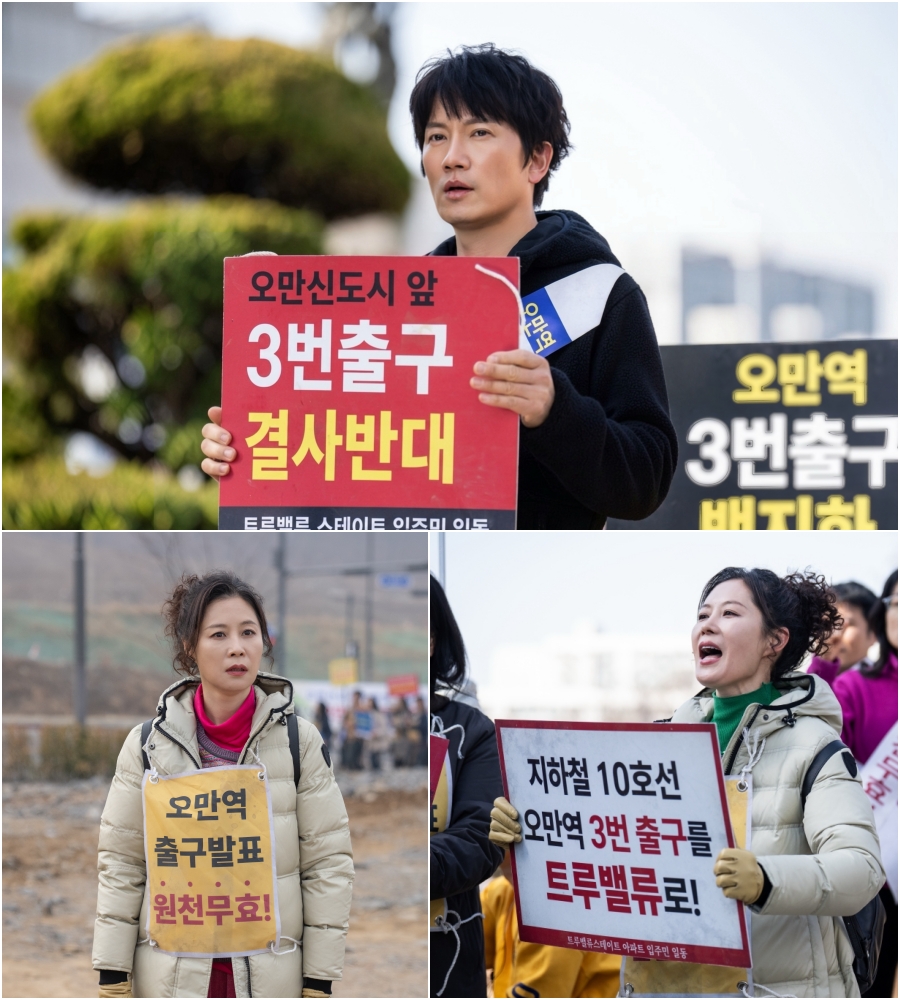
The newly released stills offer a vivid illustration of the contrasting personalities and approaches of Park Hae Kang and Jang Sook Jin, particularly in the context of a public protest. The images capture a moment where Hae Kang finds himself reluctantly drawn into a demonstration orchestrated by Sook Jin. The protest’s objective is to demand the construction of a new subway station exit, a cause that resonates with many residents.
However, Hae Kang’s participation is far from enthusiastic. Instead of actively engaging with the crowd or vocally supporting the cause, he is depicted standing on the periphery, blending in with the other residents. His expression is notably devoid of emotion, a mask of indifference. He holds a protest sign half-heartedly, his gaze fixed in a manner that suggests profound annoyance and disinterest. This visual portrayal effectively highlights his pragmatic, self-serving motivations, even when ostensibly aligned with a community initiative.
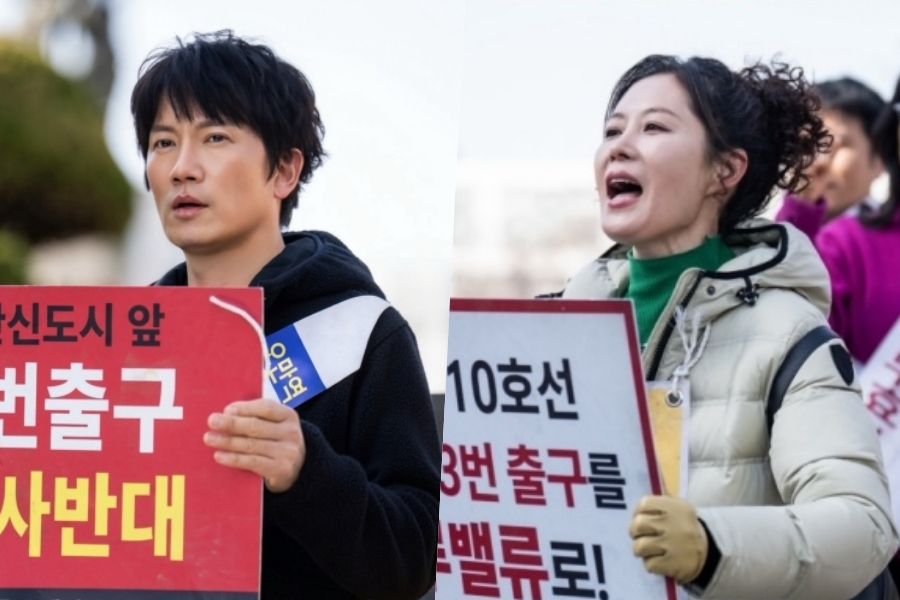
In stark contrast, Jang Sook Jin is the embodiment of fervent activism. She is shown raising her protest sign high above her head, her posture radiating energy and conviction. Her voice is implied to be leading the impassioned chants, her enthusiasm seemingly boundless. She is the catalyst, the driving force behind the demonstration, embodying the ideal of a dedicated community leader. This visual juxtaposition underscores the distinct ideologies and leadership styles of the two central characters, setting up a compelling dynamic for their interactions.
Yet, amidst Sook Jin’s energetic leadership, another still captures a different facet of her character. She is seen staring intently into the distance, her expression taut with tension. This subtle detail suggests that the protest, far from being a straightforward display of community solidarity, may be a backdrop for unforeseen events. A sense of foreboding permeates this particular image, hinting that the demonstration might trigger a critical development or expose a hidden threat, adding another layer of intrigue to the unfolding narrative.
The Unforeseen Alliance: Implications for Future Dynamics
The presence of both Park Hae Kang and Jang Sook Jin at the same protest, despite their looming election showdown, presents a compelling narrative paradox. Their shared presence on the same side of a public demonstration, even if driven by divergent motivations, raises significant questions for viewers. What events or revelations have compelled these ideological rivals to temporarily align their efforts? How will this unexpected collaboration impact their individual campaigns and their perception among the residents?
This confluence of opposing forces at a shared objective suggests that "The Apartment Job" is delving into complex moral landscapes and strategic alliances that transcend simple electioneering. The characters are likely to confront situations that force them to re-evaluate their priorities and potentially forge unexpected partnerships to achieve broader goals, or perhaps to navigate emergent dangers. The narrative promises to explore the intricacies of human motivation, the fluid nature of political alliances, and the challenges of community governance, all within the microcosm of an apartment complex.
The implications of this shared protest are far-reaching. It could serve as a catalyst for revealing deeper conspiracies within the apartment complex, forcing Hae Kang and Sook Jin to confront a common enemy that overshadows their personal ambitions. Alternatively, it might be a calculated move by one or both characters to gain an advantage in the election, using the protest as a platform for their own agendas. Regardless of the immediate cause, their temporary alliance is bound to reshape their relationship, potentially leading to unexpected shifts in their strategies and a more nuanced understanding of each other’s characters.
Chronological Progression and Narrative Significance
To fully appreciate the impact of this protest scene, it is crucial to place it within the established chronology of "The Apartment Job."
- Initial Setup: The series begins by introducing Park Hae Kang, a figure with a past steeped in organized crime, who is now seeking to leverage his street smarts for a more respectable, albeit still self-serving, position within his residential community. His primary objective is the concealed reserve fund, a substantial sum that promises to provide him with considerable financial leverage.
- Discovery of the Fund: A pivotal moment arrives with the confirmation of the 17.8 billion won reserve fund. This discovery solidifies Hae Kang’s resolve and sets in motion his elaborate plan to win the resident council presidency.
- Strategic Preparations: To achieve his electoral goals, Hae Kang orchestrates a series of calculated maneuvers. These include a fabricated marriage with Kang Ha Ri and the assembly of a makeshift "family" composed of his former associates. This strategic deception is designed to present a façade of stability and community integration, crucial for winning over the electorate.
- Emergence of Jang Sook Jin: Concurrently, Jang Sook Jin emerges as a prominent contender. Her meticulous attention to the complex’s affairs and her passionate pronouncements about restoring "common sense" position her as a direct ideological and political rival to Hae Kang. Her ambition is palpable, and her focus on ethical governance stands in stark contrast to Hae Kang’s hidden agenda.
- The Protest Scene: The current revelation, featuring the protest, marks a significant development. It signifies a deviation from their direct electoral battle, bringing them into a shared physical space for a common cause. This juxtaposition of individual ambition and collective action is a critical turning point, suggesting a broadening of the narrative scope beyond the confines of their rivalry.
- Unforeseen Developments: The tension inherent in the protest scene, particularly the glimpse of Sook Jin’s worried gaze, hints at an impending event that will likely alter the course of the narrative and their relationship. This foreshadowing suggests that the protest is not merely a symbolic act but a prelude to substantial plot advancements.
Supporting Data and Character Motivations
The success of "The Apartment Job" hinges on the intricate motivations of its central characters and the compelling societal issues it explores.
- Park Hae Kang’s Pragmatism: Ji Sung’s portrayal of Park Hae Kang is likely to be a masterclass in nuanced performance. His character is driven by a potent blend of self-preservation and a desire for financial security, remnants of his past life. While he may feign interest in community betterment, his true allegiance lies with the hidden reserve fund. His reluctant participation in the protest suggests a strategic calculation: perhaps he sees an opportunity to gain favor with a segment of the residents or to observe the dynamics of public dissent firsthand for his own benefit. His expressionless demeanor is a testament to his internal calculations, a stark contrast to the outward passion of his peers.
- Jang Sook Jin’s Idealism (and Potential Ambitions): Moon So Ri embodies Jang Sook Jin, a character who appears to be driven by a genuine desire for positive change. Her rhetoric about "common sense" and community improvement suggests an idealistic approach to leadership. However, the drama skillfully leaves room for interpretation. Her keen interest in the complex’s affairs could stem from a pure desire to serve, or it could be a carefully constructed facade to mask her own political ambitions or a deeper understanding of the corruption at play. Her intense gaze into the distance at the protest could indicate a moment of strategic planning, a recognition of a hidden threat, or a realization of the complexities involved in her pursuit of "common sense."
- The Reserve Fund as a Catalyst: The 17.8 billion won reserve fund is more than just a plot device; it represents the corruptible nature of power and resources within seemingly ordinary communities. Its existence highlights the potential for malfeasance and the importance of transparency and accountability in resident council governance. The fund acts as the primary catalyst for Hae Kang’s actions, and its potential misuse is likely a key element of the corruption that Sook Jin aims to expose.
- Community Dynamics: The apartment complex itself serves as a microcosm of broader societal issues. The residents, with their diverse needs and concerns, are susceptible to manipulation but also possess the collective power to enact change. The protest scene underscores this duality, showing how ordinary citizens can be mobilized for a common cause, even if their motivations are varied.
Official Responses and Production Insights
While direct official statements regarding the specific plot points of the protest scene might be limited until further episodes air, the production team’s decision to release these stills speaks volumes about its narrative intent. JTBC, known for its high-quality drama productions, is clearly aiming to build anticipation for a dramatic and character-driven storyline. The choice to highlight the contrasting styles of Ji Sung and Moon So Ri suggests a focus on the nuanced performances and the development of complex relationships.
The promotional strategy of releasing stills that showcase both the conflict and potential alliances between the lead characters is a classic tactic to engage the audience. It generates curiosity and encourages viewers to speculate about the unfolding plot, thus driving viewership. The inclusion of the image with Jang Sook Jin’s tense expression is a deliberate choice to inject an element of mystery and suspense, promising that the protest will be more than just a simple demonstration.
Broader Implications and Future Outlook
The unfolding events in "The Apartment Job," particularly the scenes at the protest, carry significant implications for the drama’s overall trajectory and its exploration of themes.
- The Nature of Leadership: The series is poised to question what truly constitutes effective leadership. Is it the charismatic and passionate orator who rallies the masses, or the pragmatic strategist who navigates the complexities of power behind the scenes? The contrast between Hae Kang and Sook Jin offers viewers a spectrum of leadership styles to analyze.
- The Fight Against Corruption: At its core, "The Apartment Job" appears to be a commentary on the pervasive nature of corruption, even in seemingly mundane environments. The hidden reserve fund and the potential for exploitation serve as a stark reminder that power can corrupt regardless of the scale or setting. The drama’s success will lie in its ability to portray this struggle in a relatable and engaging manner.
- The Power of Unlikely Alliances: The temporary alignment of Hae Kang and Sook Jin suggests that the fight against corruption might require more than individual effort. It hints at the possibility that even sworn rivals can find common ground when faced with a greater threat. This could lead to a more complex and morally ambiguous narrative, where characters are forced to make difficult choices and re-evaluate their loyalties.
- Community Empowerment: Ultimately, "The Apartment Job" may also explore the power of collective action and community empowerment. The residents’ ability to mobilize and demand change, even through a protest, signifies their potential to influence the outcome of the complex’s governance. The drama could serve as an allegory for the importance of civic engagement and vigilance in maintaining transparency and accountability.
As "The Apartment Job" continues to unfold, viewers can expect a narrative rich with political intrigue, character-driven drama, and a compelling exploration of the human condition within the confines of everyday life. The protest scene, with its stark visual contrasts and underlying tensions, promises to be a significant turning point, reshaping the destinies of Park Hae Kang, Jang Sook Jin, and the entire apartment complex. The question remains: will this unexpected collaboration lead to the exposure of corruption, or will it simply be another strategic move in a larger, more complex game of power?
The next episode of "The Apartment Job" airs on July 18 at 10:40 p.m. KST.


 Ali Ikhwan
  Layla Zulfa
  Nana
Nana 
