
 By Neng Nana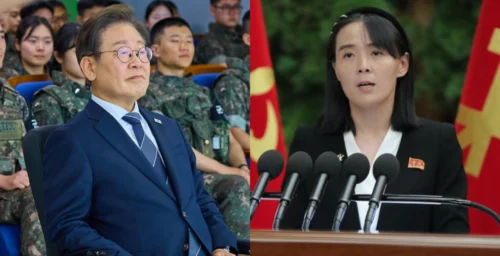
By Editorial Staff
In a sharp escalation of rhetoric and military posturing, Kim Yo Jong, the powerful sister of North Korean leader Kim Jong Un and a senior official in the Workers’ Party of Korea, issued a scathing rebuke of the South Korean administration on Thursday. Her statement, released via the state-run Korean Central News Agency (KCNA), followed a provocative barrage of ballistic missiles launched by Pyongyang into the East Sea (Sea of Japan), marking a volatile period in inter-Korean relations.
The primary point of contention fueling this latest diplomatic spat is the abrupt truncation of the annual Ulchi Freedom Shield (UFS) military exercises. Originally slated for an 11-day duration, the joint U.S.-ROK drills were slashed to a mere five days following what Pyongyang described as a "sudden order" from U.S. President Donald Trump.
The Core Conflict: A Shift in Military Posture
Kim Yo Jong’s statement was not merely a reaction to the missile launches, but a calculated political assault on the credibility of the South Korean government under President Lee Jae Myung. In her address, she characterized the ROK administration as a "puppet" regime, utterly reliant on Washington’s shifting whims for its security architecture.
"The plight of the ROK, which is forced to dance to the tune of its master while begging for a security umbrella that is folded at a moment’s notice, is the natural consequence of its subservient policies," Kim asserted. She dismissed any lingering hopes for a return to inter-Korean engagement, framing Seoul’s current predicament as a case of "reaping what it sowed."
The reduction of the UFS exercise has sent shockwaves through the regional security apparatus. For decades, these exercises have served as the cornerstone of the U.S.-ROK alliance, intended to deter North Korean aggression. By shortening the drill, the Trump administration has signaled a potential shift in its approach to regional military commitments, leaving the ROK government in a precarious position between its reliance on American protection and the escalating hostility from the North.
Chronology of Escalation: August 2026
The current crisis did not emerge in a vacuum. The following timeline outlines the rapid deterioration of the security environment on the Korean Peninsula over the past week:
- August 18, 2026: The annual Ulchi Freedom Shield (UFS) exercises commence with standard readiness protocols.
- August 19, 2026: Intelligence reports indicate an increase in North Korean troop movements near the DMZ and heightened readiness at coastal artillery batteries.
- August 20, 2026: U.S. President Donald Trump issues a surprise directive to command structures to expedite the completion of joint exercises, citing the need for "strategic flexibility."
- August 21, 2026 (Morning): Pyongyang conducts a multi-stage ballistic missile test, firing several short-range projectiles into the East Sea.
- August 21, 2026 (Evening): Kim Yo Jong releases a formal statement via KCNA, mocking Seoul’s response to the shortened drills and declaring the prospect of diplomatic dialogue "null and void."
Supporting Data: Regional Security Trends
The North Korean missile launch serves as a stark reminder of the regime’s accelerated efforts to diversify its nuclear delivery systems. Military analysts note that the recent barrage demonstrated high-precision capabilities, suggesting advancements in guidance systems that could potentially bypass existing regional missile defense networks.
Data from the ROK Joint Chiefs of Staff indicates that North Korea has significantly increased its missile test frequency compared to the same period in 2025. This uptick is largely interpreted as a response to the perceived instability of the U.S.-ROK alliance.
Furthermore, satellite imagery of the Punggye-ri nuclear test site and surrounding support facilities shows consistent maintenance and occasional activity, fueling speculation that the North is maintaining its capability for a seventh nuclear test should it decide that the geopolitical climate warrants a "strategic demonstration."
Official Responses: A Divided Landscape
The reaction to the dual events—the missile launches and the truncated drills—has been starkly divided across the Pacific.

The ROK Perspective
The Presidential Office in Seoul has remained in a state of high alert. While President Lee Jae Myung’s administration has publicly maintained that the alliance remains "ironclad," internal pressure is mounting. Opposition leaders in the National Assembly have criticized the government for its inability to influence Washington’s decision-making process, arguing that the truncated drills have weakened the ROK’s deterrent posture.
The U.S. Position
Washington has adopted a policy of studied ambiguity. White House spokespersons have maintained that the decision to shorten the UFS exercise was based on "resource optimization and strategic recalibration," rather than a weakening of the alliance. However, the move has ignited a fierce debate in Washington, with some foreign policy hawks arguing that any deviation from established military schedules encourages North Korean brinkmanship.
Pyongyang’s Narrative
North Korea’s official media continues to portray the country as a victim of "hostile forces." By positioning the U.S. as a fickle actor and South Korea as a weak-willed vassal, Pyongyang aims to erode public confidence in Seoul and drive a wedge between the ROK and the United States.
Implications: The Future of the Peninsula
The fallout from this week’s events poses profound implications for the future of Northeast Asian security.
1. The Death of Diplomacy?
Kim Yo Jong’s dismissal of engagement is not merely rhetorical—it reflects a hardening of North Korea’s long-term strategy. By explicitly stating that the ROK is no longer a viable partner, Pyongyang is effectively closing the door on the "Sunshine Policy" era of dialogue. Any future attempt at rapprochement would now require a total reset of the regional power balance.
2. The Credibility Gap
The U.S. decision to shorten the drills will be studied extensively by allies and adversaries alike. For South Korea, the event highlights a "sovereignty gap," where the nation’s primary security guarantees are subject to the unilateral decisions of a foreign power. This may lead to renewed calls within the ROK for an independent nuclear deterrent—a move that would fundamentally destabilize the global non-proliferation regime.
3. A New Cold War Calculus
We are witnessing a shift from managed competition to overt hostility. As North Korea integrates its military advancements with more aggressive diplomatic messaging, the space for error is shrinking. The reliance on "strategic patience" or "pressure campaigns" appears increasingly inadequate in the face of a North Korea that is no longer interested in the traditional rules of the diplomatic game.
4. The Economic Fallout
Regional markets remain sensitive to the heightened rhetoric. Investors are closely monitoring the potential for localized military skirmishes. While a full-scale conflict remains a low-probability event, the persistent uncertainty surrounding the security of the Korean Peninsula is beginning to impact long-term capital investment in the region.
Conclusion
As the dust settles on the abbreviated Ulchi Freedom Shield exercises, the reality of the situation is clear: the Korean Peninsula is entering a phase of increased unpredictability. Kim Yo Jong’s rhetoric, while aggressive, highlights a systemic vulnerability in the current security architecture.
For South Korea, the challenge is twofold: maintaining the structural integrity of the alliance with the United States while simultaneously navigating the hostile waters of a northern neighbor that is increasingly emboldened by the perceived weaknesses of its rivals. As the world watches, the diplomatic path forward appears narrower than ever, leaving the region at a precarious crossroads where the next miscalculation could have catastrophic consequences.
The focus now shifts to the upcoming U.N. Security Council meetings, where the international community will be forced to contend with a reality where long-standing military conventions are being dismantled, and the prospect of peace feels more distant than it has in years.
 Ammar Sabilarrohman
  Pevita Pearce
  Nana Wu
