
 By Suro Senen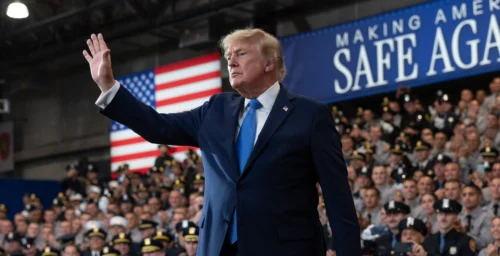
By Editorial Staff
In a development that has sent ripples through the international diplomatic community, U.S. President Donald Trump declared on Wednesday his intention to meet with North Korean leader Kim Jong Un later this year. The announcement, delivered to White House pool reporters during a visit to the David S. Mack Center for Training and Intelligence in Garden City, New York, stands in stark contrast to the dismissive tone emanating from Pyongyang earlier the same day.
The president’s brief but confident assertion—responding with a simple “Yeah, I will be” when asked about a potential summit—has reignited questions regarding the stability of U.S.-DPRK communications and the strategic direction of Washington’s “maximum pressure” and engagement policies.
Main Facts: A Disconnect in Diplomacy
The central tension of the current situation lies in the conflicting narratives presented by the White House and the North Korean Foreign Ministry. While President Trump continues to signal an openness to high-level dialogue, Pyongyang has been increasingly opaque, and at times outright contradictory, regarding the status of back-channel communications.
Despite North Korean officials recently suggesting that no meaningful contact has occurred between the two leaders, President Trump remains steadfast in his assessment of the bilateral relationship. During his remarks in New York, the president declined to elaborate on the logistics of a potential summit—omitting details regarding dates, locations, or the nature of any ongoing correspondence.
What is clear is that the White House is prioritizing the maintenance of a personal rapport with Chairman Kim. By emphasizing his “positive relationship” with the North Korean leader, Trump appears to be banking on the efficacy of top-down diplomacy, a strategy that defined much of his administration’s early engagement with the reclusive state.
Chronology of Stalled Progress
To understand the weight of Wednesday’s announcement, one must look back at the erratic trajectory of the U.S.-DPRK relationship over the past several months:
- Early 2026: Initial optimism regarding a "thaw" in relations emerged following informal signals from North Korean intermediaries.
- May 2026: Speculation began to mount regarding a third summit, fueled by rumors of an exchange of personal letters between Washington and Pyongyang.
- July 2026: Tensions flared as North Korea conducted a series of short-range missile tests, leading to a temporary cooling of public rhetoric from the White House.
- August 14, 2026: Pyongyang officially denied being in active communication with the United States, casting doubt on the validity of previous claims regarding the state of negotiations.
- August 14, 2026 (Afternoon): President Trump publicly rejects the narrative of total silence, insisting that a summit remains on the table for the calendar year.
This timeline reflects a pattern where diplomatic overtures are frequently punctuated by periods of silence and public denials, highlighting the fragile nature of communication between the two nuclear-armed powers.
Supporting Data: The Strategic Calculus
Behind the rhetoric lies a complex web of military and geopolitical considerations. A significant component of the current diplomatic push, as noted by South Korean officials, involves the potential reduction of joint military drills.
The Role of Military Exercises
South Korean President Lee has publicly expressed optimism that President Trump’s push to scale back joint military exercises will serve as a catalyst for renewed dialogue. For Pyongyang, these exercises—which they characterize as "rehearsals for invasion"—have long been a primary sticking point. By potentially curtailing these drills, the U.S. is signaling a willingness to provide a "security guarantee" in exchange for tangible progress on denuclearization.
Economic and Security Indicators
Economic sanctions remain the primary lever of U.S. policy. However, data suggests that the effectiveness of these sanctions has been mitigated by illicit ship-to-ship transfers and the resilience of the North Korean domestic economy. The U.S. intelligence community remains concerned that without a breakthrough in high-level talks, the current period of relative calm may be used by the DPRK to further modernize its missile and nuclear delivery systems.

Official Responses: Seoul’s Cautious Optimism
The government in Seoul finds itself in a delicate position, acting as the primary mediator between Washington and Pyongyang. President Lee’s administration has consistently pushed for a "peace-first" approach, advocating for incentives that would draw the North back to the negotiating table.
In response to Trump’s latest comments, the Blue House issued a statement welcoming the prospect of a summit. “We believe that any direct dialogue between the leaders of the United States and North Korea is a positive step toward the permanent peace and denuclearization of the Korean Peninsula,” the statement read.
However, behind the scenes, there is palpable anxiety in Seoul. Officials are reportedly worried that a summit without a clear agenda or prior working-level preparation could lead to another "no-deal" outcome, which might further embolden North Korea to pursue more provocative actions in the following year.
Implications: Where Does Diplomacy Go From Here?
The insistence by President Trump that a summit will occur, despite Pyongyang’s denials, leaves several critical questions unanswered.
1. The Validity of Back-Channels
If Pyongyang is indeed denying contact, the U.S. must grapple with the possibility that its back-channels are compromised or that the North Korean leadership is attempting to reset the terms of the relationship by creating a "public gap" in communications.
2. The Domestic Political Landscape
With the political calendar in the United States intensifying, the optics of a foreign policy win in Asia are significant. Critics argue that the desire for a "win" might lead to premature negotiations, while supporters argue that direct presidential engagement is the only way to break the inertia of bureaucratic deadlock.
3. The Denuclearization Question
Ultimately, the success of any potential summit will be measured by the concrete concessions made regarding North Korea’s nuclear program. To date, the "freeze-for-freeze" approach—halting nuclear tests in exchange for limited sanctions relief or military drill adjustments—has failed to result in the total, verifiable, and irreversible dismantlement of North Korea’s nuclear infrastructure.
4. Regional Security
Japan and other regional allies are watching closely. Any move by the U.S. to reduce its military footprint in the region to accommodate North Korea will necessitate a restructuring of regional security architectures. Tokyo has repeatedly emphasized that any diplomatic solution must address the issue of short-range missiles that threaten the Japanese mainland, a topic that has often been secondary in U.S.-DPRK summits.
Conclusion
President Trump’s confidence in a future summit highlights a persistent, if not defiant, commitment to his personal brand of diplomacy. While the world waits to see if Pyongyang will shift its stance from public denial to private acceptance, the diplomatic machinery continues to churn.
The coming months will likely be decisive. If a summit does occur, it will represent either a masterclass in personal diplomacy or a repetition of past frustrations. If it fails to materialize, the administration will be forced to reconsider its strategy in a region where the margin for error is becoming increasingly slim. For now, the world remains in a state of watchful waiting, as the leaders of the two nations continue to play a high-stakes game of public messaging, diplomatic signaling, and strategic ambiguity.
 Ammar Sabilarrohman
  Pevita Pearce
  Nana Wu
