
 By Siti Muinah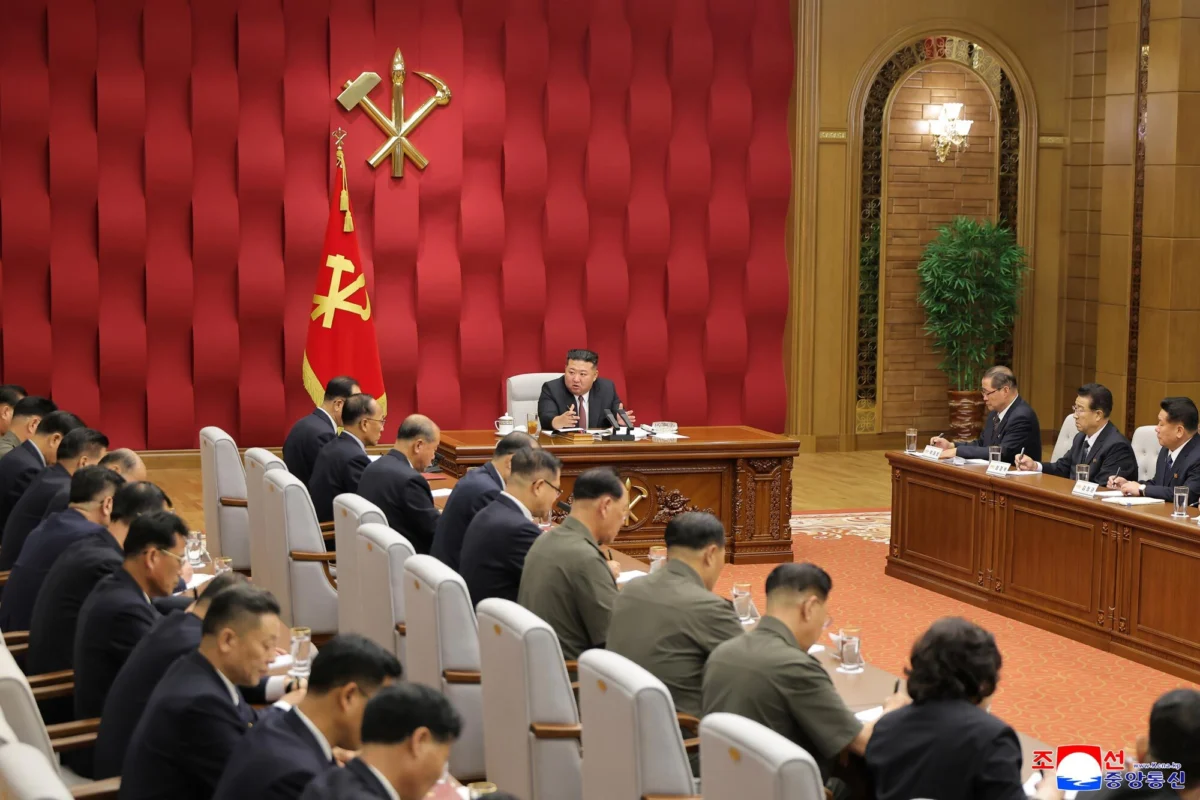
PYONGYANG – North Korean leader Kim Jong Un convened the fourth enlarged meeting of the Political Bureau of the Workers’ Party of Korea (WPK) Central Committee on Tuesday, August 25, 2026. While the session was ostensibly called to address the momentum of the state’s ongoing five-year economic development plan, the brevity of the official readout and the conspicuous absence of substantive details have fueled intense speculation regarding the regime’s true strategic priorities.
State media organ the Korean Central News Agency (KCNA) confirmed the gathering at the WPK headquarters, publishing a report that emphasized the leadership’s focus on domestic economic management. However, for regional observers and intelligence analysts, the report was most notable for what it chose to omit. Despite a backdrop of heightened geopolitical friction and significant military movements, the regime’s official summary remained sterile, focusing on bureaucratic cohesion rather than the specific, granular project updates typically associated with the midterm execution of a five-year plan.
The Chronology of a Vague Directive
The meeting follows a turbulent summer for the Democratic People’s Republic of Korea (DPRK). The current five-year plan, inaugurated earlier this year, was intended to stabilize an economy battered by years of pandemic-era border closures and the lingering effects of international sanctions.
- Early 2026: The WPK Central Committee formalizes the objectives for the current five-year economic cycle, emphasizing self-reliance and the modernization of domestic industrial sectors.
- May–July 2026: Periodic reports suggest minor gains in agricultural output, though these are frequently offset by regional weather disturbances and supply chain bottlenecks.
- August 20, 2026: Reports emerge concerning a suspected ballistic missile launch, drawing sharp condemnation from Tokyo and Washington.
- August 25, 2026: Kim Jong Un convenes the fourth enlarged Political Bureau meeting.
- August 26, 2026: KCNA releases a redacted summary of the proceedings, emphasizing party discipline and economic adherence without identifying specific sector benchmarks.
The meeting’s timing is critical. It arrives just days after intense international discourse regarding the potential deployment of North Korean personnel in foreign conflicts and ongoing speculation about a possible summit-level diplomatic initiative involving the United States.
Supporting Data: The Economic Disconnect
The disconnect between the rhetoric of the Politburo and the reality of the DPRK’s economic indicators remains a primary focus for Western intelligence agencies. Since the adoption of the latest economic roadmap, the regime has struggled to meet production quotas in the coal, steel, and textile industries—the traditional pillars of North Korean industrial propaganda.
According to data compiled by independent research groups tracking DPRK trade, imports of essential machinery from primary partners remain significantly below pre-2020 levels. The reliance on "state-led development" projects often functions as a catch-all term in Pyongyang to describe mobilization efforts, where labor is diverted to large-scale infrastructure or residential construction projects.
Analysts note that the lack of detail in the latest KCNA report likely serves two purposes:
- Strategic Ambiguity: By withholding specific targets, the regime avoids public accountability should those targets fail to materialize before the end of the year.
- Internal Control: The meeting appears to have functioned more as an exercise in political consolidation than as a platform for economic debate. By gathering the upper echelon of the Politburo, Kim Jong Un reinforces the "monolithic leadership" structure, ensuring that party officials remain aligned with his overarching vision, even as that vision remains opaque to the public.
Geopolitical Silence: The Elephant in the Room
Perhaps the most startling aspect of the KCNA report was the total silence regarding the military and foreign policy arenas. In previous years, even economic meetings were typically framed through the lens of "defensive strength" or "diplomatic maneuvers."
The omission is particularly striking given recent reports regarding the potential deployment of up to 50,000 North Korean soldiers to support Russian operations in Ukraine. If these reports are accurate, the logistical and financial implications for the North Korean state would be massive. Furthermore, the North’s recent ballistic missile testing indicates a continued commitment to its nuclear-capable delivery systems, yet the Politburo report ignored these developments entirely.

This silence is often interpreted by experts as a "blackout policy." When the DPRK is engaged in sensitive, potentially volatile external operations, state media is often instructed to sanitize its output to prevent the international community from gauging the regime’s level of commitment or its internal stress points.
Official Responses and International Reaction
The international community has met the lack of transparency with renewed caution. South Korea’s Ministry of Unification issued a brief statement urging Pyongyang to "engage in meaningful dialogue and transparency" regarding its economic policies, noting that the welfare of the North Korean people should take precedence over military adventurism.
In Washington and Tokyo, the meeting is being viewed through a security-first lens. "The fact that they are holding a meeting of this magnitude and discussing nothing of substance is, in itself, a signal," remarked a senior fellow at a D.C.-based think tank. "They are signaling that the regime is in a ‘fortress’ mindset, prioritizing internal stability and covert foreign activities over transparent governance."
China, the DPRK’s primary economic lifeline, has remained largely silent, though diplomatic cables suggest that Beijing is increasingly wary of the potential for instability on its border should the DPRK’s economic projects fail to yield tangible results before the winter months.
Implications: A Shift in Governance Style?
The 2026 Politburo meeting may represent a fundamental shift in how Kim Jong Un governs. By moving away from specific project announcements and toward a more generalized, ideological discourse, the leader may be attempting to decouple his personal image from the inevitable failures of the state’s economic plans.
The Risks of Stagnation
If the five-year plan continues to stagnate, the regime will face a critical choice: either implement genuine market-oriented reforms—which would threaten the centralized control of the WPK—or further increase military posturing to distract the populace. The current trajectory suggests the latter.
Looking Ahead
The coming months will be telling. If the Politburo continues to ignore foreign policy in its official communications, it will suggest that the regime is deeply embedded in its current, highly secretive, and potentially high-risk international alliances. Conversely, if there is a sudden pivot toward diplomatic outreach, it would signal that the economic pressures discussed in the August 25 meeting have reached a breaking point, necessitating a return to the negotiating table.
Ultimately, the fourth enlarged meeting of the ninth WPK Central Committee proves that in the current North Korean political landscape, what is left unsaid is far more important than the rhetoric provided. As the global community waits for clarity, the regime in Pyongyang continues to operate in the shadows, keeping its neighbors and adversaries guessing as to its next move on both the domestic and international stage.
 Ammar Sabilarrohman
  Pevita Pearce
  Nana Wu
