
 By Layla Zulfa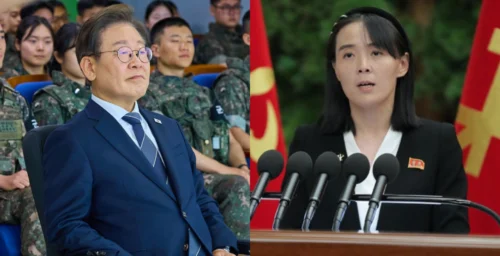
Executive Summary: A New Phase of Regional Volatility
The geopolitical landscape of the Korean Peninsula has shifted dramatically this week, as North Korea’s powerful propaganda chief and sister to the leader, Kim Yo Jong, launched a scathing verbal assault on the South Korean administration. Her latest statement, released via the state-controlled Korean Central News Agency (KCNA), serves as a biting commentary on the recent shortening of the annual Ulchi Freedom Shield (UFS) joint military exercises.
The drills, originally slated for an 11-day window, were abruptly slashed to five days following a direct intervention by U.S. President Donald Trump. This development, which many analysts view as a calculated attempt by the U.S. to de-escalate tensions or realign strategic priorities, has instead provided Pyongyang with a rhetorical weapon. Kim Yo Jong’s remarks characterize the South Korean government as a "subservient puppet" of Washington, signaling that any hope for inter-Korean reconciliation or renewed diplomatic engagement remains firmly off the table.
Chronology of Escalation
The recent flare-up follows a pattern of high-intensity signaling between the three involved capitals.
- August 18, 2026: The annual Ulchi Freedom Shield (UFS) exercises commence with the stated goal of bolstering the combined defense posture of the U.S. and the Republic of Korea (ROK) against regional threats.
- August 20, 2026: Reports emerge that President Donald Trump has issued a "sudden order" to truncate the exercise schedule, citing the need for regional stability and a shift in military resource allocation.
- August 21, 2026 (Morning): Pyongyang responds to the ongoing drills—and perhaps the perceived uncertainty within the alliance—by launching a barrage of short-range ballistic missiles into the East Sea (Sea of Japan).
- August 21, 2026 (Evening): Kim Yo Jong releases a formal statement through KCNA, mocking Seoul for its reliance on Washington and describing the curtailed exercises as evidence of the "ROK’s pitiable dependence" on the U.S. security umbrella.
The Rhetorical War: Kim Yo Jong’s Assessment
In her statement, Kim Yo Jong did not merely criticize the military drills; she dismantled the credibility of the current South Korean administration. She argued that the reduction of the UFS exercise duration is proof that Seoul holds no agency in its own national security decisions.
"The plight of the ROK, which is forced to dance to the tune of its master, is a pathetic spectacle," Kim wrote, utilizing the vitriolic rhetoric for which she has become infamous. By framing the decision to shorten the drills as a failure of South Korean sovereignty, Pyongyang aims to drive a wedge between the South Korean public and their government, as well as between Seoul and Washington.
Kim further dismissed any possibility of renewed dialogue. Her message was clear: North Korea views the current South Korean government, led by President Lee Jae Myung, as a "vassal state." She suggested that Pyongyang would continue to bolster its nuclear and missile capabilities regardless of the duration or intensity of joint U.S.-ROK drills, framing the North’s military expansion as a necessary reaction to an "encroaching imperialist threat."
Supporting Data: Missile Tests and Military Posture
The recent missile launch serves as the physical manifestation of Pyongyang’s political rhetoric. According to data from the South Korean Joint Chiefs of Staff (JCS), the barrage consisted of multiple ballistic missiles that traveled roughly 300 kilometers before impacting the waters of the East Sea.
Strategic Implications of the UFS Curtailment
The Ulchi Freedom Shield exercise is typically the most significant combined military training event on the peninsula. Its reduction from 11 days to five is unconventional. Military analysts point to several potential drivers for this decision:
- Strategic Rebalancing: The U.S. may be shifting assets to other theaters of operation, potentially in the Indo-Pacific or Eastern Europe, necessitating a reduction in the ROK theater.
- Diplomatic Signaling: The White House may be attempting to avoid a "tit-for-tat" escalation cycle during a delicate window of regional diplomatic efforts.
- Financial and Logistics Constraints: The rapid pace of modern warfare exercises requires immense logistical support, and administrative changes in the Pentagon may have necessitated a shorter, more intense exercise window.
However, the political cost of this decision is evident: it has empowered North Korean propaganda outlets to frame the alliance as indecisive and fragile.
Official Responses: Seoul and Washington
The View from Seoul
The South Korean Ministry of National Defense issued a brief statement condemning the North’s missile launches as a "grave provocation" that violates UN Security Council resolutions. Regarding the shortening of the UFS exercises, the Ministry maintained that the drills were "successfully completed" in accordance with the current strategic requirements of the alliance.

President Lee Jae Myung’s office has remained relatively tight-lipped regarding Kim Yo Jong’s specific insults, opting to focus on the "ironclad" nature of the U.S.-ROK alliance. However, sources within the Blue House suggest that the administration is concerned that the public perception of a "shortened drill" undermines the government’s deterrence messaging.
The View from Washington
The U.S. Department of State and the Pentagon have reiterated that the U.S. commitment to the defense of South Korea remains "unwavering." A spokesperson stated that decisions regarding exercise length are made in coordination with partners and are based on evolving threat assessments. Washington continues to call for a return to the negotiating table, though these calls have been systematically ignored by Pyongyang for several years.
Implications: A Peninsula at a Crossroads
The current situation represents a dangerous convergence of domestic political pressures and international instability.
1. The Erosion of Deterrence
By mocking the ROK’s dependence on the U.S., Pyongyang is attempting to degrade the perceived efficacy of the extended deterrence umbrella. If the South Korean public begins to believe that the U.S. will curtail security commitments at the whim of a president in Washington, the domestic consensus for maintaining the current defense posture may fracture.
2. The Normalization of Missile Testing
The barrage of missiles launched on Thursday reflects a broader trend: the normalization of "business as usual" missile testing by the North. Pyongyang is no longer seeking grand breakthroughs in diplomacy; it is focused on the technical refinement of its nuclear delivery systems while utilizing the regional geopolitical climate to consolidate domestic control.
3. The Future of Engagement
Any hope for a return to the 2018-era diplomatic thaw is effectively dead. The current discourse between North and South has devolved into a cycle of insults and threats. With Kim Yo Jong’s explicit dismissal of engagement, the region appears to be entering a period of prolonged "frozen conflict," where the threat of accidental escalation is significantly higher than in previous decades.
4. Regional Strategic Alignment
Japan, which often tracks these developments closely, has expressed renewed concern. If the U.S.-ROK alliance is perceived as wavering, Tokyo may feel compelled to accelerate its own defense spending and independent strike capabilities, leading to an arms race that neither Washington nor Beijing desires.
Conclusion
The intersection of the curtailed Ulchi Freedom Shield exercises and Kim Yo Jong’s bellicose rhetoric marks a low point in inter-Korean relations. While the U.S. may view the reduction of military drills as a strategic necessity or a diplomatic gesture, Pyongyang views it as a vulnerability to be exploited. As the North continues to advance its ballistic missile program, the task for Seoul and Washington will be to restore confidence in the alliance without falling into the trap of reactive, escalatory cycles that only serve to embolden the leadership in Pyongyang.
For now, the Korean Peninsula remains a volatile theater, with the words of Kim Yo Jong serving as a stark reminder that in the shadow of nuclear proliferation, silence is rarely an option, and dialogue remains a distant, perhaps impossible, prospect.
 Evan Lee Salim
  Neng Nana
  Ammar Sabilarrohman
