
 By Nana Wu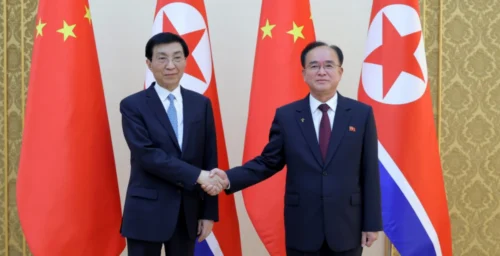
In a significant display of ideological alignment and diplomatic solidarity, Wang Huning—the fourth-ranking official in the Chinese Communist Party (CCP) hierarchy—concluded a high-profile visit to Pyongyang this week. The visit, which saw the top political strategist meeting with key North Korean leadership, underscores a renewed effort by Beijing and Pyongyang to consolidate party-to-party ties amidst a volatile geopolitical landscape in East Asia.
The meetings, held at the Pyongyang Assembly Hall, served as a platform for both nations to reaffirm their commitment to the "shared vision" of their respective leaders, Xi Jinping and Kim Jong Un. As China navigates increasing pressure from the West and North Korea continues to accelerate its military and nuclear posturing, the optics of this visit suggest that the traditional "blood-forged" alliance remains a cornerstone of regional stability for both regimes.
The Core of the Diplomatic Engagement
Wang Huning, the Chairman of the Chinese People’s Political Consultative Conference (CPPCC), arrived in the North Korean capital on Wednesday, leading a high-level Chinese party and government delegation. His counterpart for the primary discussions was Jo Yong Won, a member of the Presidium of the Political Bureau of the Workers’ Party of Korea (WPK) and a figure widely considered to be one of Kim Jong Un’s most trusted inner-circle confidants.
According to reports from the state-run Korean Central News Agency (KCNA), the discussions were centered on institutionalizing cooperation. Beyond the standard diplomatic pleasantries, the two sides focused on "party-to-party exchanges," a mechanism that allows the two authoritarian states to share governance strategies, internal party management techniques, and ideological training protocols.
The emphasis on party-to-party relations is distinct from government-to-government diplomacy. It signals that the two regimes are prioritizing the survival and ideological cohesion of their respective ruling parties, viewing this internal stability as the foundation for their external bilateral strength.
Chronology of the Visit
The itinerary of the Chinese delegation reflects the meticulously choreographed nature of modern Sino-DPRK diplomacy:
- Wednesday, July 15, 2026: The Chinese delegation, led by Wang Huning, touches down in Pyongyang. They are met with a formal reception, signaling the importance Beijing places on the trip.
- Thursday, July 16, 2026: Formal talks commence at the Pyongyang Assembly Hall. Wang meets with Jo Yong Won. During these sessions, they cover a broad spectrum of issues, including economic integration, cultural collaboration, and the synchronization of regional policy.
- Friday, July 17, 2026: The delegation engages in secondary discussions aimed at refining the details of cooperation agreements. Reports suggest discussions touched upon the expansion of trade corridors and potential cultural exchange programs meant to bolster the public perception of the China-DPRK friendship.
- Saturday, July 18, 2026: The visit concludes with both parties issuing statements pledging to implement the decisions reached during the talks, effectively setting the stage for increased high-level contact throughout the remainder of 2026.
Strategic Implications: Why Wang Huning?
The selection of Wang Huning for this mission is far from accidental. Wang is widely regarded as the primary architect of China’s contemporary political ideology. His role as the chief strategist for the CCP makes him the ideal interlocutor for a North Korean leadership that is increasingly obsessed with internal ideological purity and the consolidation of party power.
By sending a figure of Wang’s stature—rather than a purely economic or foreign affairs official—Beijing is sending a clear signal: China is committed to the long-term sustainability of the North Korean system.
Geopolitical Balancing
For Beijing, the relationship with Pyongyang serves as a crucial leverage point in its broader rivalry with the United States. While China has historically been cautious about North Korea’s nuclear provocations, it has simultaneously been unwilling to allow the North Korean state to collapse, fearing a unified Korean peninsula aligned with Washington. Wang’s visit acts as a reminder to the international community that China remains the primary patron of the Kim regime, and any attempt to isolate Pyongyang will be met with Chinese pushback.
Economic and Cultural Cooperation
While the "party-to-party" aspect dominated the headlines, the inclusion of economic and cultural cooperation on the agenda is telling. North Korea continues to suffer from the lingering effects of international sanctions and the economic shocks of the post-pandemic era. By deepening economic ties—potentially through enhanced cross-border trade and the development of special economic zones—Beijing is providing a vital lifeline to the North Korean economy, effectively mitigating the impact of Western-led sanctions regimes.
Supporting Data: The Sino-DPRK Trade Nexus
While official figures are often obscured, available trade data and historical patterns suggest that the economic cooperation discussed by Wang and Jo is likely to focus on three key pillars:

- Infrastructure Connectivity: Improving road and rail links between the Chinese border city of Dandong and the North Korean city of Sinuiju to facilitate a more efficient flow of goods.
- Energy and Food Security: Ensuring that the flow of Chinese fuel and grain remains uninterrupted, which is essential for the North Korean regime to maintain domestic stability.
- Digital Governance and Surveillance: There is growing evidence that the two nations are collaborating on the digital infrastructure required to manage state-controlled information flows, a specialty of Wang Huning’s own domestic policy portfolio in China.
Official Responses and Regional Reactions
The official statements from both Pyongyang and Beijing have been characterized by a notable absence of dissent.
From Pyongyang: The KCNA framed the meeting as a "historic milestone," emphasizing the traditional friendship and the need to defend socialist ideals against "imperialist encroachment." The rhetoric mirrors the regime’s long-standing narrative of self-reliance bolstered by the support of a "great power" ally.
From Beijing: The Chinese Foreign Ministry, while maintaining a level of diplomatic distance, emphasized that the visit was part of "normal bilateral exchanges between two neighboring countries." However, analysts in Beijing note that the visit serves to solidify China’s influence in the region at a time when the U.S.-ROK-Japan trilateral security cooperation is reaching new levels of integration.
Regional Context: The reaction from Seoul and Washington has been one of wary observation. Officials in the Republic of Korea (ROK) have expressed concern that the strengthening of ties between the two capitals could embolden Pyongyang to further accelerate its missile testing programs, emboldened by the knowledge that they have a diplomatic shield in the UN Security Council.
Implications for the Future
The Wang-Jo meetings signify that the "strategic partnership" between China and North Korea is entering a more mature and institutionalized phase.
1. Hardening of Blocs
The visit suggests that the "New Cold War" dynamic in Northeast Asia is intensifying. By aligning their ideological frameworks, China and North Korea are effectively insulating themselves against the democratic values promoted by the United States and its allies.
2. A Buffer for Beijing
For Xi Jinping, North Korea remains a vital strategic buffer. As long as the WPK remains in power, China can prevent the presence of U.S. troops on its immediate border. Wang Huning’s visit serves to ensure that this buffer remains stable, loyal, and ideologically aligned.
3. Implications for Denuclearization
Perhaps most concerning for the international community is the lack of any mention of denuclearization in the reports surrounding the visit. By focusing on "cooperation" and "party exchanges," both sides are effectively sidelining the issue of North Korea’s nuclear arsenal, treating it as a settled matter rather than a topic for negotiation. This suggests that the current Chinese strategy is to prioritize regional stability and regime survival over the long-term goal of a denuclearized Korean Peninsula.
Conclusion
The high-profile meeting between Wang Huning and Jo Yong Won is more than a mere diplomatic formality. It is a calculated move to reinforce the ideological and strategic foundations of the China-DPRK alliance. As North Korea continues to grapple with the challenges of isolation and domestic control, and as China faces mounting pressure on the global stage, both nations have found a common interest in deepening their integration.
For the international community, the visit serves as a sobering reminder: the geopolitical realities of the Korean Peninsula are increasingly being defined by the deep-seated cooperation between Beijing and Pyongyang, leaving little room for Western intervention or the prospect of a diplomatic breakthrough in the near term. As the two sides move forward with their pledge to increase exchanges, the coming months will likely see a more synchronized, and potentially more assertive, Sino-North Korean presence in the regional and global arena.
 Ammar Sabilarrohman
  Pevita Pearce
