
 By rifanmuazin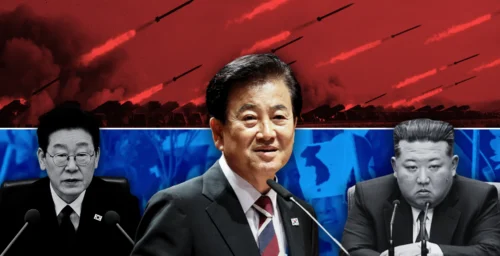
For decades, the cornerstone of South Korean diplomacy toward the Democratic People’s Republic of Korea (DPRK) was built upon a singular, rigid foundation: denuclearization as the mandatory prerequisite for any meaningful economic or political engagement. However, as the geopolitical landscape on the Korean Peninsula has curdled into a state of permanent volatility, the administration of President Lee Jae-myung has signaled a dramatic departure from this status quo.
In a candid announcement on Thursday, ROK Unification Minister Chung Dong-young confirmed that Seoul has officially “reset” its North Korean policy. The new doctrine prioritizes a “peace-first” approach, effectively decoupling the immediate pursuit of denuclearization from the broader objectives of tension reduction and humanitarian dialogue. While the administration frames this as a pragmatic evolution, the move has ignited a fierce debate among security analysts, with many questioning whether Pyongyang—a regime that has repeatedly shuttered its doors to diplomatic overtures—is even willing to participate in a new era of engagement.
The Chronology of a Failed Paradigm
To understand the necessity of the current “reset,” one must look at the gradual erosion of the previous engagement models.
- 2018: The Peak of Optimism: The inter-Korean summits of 2018 fostered a brief, flickering hope for lasting peace, characterized by the Panmunjom Declaration and the subsequent military agreements. However, these gains were largely predicated on a level of trust that evaporated following the collapse of the Hanoi summit in 2019.
- 2022–2024: The Hardening of Lines: As the Lee Jae-myung administration took office, it inherited a North Korea that had pivoted toward overt hostility. The regime’s constitutional changes, which formally defined the South as its “principal enemy,” signaled an end to the era of reunification rhetoric.
- March 2025: The Catalyst of Crisis: Tensions reached a fever pitch in March 2025, when the Korean People’s Army (KPA) conducted a series of large-scale artillery drills explicitly simulating an attack on Seoul. This display of kinetic capability underscored the obsolescence of South Korea’s previous “denuclearization-first” framework, which relied on the assumption that Pyongyang valued diplomatic incentives over its nuclear arsenal.
- July 2026: The Policy Reset: Minister Chung’s announcement serves as the administrative acknowledgment that the previous strategy failed to deter the North’s nuclear advancements and, more critically, failed to prevent the normalization of military friction along the Demilitarized Zone (DMZ).
The Strategic Shift: Why "Peace First"?
The transition to a “peace-first” strategy represents a move from idealistic long-term goals to immediate, tangible risk management. Under the old model, the logic was linear: first, provide a roadmap for the North to abandon its weapons; then, provide the economic and diplomatic carrots to reward that compliance.
The “peace-first” model inverts this. It posits that the nuclear issue is a symptom of a larger, systemic lack of security. By prioritizing the establishment of a peace regime—or, at the very least, a robust crisis-management framework—Seoul hopes to lower the temperature on the peninsula. The theory is that by reducing the North’s perceived need for a nuclear deterrent through de-escalation, the path to eventual disarmament becomes a secondary, albeit still critical, goal.
The Pragmatic Reality
Minister Chung’s remarks emphasize that South Korea can no longer afford to wait for a “perfect” diplomatic environment. “We are moving toward a pragmatic path,” the Ministry stated. This implies that Seoul may be willing to explore sectoral cooperation, cross-border humanitarian aid, or formal communication hotlines without the immediate prerequisite of a verifiable nuclear freeze.
Supporting Data and the Security Dilemma
The urgency of this shift is backed by a harrowing reality of recent security trends. According to intelligence reports synthesized by the ROK Ministry of Unification, the DPRK’s nuclear inventory has grown not only in quantity but in technical sophistication.
- Nuclear Proliferation: Estimates suggest the North has surpassed the 60-warhead threshold, with an increasing emphasis on tactical nuclear weapons designed for battlefield use.
- Military Expenditure: The regime in Pyongyang has prioritized military spending at the expense of its civilian economy, indicating a strategic decision to treat nuclear status as an irreversible fact of statehood.
- Cross-Border Tension: Since the beginning of 2025, there have been a 40% increase in unauthorized drone incursions and a sustained, high-decibel propaganda campaign directed across the border, creating a high-risk environment for accidental miscalculation.
These data points suggest that the “denuclearization-first” policy was effectively a stalemate policy. It prevented progress, but it also failed to prevent the North from reaching its current, highly dangerous level of nuclear readiness.
Official Responses and Internal Skepticism
The announcement of the “reset” has met with a complex array of responses from the political establishment and the international community.

The Administration’s Defense
The Lee Jae-myung administration argues that this is not a sign of weakness, but a recognition of sovereignty and reality. Supporters within the government note that maintaining a policy that the North refuses to discuss is not a policy at all; it is a passive acceptance of irrelevance. By changing the goalposts, Seoul aims to reclaim the initiative and force Pyongyang to at least acknowledge a diplomatic channel.
The Conservative Opposition
Conversely, conservative lawmakers in Seoul have labeled the shift a “capitulation to nuclear blackmail.” They argue that by separating peace from denuclearization, the government is essentially granting the North legitimacy as a nuclear-armed state, which risks alienating South Korea’s primary security guarantor, the United States.
The International Perspective
Washington has remained characteristically cautious. While the U.S. State Department maintains that its commitment to the “complete denuclearization of the Korean Peninsula” remains unchanged, there is a quiet understanding that the ROK must lead on issues of regional stability. However, the fear in Washington is that a “peace-first” strategy could be exploited by Pyongyang to secure sanctions relief without offering any meaningful concessions on its weapons programs.
Implications: A High-Stakes Gamble
The success of the “peace-first” strategy depends entirely on factors beyond the control of the South Korean government.
The Pyongyang Factor
The most significant hurdle is the internal logic of the Kim Jong Un regime. For Pyongyang, the nuclear program is the ultimate insurance policy against regime change. If the regime perceives that "peace" is a trap designed to induce internal decay through economic liberalization, they are unlikely to engage, regardless of the change in Seoul’s rhetoric.
The Risk of Miscalculation
There is a profound risk that by seeking peace, South Korea may inadvertently create a vacuum that the North fills with renewed provocations. If the North views the “peace-first” pivot as a symptom of a weakened South Korean resolve, they may test the new policy with further military drills or cyber-attacks.
Future Trajectories
If this policy is to succeed, it must be accompanied by a ironclad commitment to deterrence. The Lee administration must walk a razor’s edge: they must be open to dialogue while simultaneously proving that the cost of continued aggression remains prohibitively high for the North.
Ultimately, the “reset” is a move toward realism. It acknowledges that the era of grand bargains is over, replaced by an era of micro-negotiations and granular de-escalation. Whether this will lead to a quieter peninsula or merely a more emboldened North Korea remains the central question of the Lee Jae-myung presidency. For now, Seoul has placed its bet on the idea that even a fragile, imperfect peace is better than the slow, grinding drift toward a conflict that neither side can afford.
 Ammar Sabilarrohman
  Pevita Pearce
  Nana Wu
