
 By Ali Ikhwan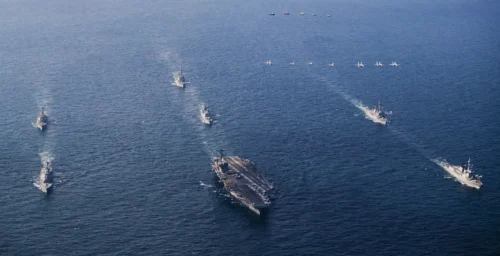
SEOUL — Tensions on the Korean Peninsula have reached a critical inflection point as North Korea’s newly appointed Minister of National Defense, Kim Song Gi, issued a stern warning against the ongoing trilateral "Freedom Edge" military exercises. The maneuvers, which involve the United States, South Korea, and Japan, have been characterized by Pyongyang as an "adversarial" and "provocative" escalation, prompting threats of a "more powerful and resolute" response from the Democratic People’s Republic of Korea (DPRK).
The condemnation arrives at a volatile time for regional security, exacerbated by a shift in U.S. foreign policy rhetoric. Recent signals from Donald Trump regarding a potential pivot toward engagement with Pyongyang—specifically through the reduction of joint U.S.-ROK military drills—have created a paradoxical atmosphere of diplomatic uncertainty and heightened tactical vigilance.
The Core Conflict: Freedom Edge and the DPRK’s Response
The Freedom Edge exercises, which commenced this week, represent a deepening of the trilateral security architecture between Washington, Seoul, and Tokyo. The drills involve complex naval, aerial, and cyber components, designed to demonstrate interoperability and a unified front against what the allies describe as the growing nuclear and missile threats posed by the Kim Jong Un regime.
In a statement released late Monday via the state-run Korean Central News Agency (KCNA), Minister Kim Song Gi explicitly denounced the exercise. "The U.S.-led effort to target the DPRK under the pretext of countering our nuclear and missile threats is a blatant violation of our sovereignty," the statement read. Pyongyang has long maintained that these joint exercises are rehearsals for a full-scale invasion, a narrative the state media uses to justify its own aggressive development of strategic weapons systems.
Chronology of Escalation: From Diplomacy to Deterrence
To understand the current volatility, one must look at the timeline of the shifting security landscape in Northeast Asia:
- 2023-2024: The "Camp David" trilateral framework solidified, leading to the institutionalization of Freedom Edge. These exercises moved beyond mere training to become a cornerstone of regional containment.
- November 2024: High-profile naval drills featuring the USS George Washington aircraft carrier, the JS Haguro Aegis destroyer, and the ROKS Seoae Ryu Seong-ryong underscored the technological integration of the three nations.
- Early 2025: North Korea ramped up its rhetoric, testing advanced intercontinental ballistic missiles (ICBMs) and solid-fuel engines, signaling a move away from the failed "thaw" of the late 2010s.
- Late 2026 (Present): The return of high-stakes political debate in Washington regarding the utility of joint drills has coincided with a new, more militant stance from the North Korean Ministry of Defense.
Supporting Data: The Strategic Calculus of the Trilateral Alliance
The Freedom Edge drills are not merely symbolic; they represent a significant leap in trilateral military integration. By syncing Aegis combat systems and sharing real-time missile warning data, the U.S., Japan, and South Korea have created a defensive "shield" that frustrates Pyongyang’s attempts to use tactical nuclear weapons as a deterrent.
According to military analysts, the current iteration of the drills focuses on three specific domains:
- Anti-Submarine Warfare: Designed to track North Korean submarine-launched ballistic missile (SLBM) capabilities.
- Integrated Air and Missile Defense (IAMD): Utilizing the Aegis systems to simulate the interception of North Korean cruise and ballistic missiles.
- Cyber/Electronic Warfare: Securing communication channels against the DPRK’s sophisticated cyber-warfare units.
For the Kim regime, this integration is a direct threat to the survivability of their nuclear arsenal. The speed at which the three nations can now coordinate has significantly narrowed the "reaction window" for the Korean People’s Army (KPA), forcing Pyongyang to adopt a more aggressive posture to maintain the illusion of deterrence.
Official Responses and Diplomatic Friction
The U.S. State Department and the ROK Ministry of National Defense have consistently defended the Freedom Edge exercises as defensive in nature. "These drills are about maintaining regional stability and ensuring our collective ability to respond to provocations," a spokesperson for the ROK Joint Chiefs of Staff stated on Tuesday.

However, the political environment is becoming increasingly complex. The recent suggestions from the Trump camp regarding the scaling back of joint exercises to encourage North Korean dialogue have caused internal friction. Many in Seoul fear that any unilateral concession to Pyongyang—without a reciprocal freeze in North Korean missile development—could lead to the unraveling of the trilateral security framework.
"We are seeing a divergence in strategy," says Dr. Elena Park, a senior fellow at the Institute for Global Security. "While the U.S. political sphere debates whether engagement or containment is the better path to denuclearization, the North Korean defense establishment is exploiting this hesitation to frame every allied action as an act of war."
The Implications: A Region on the Brink
The implications of Pyongyang’s threat to launch a "more powerful and resolute" response are multifaceted.
1. The Risk of Miscalculation
As both sides increase the intensity of their maneuvers—the allies through training, and the North through frequent missile tests—the risk of a tactical error escalating into a kinetic conflict grows. The absence of a robust "hotline" or communication channel between Pyongyang and the trilateral allies makes a minor incident dangerously prone to rapid escalation.
2. The Future of the Trilateral Framework
If the U.S. follows through on promises to scale back exercises as a diplomatic incentive, it may alienate Japan and South Korea, both of which view the presence of U.S. military power as the only viable deterrent against a nuclear-armed North. Any perceived "weakening" of this alliance could empower Pyongyang to pursue even more aggressive provocations.
3. Domestic Impacts in the DPRK
Kim Song Gi’s appointment and his aggressive rhetoric suggest that the North Korean leadership is doubling down on a hardline security policy. By framing the trilateral exercises as an existential threat, the regime continues to mobilize its population for a state of "permanent war," ensuring that domestic political control remains tethered to the perceived external danger.
Conclusion: A Delicate Balance
As the Freedom Edge drills conclude this Friday, the eyes of the international community remain fixed on the Korean Peninsula. While the exercises are meant to showcase the strength and unity of the U.S.-ROK-Japan alliance, they have also served as a catalyst for renewed hostility from Pyongyang.
The challenge for the international community is to navigate the fine line between necessary deterrence and unnecessary provocation. As Washington, Seoul, and Tokyo assess the fallout of the current drills, the central question remains: can diplomacy regain its footing before the cycle of military tit-for-tat leads to a miscalculation that neither side intends?
For now, the DPRK remains locked in its "resolute" stance, and the regional status quo—defined by a fragile, armed peace—seems more precarious than ever. With the potential for new policy shifts in the U.S. and an increasingly emboldened North Korean defense ministry, the coming months will likely be defined by a high-stakes game of geopolitical brinkmanship, where every move is scrutinized, and every silence is potentially ominous.



 Ammar Sabilarrohman
  Pevita Pearce
  Nana Wu
