
 By Muslim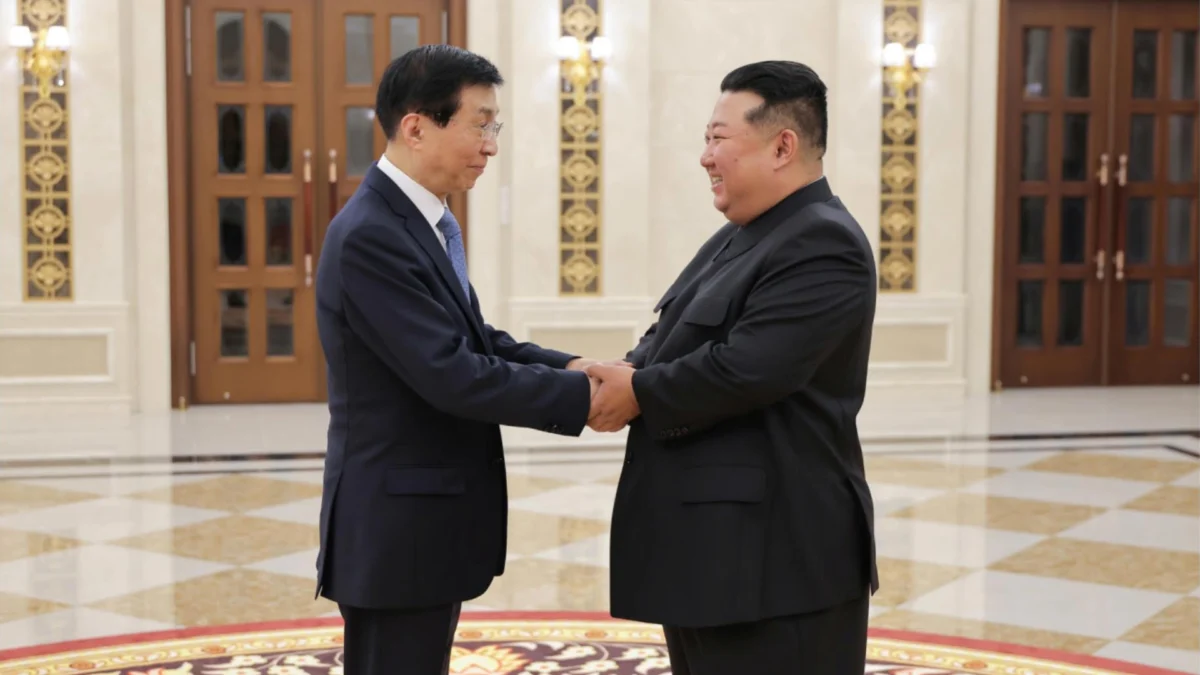
Introduction: A High-Level Diplomatic Milestone
In a significant display of regional solidarity, Wang Huning—the preeminent political strategist and a central pillar of the Chinese Communist Party’s (CCP) ideological apparatus—met with North Korean leader Kim Jong Un in Pyongyang on July 16, 2026. The high-profile encounter served as the centerpiece for the 65th-anniversary commemorations of the China-DPRK Treaty of Friendship, Cooperation and Mutual Assistance, a cornerstone document of bilateral relations originally inked in 1961.
The visit, which saw Wang lead a substantial delegation into the North Korean capital, signals a concerted effort by both Beijing and Pyongyang to fortify their partnership amidst an increasingly volatile geopolitical landscape in Northeast Asia. As the United States and its allies continue to bolster their military posturing in the Pacific, the reaffirmation of this Cold War-era pact underscores a deepening strategic alignment between the two communist neighbors.
Chronology of the Visit and Diplomatic Engagement
The diplomatic mission unfolded with a series of choreographed events designed to showcase the enduring nature of the "blood-forged" alliance.
- July 15, 2026: Wang Huning and his delegation arrived in Pyongyang via a specially chartered aircraft. The arrival was greeted with high-level protocol, reflecting the importance Beijing places on maintaining personal ties with the North Korean leadership.
- July 16, 2026: The core diplomatic summit took place. Wang Huning delivered a personal message from President Xi Jinping to Kim Jong Un, facilitating a closed-door discussion that centered on the historical legacy of the 1961 treaty.
- July 17, 2026: The Rodong Sinmun, the official newspaper of the Workers’ Party of Korea, provided extensive coverage of the meeting, emphasizing the "invincible friendship" between the two nations and the mutual commitment to navigating global pressures.
Throughout the visit, the focus remained on the ideological continuity of the relationship. Wang, known for his role as the architect of "Xi Jinping Thought," engaged in high-level consultations regarding the management of regional stability and the preservation of socialist governance in the face of what both nations describe as "external hegemonic interference."
The 1961 Treaty: A Foundation for Modern Geopolitics
The China-DPRK Treaty of Friendship, Cooperation and Mutual Assistance remains one of the most potent, yet enigmatic, security documents in Asia. Signed on July 11, 1961, by Kim Il Sung and Zhou Enlai, the treaty includes a provision that obligates both parties to provide immediate military and other assistance if the other is attacked by an outside power.
For decades, the treaty has been periodically renewed, and its 65th anniversary carries specific weight. In the current context, the treaty serves as a deterrent mechanism. By dispatching a figure of Wang Huning’s stature—who sits on the Politburo Standing Committee—Beijing is sending a clear message to Washington, Seoul, and Tokyo that China remains the ultimate guarantor of the DPRK’s survival.
The Role of Wang Huning
Wang Huning’s presence in Pyongyang is not merely ceremonial. As the CCP’s leading ideologue, Wang is tasked with ensuring that the narrative of "socialist solidarity" remains dominant. His visit suggests that the Sino-DPRK relationship is moving beyond mere state-to-state logistics into a deeper ideological partnership. This integration is vital for both regimes, as they seek to cultivate a domestic narrative that portrays the international sanctions regime as an unjust attempt to stifle their sovereign development.
Supporting Data: Economic and Strategic Interdependence
While the official discourse focuses on friendship, the underlying reality is one of profound strategic interdependence.
- Security Integration: The 2026 summit occurred against a backdrop of intensified joint naval exercises by the U.S., South Korea, and Japan. The North Korean leadership has frequently characterized these exercises as a precursor to invasion. China, by renewing its commitment to the 1961 treaty, effectively provides a "strategic umbrella" that complicates any potential kinetic action against Pyongyang.
- Trade Resilience: Despite international sanctions aimed at North Korea’s nuclear program, trade between China and the DPRK has shown significant resilience. Recent data indicates that Chinese exports of essential goods—including fuel, grain, and fertilizers—have increased in the lead-up to this anniversary, effectively mitigating the impact of external pressure.
- Diplomatic Coordination: The frequency of high-level exchanges between the two countries has reached its highest point since the mid-2010s. This includes not only political summits but also lower-level exchanges between the CCP’s International Liaison Department and the Workers’ Party of Korea’s International Department.
Official Responses and Rhetoric
The Rodong Sinmun reported that Kim Jong Un expressed profound gratitude for the delegation, characterizing it as a testament to the "eternal vitality" of the bilateral relationship. Kim emphasized that the DPRK and China are "in the same trench" against the forces of imperialism.

Conversely, the Chinese Foreign Ministry maintained a characteristically measured tone. When asked about the visit, a spokesperson stated: "China and the DPRK are friendly neighbors linked by mountains and rivers. Our cooperation is based on the principles of mutual respect, equality, and common development, contributing to the peace and stability of the entire region."
Notably, the silence from the U.S. State Department during the immediate 48-hour window following the meeting signaled a cautious approach, likely aimed at avoiding the escalation of tensions that usually follows high-profile Sino-North Korean summits. However, independent security analysts in Washington have raised concerns that the visit effectively serves as a green light for North Korea to continue its provocative ballistic missile testing schedule for the remainder of the year.
Implications for Regional Security
The meeting between Wang and Kim carries several far-reaching implications for the global order:
1. The "New Cold War" Narrative
The deepening of the Beijing-Pyongyang axis suggests that the world is moving toward a more rigid bipolarity. By aligning more closely with the DPRK, China is signaling that it no longer feels compelled to prioritize relations with the West over its regional security interests. This shift could lead to a further breakdown in communication channels regarding the denuclearization of the Korean Peninsula.
2. The Deterioration of the Six-Party Framework
The 65th-anniversary celebrations effectively bury the prospects of reviving the Six-Party Talks. With Beijing openly doubling down on its support for the DPRK’s security, the incentive for Pyongyang to engage in meaningful denuclearization talks with the U.S. has effectively vanished. The current reality is one of "managed tension," where Beijing uses Pyongyang as a strategic lever against American influence in the Indo-Pacific.
3. Impact on South Korea
For Seoul, the strengthening of the China-DPRK alliance represents a severe security challenge. South Korean policymakers are now faced with the daunting prospect of a dual threat: an emboldened nuclear-armed North Korea and a China that is increasingly willing to provide diplomatic and economic cover for the North’s actions. This will likely push the ROK (Republic of Korea) to seek even closer military integration with the United States and potentially reconsider its own nuclear options.
Conclusion: A Turning Point for Northeast Asia
The visit of Wang Huning to Pyongyang marks more than just a celebratory anniversary; it is a tactical repositioning of the Asian geopolitical chessboard. By invoking the spirit of the 1961 treaty, Beijing and Pyongyang have declared their intent to withstand the pressures of the international community through collective resilience.
As the region looks toward the latter half of 2026, the question is not whether the alliance will hold, but how the international community will respond to a unified Sino-North Korean front. With the ideological architecture of the CCP and the strategic military capabilities of the DPRK now more closely linked than at any point in the last decade, the potential for rapid change in the status quo remains high.
The events of July 2026 serve as a stark reminder that in the volatile arena of Northeast Asian security, history is not just being remembered—it is being actively leveraged to shape the future of global power dynamics.
 Ammar Sabilarrohman
  Pevita Pearce
  Nana Wu
