 By Asro
Taiwan, an island nation of over 23 million people, boasts a rich tapestry of cultural identities, with the Hakka community representing a significant and vibrant thread within this diverse fabric. While the majority of Taiwan’s population identifies ethnically as Han Chinese, a substantial 20% of its citizens proudly claim Hakka cultural roots or possess Hakka ancestry. Recognizing the profound importance of preserving and celebrating this heritage, the Hakka Fashion Awards have emerged as a pivotal platform, bringing the distinct traditions, stories, and aesthetics of the Hakka people into the global spotlight. The second edition of this groundbreaking competition, culminating in an award ceremony this past July, underscored a unique mandate: to transform the rich narratives of Hakka literature into tangible, wearable art. Designers drew inspiration from the poignant works featured in the Hakka Young Writers’ Literature Award, guided by the evocative theme, "Inheritance Through Clothing, Weaving the Future" (衣緒傳承、織繪未來). This theme encapsulates the dual mission of the awards – to honor the legacy of the past while actively shaping the future of Hakka cultural expression.
The culmination of this creative endeavor was showcased at the Hakka Cultural Center in Taipei, where the winning designs graced an exhibition during Taipei Fashion Week in mid-October. These eleven meticulously crafted pieces serve as a powerful testament to the transformative potential of fashion, translating deep-seated cultural narratives into what can be described as "wearable Hakka literature." Each garment is a dialogue between the land, the ancestral memories woven into the very fabric of Hakka life, and the innovative vision of contemporary designers.
A Celebration of Hakka Literary Inspiration in Fashion
The Hakka Fashion Awards have quickly established themselves as a significant event in Taiwan’s cultural calendar, bridging the gap between literary arts and the dynamic world of fashion. The competition’s inception stems from a desire to provide a novel avenue for the promotion of Hakka literature and culture. By engaging emerging and established designers, the awards aim to ensure that the stories and philosophies embedded in Hakka writings resonate with a wider audience through the universal language of design. This year’s theme, "Inheritance Through Clothing, Weaving the Future," particularly emphasized the intergenerational transmission of knowledge, values, and artistic traditions, with clothing serving as a potent medium for this continuity.
The competition drew submissions from across Taiwan, with a rigorous selection process that highlighted creativity, technical skill, and a profound understanding of the thematic brief. The jury, comprised of esteemed figures from the fashion, literary, and cultural sectors, faced the challenging task of identifying works that not only demonstrated aesthetic excellence but also effectively conveyed the spirit and essence of the chosen literary pieces. The exhibition at the Hakka Cultural Center, a hub for Hakka cultural activities, provided an ideal backdrop for these creations, allowing visitors to immerse themselves in the stories and inspirations behind each design.
Gold, Silver, and Bronze: Award-Winning Interpretations of Hakka Narratives
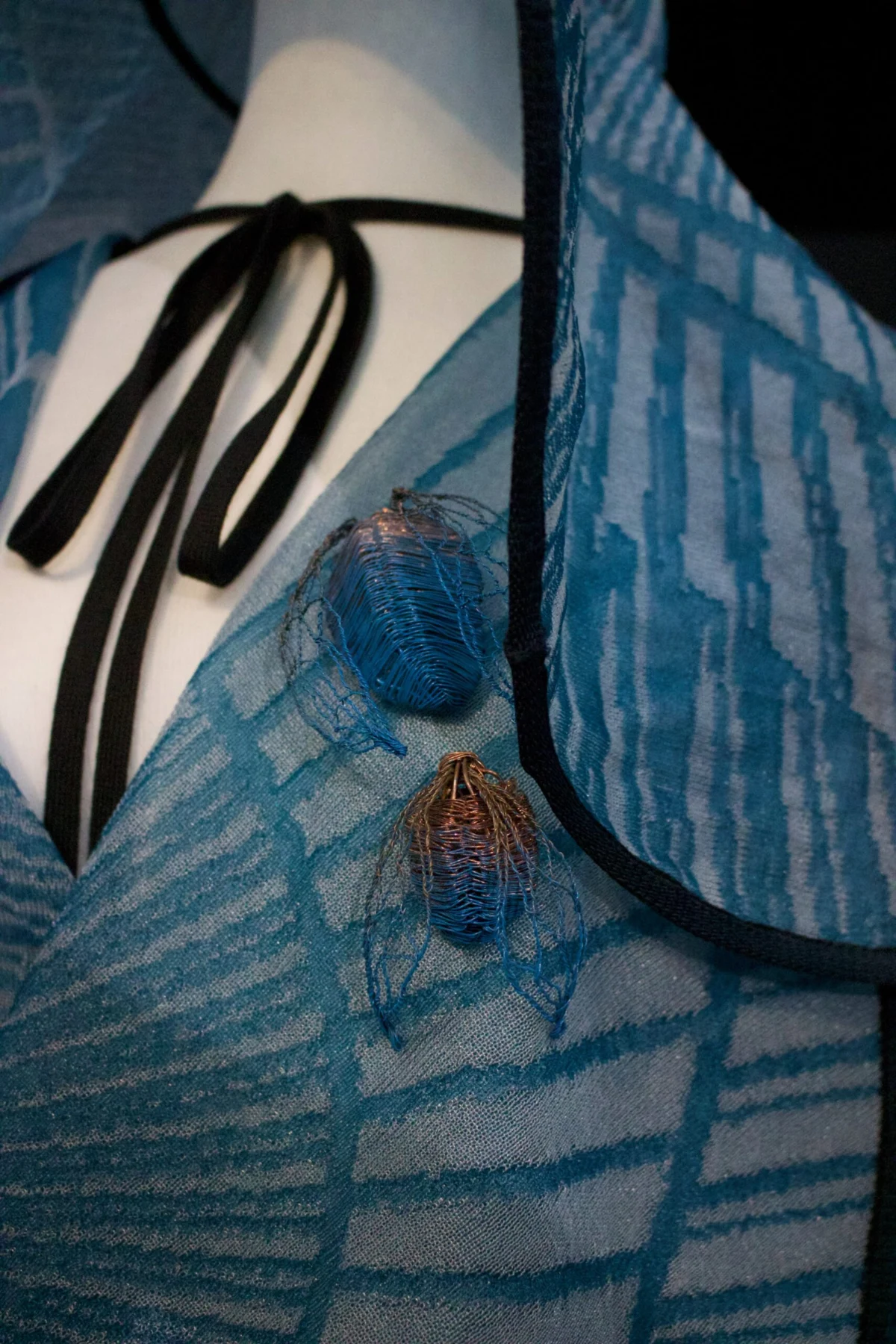
The coveted Gold Award was bestowed upon designer Kao Yuan-lung for his striking creation, "Cicada’s Guest Inn." This masterpiece draws its essence from Hsu Sheng-yun’s evocative essay, "Cicada." Kao Yuan-lung masterfully translated the life cycle of the cicada – from its subterranean origins through decay, emergence, and its final, resonant song – into a garment of profound textural and structural depth. The use of semi-transparent Jacquard knit fabric lends a unique softness to the design, while thicker threads spiraling across the main body of the ensemble subtly echo the insect’s natural forms and life stages. The garment is not merely an aesthetic object but a narrative woven in thread, inviting contemplation on themes of transformation, renewal, and the ephemeral nature of life. This piece exemplifies how a literary metaphor can be rendered tangible through innovative textile manipulation and thoughtful design.
Taking home the Silver Award was designer Fusion Hung for "Light Under the Stove." Hung’s work delves into the complex duality of the domestic sphere, exploring the intertwined notions of security and labor often associated with the kitchen. The design features a deliberate interplay of tan dye against a backdrop of deep indigo, a color palette deeply rooted in Hakka craftsmanship. This juxtaposition is not merely visual; it serves as a powerful metaphor, interrupting the visual field to create highlights that evoke the flickering glow of fire and the indelible marks of heat and time. The modular fastening and strap designs contribute to the garment’s inherent practicality, suggesting a functionality that mirrors the purposeful nature of kitchen work. The infusion of traditional Hakka embroidery and indigo dyeing techniques further anchors the piece to its cultural heritage, demonstrating a deep respect for ancestral practices while reinterpreting them for a contemporary audience.
The Bronze Award was presented to Chang Ya-che for "Burning Characters Into Flowers." This intricate design is a symphony of bold colors and delicate textures, incorporating fire-red Ugandan yarn, translucent layers, and lace stitched onto the outermost fabric. The gauze layers are artfully arranged to resemble flower petals, creating a delicate, layered floral structure. However, a closer examination reveals a poignant subtext: paper-like curls inscribed with text are interspersed among the petals. This subtle yet powerful detail is widely interpreted as a poignant reference to Taiwan’s White Terror period, a nearly four-decade era of authoritarian rule during which languages other than Mandarin Chinese, including Hakka, were suppressed. Despite this historical context of suppression, "Burning Characters Into Flowers" stands as a quiet testament to resilience. Like a softly blooming flower made of seemingly fragile components, the garment, and by extension Hakka culture itself, demonstrates an enduring strength and capacity to flourish even in the face of adversity.
Land, Memory, and the Embodied Hakka Experience
Beyond the top three awards, the Hakka Fashion Awards celebrated a range of designs that further illuminated the profound connection between Hakka identity, the land, and intergenerational memory.
Yeh Chia-ching’s "Grandma," recipient of the Popularity Award, beautifully weaves together personal memories and a deep reverence for nature. This zero-waste creation embodies a philosophy of mindful design, with a gauzy dress that can be folded and extended as needed, minimizing material waste. The color palette of white, pastel yellows, and greens evokes a sense of softness and tranquility, a feeling that extends beyond the fabric’s texture to the emotional resonance of the piece. The design reflects a deep connection to ancestral wisdom and the gentle rhythms of life, likely inspired by the designer’s grandmother.
The Rookie Award winner, Liu Ya-ting, presented "The Footwear of Farming and Weaving." This ensemble pays homage to the Hakka people’s historical connection to the land and their traditional crafts. The overcoat subtly references the intricate patterns of bamboo weaving, a skill central to Hakka life. The layer beneath, dyed in indigo, further signifies the importance of this traditional dye in Hakka culture. The addition of silver flowers embroidered onto the woven overcoat adds a touch of delicate beauty, symbolizing the coexistence of fragility and strength inherent in Hakka resilience.
Wang Cheng-han, another recipient of a Rookie Award, captivated with "Terraced Field Texture." This design literally melds the land with the body, taking inspiration from the iconic terraced fields of his hometown, Xinpu, a Hakka village in Hsinchu County. These meticulously constructed agricultural landscapes, a testament to the perseverance of early Hakka migrants who arrived from China’s Fujian and Guangdong provinces during the Ming and Qing dynasties, represent a profound transformation of challenging terrain into productive land. Wang Cheng-han’s piece mirrors this step-by-step construction through textured appliqués, with fabric layers stacked upon each other to create a visual and tactile representation of the terraced fields. Draped in various shades of gauzy green fabric, the silhouette of the garment evokes this tiered effect, while a woven fishnet-like bag completes the ensemble. As described by the exhibition notes, Wang Cheng-han’s creation transforms clothing into a "landscape worn on the body," a powerful metaphor for the deep and enduring connection between the Hakka people and their ancestral homeland.
Patching Together History and Resilience
The theme of historical continuity and resilience was a recurring motif throughout the awards, with designers employing innovative techniques to convey these complex narratives.
Li Chia-chuan’s "Rest," a recipient of a Popularity Award, offers a compelling juxtaposition of modern casual wear and intricate traditional elements. The design features a denim hoodie paired with a vibrantly textured gown. Triangular, double-layered pockets on the gown, along with its pleated oil paper construction, create a unique tactile experience that contrasts sharply with the softness of the denim jacket. The overall impression is one of bold yet serene confidence, a look that immediately commands attention while subtly hinting at layers of cultural depth.
Chung Shang-ye and Hsiao Yun-chen, winners of a Rising Star Award, collaborated on "One Persimmon, One Shape." This bubble patchwork piece is a profound exploration of the resilience of Hakka women. The garment’s silhouette, characterized by curved shapes and stuffed circular sections at the hips, along with its multi-colored fringe, draws inspiration from the physical toll that hard labor often exacted on women’s bodies. The exhibition description eloquently states that the look "reconstructs the deformed bones of their ancestors’ labor." Furthermore, the designers integrated persimmon dyeing, a traditional Hakka craft, into their creation process. This fusion of historical acknowledgment and contemporary design allows them to stitch memory into the present, offering a tangible way to "wear Hakka history."
Another Rising Star Award recipient, Ou Xiu-wei, presented "Blue Field," a design that also masterfully stitches together fragmented histories. Recycled denim forms the inner layer of the long coat, while reconstructed denim constitutes the outer layer. The patched denim creates a collage-like texture, a visual representation of piecing together a fractured past. The addition of black beads of varying sizes provides both visual and textural contrast, strategically placed near the hem, cuffs, and lapel edges. The ensemble is crowned with a Hakka liangmao, a traditional bamboo hat worn by Hakka laborers. Cascading floral lace around the head, coupled with the reappearance of the black beads, threads together Hakka craftsmanship and the enduring spirit of the people.
The Enduring Craftsmanship of Hakka Culture
The emphasis on traditional Hakka craftsmanship was a cornerstone of many of the award-winning designs, showcasing the enduring relevance of age-old techniques in contemporary fashion.
Lin Yi-chen’s "Return to Cocoon," a Rookie Award winner, places significant importance on Hakka cultural craftsmanship, particularly through its engagement with indigo dyeing traditions and natural gardenia dyeing. Lin Yi-chen embraced a zero-waste approach, meticulously folding, looping, and stitching the material without any cutting or discarding. The dress is a harmonious blend of ramie fabric and Tencel yarn, resulting in a garment that highlights the distinct, slightly rough texture of natural fibers while maintaining a beautifully soft drape. This approach not only honors traditional dyeing methods but also reflects a contemporary commitment to sustainability.
Kuo Wei, designer behind the brand INF and winner of the Special Jury Award, presented "Metamorphosis," a stacked indigo ensemble. This piece embodies Kuo Wei’s signature concept of "transformation," utilizing modern fashion techniques to reimagine traditional Hakka elements. The silhouette is inspired by the classic Hakka blue shirt, but it is reshaped and innovated. In a remarkable display of creative repurposing, Kuo Wei transformed a bag into a coat, a tribute to the significance of indigo dye in Hakka culture. Further staying true to the "metamorphosis" theme, the designer deconstructed a traditional Hakka straw hat and fused it with a gentleman’s cap, creating a new form that seamlessly weaves together the traditional and the modern.
The 2026 Hakka Fashion Awards exhibition, a testament to the enduring legacy and innovative future of Hakka culture, is on view until November 25th. The awards continue to serve as a vital platform for designers to explore and express the multifaceted richness of Hakka heritage, ensuring its continued relevance and vibrant presence in the global cultural landscape. The success of this initiative not only celebrates individual designers but also fosters a deeper appreciation for the intricate narratives, resilient spirit, and enduring craftsmanship that define the Hakka people.
For those interested in delving further into Taiwan’s vibrant fashion scene, EnVi’s analysis of Taiwanese fashion label WEITZUYUAN’s SS27 collection at Taipei Fashion Week offers additional insight into the nation’s burgeoning design talent. The Hakka Fashion Awards, through their commitment to literary inspiration and artisanal excellence, are undoubtedly weaving a compelling new chapter in the ongoing story of Hakka cultural preservation and innovation.

