
 By Azzam Bilal Chamdy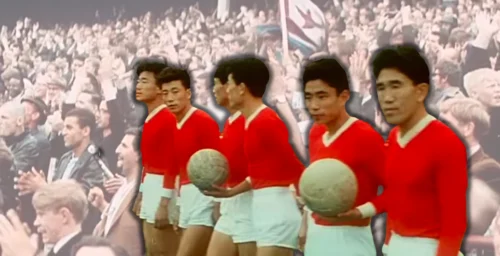
This is the second installment of a two-part series exploring the DPRK’s historic 1966 World Cup campaign. Part one, detailing the political hurdles and qualification process, can be found here.
In the sweltering, industrial summer of 1966, an unlikely cultural collision occurred in the north-east of England. As the world’s eyes turned toward the FIFA World Cup, a group of players from the Democratic People’s Republic of Korea (DPRK)—a nation then almost entirely opaque to the Western public—arrived in the working-class town of Middlesbrough. What began as a logistical arrangement for hosting group-stage matches blossomed into one of the most enduring, poignant, and unexpected sporting romances in football history.
Main Facts: A David vs. Goliath Narrative
The 1966 World Cup was a tournament defined by established powerhouses, yet the DPRK squad arrived in Ayresome Park, Middlesbrough, as virtual unknowns. They were the first Asian team to reach the final tournament in the modern era, representing a closed state that most British locals had never encountered.
The core of the story lies in the psychological transformation of the Middlesbrough public. Initially, the local populace viewed the Korean delegation with skepticism. The geopolitical climate of the mid-1960s, underscored by the ongoing Cold War, ensured that the arrival of the North Korean team was met with caution. However, the narrative shifted rapidly. The team’s disciplined work ethic, their modest demeanor, and their electrifying, high-speed style of play resonated deeply with the inhabitants of a town forged by steel, shipbuilding, and coal mining.
By the time the team walked onto the pitch to face the titans of Italian football, they were no longer playing as visitors; they were playing as adopted sons of the North East.
Chronology: The Road to Ayresome Park
1. The Arrival (July 1966)
When the North Korean team touched down in Middlesbrough, they were greeted by a town that was, at best, indifferent. The squad was housed in modest accommodation, and their presence was initially viewed as a curiosity of international bureaucracy. However, the players’ commitment to rigorous training sessions at Ayresome Park began to earn the respect of the local dockworkers and steelworkers who stopped by to watch.
2. The Group Stages
The DPRK’s opening performance against the Soviet Union—a 3-0 defeat—did little to ignite public passion. Yet, the resilience they showed in a subsequent draw against Chile suggested that the team possessed a fighting spirit that mirrored the industrial grit of the local population.
3. The Miracle of Middlesbrough (July 19, 1966)
The defining moment occurred on a Tuesday afternoon. Italy, a two-time World Cup winner, needed only a draw to qualify for the quarter-finals. The world expected a landslide. Instead, the DPRK team, led by Pak Doo-ik, executed a tactical masterclass. In the 42nd minute, Pak struck the ball past the Italian goalkeeper, securing a 1-0 victory that sent shockwaves through the sporting world.
4. The Departure and Legacy
Following their exit in the quarter-finals against Portugal, the team departed Middlesbrough. But they left behind a permanent imprint. For sixty years, the bond between the town and the players has been sustained through documentary projects, cultural exchanges, and a shared pride in the "Miracle of 1966."

Supporting Data: Statistical Resilience
The 1966 performance by the DPRK was statistically significant for several reasons:
- Defensive Prowess: Despite their relative lack of international experience, the team conceded only one goal in their first two matches (the loss to the USSR).
- Tactical Versatility: Their victory over Italy remains one of the greatest upsets in FIFA history, often cited alongside the United States’ win over England in 1950 or Cameroon’s victory over Argentina in 1990.
- Spectator Impact: Attendance records at Ayresome Park during the DPRK’s matches showed a marked increase in local support as the team progressed, shifting from a few hundred curious onlookers to thousands of vocal, pro-DPRK supporters by the final group game.
Official Responses and Geopolitical Context
At the time, the British government faced immense pressure from the international community regarding the DPRK’s participation. Because the United Kingdom did not formally recognize the DPRK, the team’s entry into the country was a bureaucratic nightmare.
FIFA and the British organizing committee were forced to navigate a diplomatic tightrope. When the DPRK national anthem was omitted during the opening ceremonies, the team protested, and the British government eventually relented, ensuring that the team was treated with the same diplomatic protocols as any other sovereign nation. This "sports diplomacy" functioned as a rare window of communication between the DPRK and the Western world during the height of the Cold War.
Implications: A Lasting Cultural Bridge
The legacy of the 1966 squad is not merely one of athletic achievement; it is a case study in the power of sport to transcend political isolation.
The Human Element
The "Middlesbrough connection" serves as a reminder that empathy is often found in shared struggle. The workers of Middlesbrough, facing their own economic uncertainties, saw themselves in the North Korean players. They recognized the same commitment to a collective goal, the same refusal to submit to more powerful adversaries, and the same quiet dignity in the face of international marginalization.
The Modern Reflection
Today, as the world navigates a complex geopolitical landscape, the story of the 1966 North Korean team remains relevant. It highlights the potential for "people-to-people" diplomacy. While formal diplomatic relations between Pyongyang and London remain strained, the memory of the 1966 squad serves as a bridge, proving that shared human experiences—like the tension of a football match—can persist long after the political headlines of the day have faded.
Conclusion
The narrative of North Korea in Middlesbrough is a testament to the unpredictable nature of global events. It reminds us that history is not solely written by the powerful, but often by the underdogs who capture the imagination of the public. Sixty years later, the red jerseys of the 1966 DPRK team still hold a place of honor in the lore of Middlesbrough, a town that chose to cheer for the outsider, and in doing so, became part of the story itself.
© Korea Risk Group. All rights reserved. No part of this content may be reproduced, distributed, or used for commercial purposes without prior written permission from Korea Risk Group.


 Ammar Sabilarrohman
  Pevita Pearce
  Nana Wu
