
 By Iffa Jayyana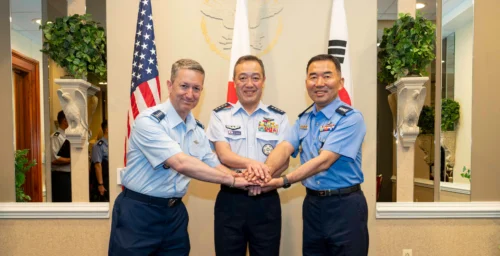
WASHINGTON — In a robust display of strategic alignment, the top military commanders of the United States, South Korea, and Japan convened at the Pentagon this Wednesday for the 23rd annual Trilateral Chiefs of Defense (CHOD) meeting. Amidst a backdrop of escalating provocations from Pyongyang and shifting geopolitical dynamics in the Indo-Pacific, the three nations reaffirmed their unwavering commitment to the complete denuclearization of the Korean Peninsula and pledged to institutionalize their defense cooperation through upcoming high-stakes military exercises.
The meeting, hosted by U.S. Joint Chiefs of Staff Chairman Gen. Dan Caine, brought together his counterparts—ROK Joint Chiefs of Staff Chairman Gen. Jin Yong-sung and Japanese Chief of Staff Gen. Hiroaki Uchikura. Together, they sought to harmonize their military postures to address the multifaceted security challenges posed by North Korea’s nuclear ambitions and the broader regional instability.
I. Main Facts: A Strategic Pivot
The primary focus of the 23rd CHOD meeting was the solidification of the trilateral security framework, which has seen rapid evolution since the landmark Camp David summit. The commanders underscored that the security of their respective nations is inextricably linked, particularly in the face of North Korea’s advancing intercontinental ballistic missile (ICBM) capabilities and tactical nuclear weapon development.
Key takeaways from the high-level summit included:
- Commitment to Denuclearization: The three chiefs reiterated that the complete, verifiable, and irreversible denuclearization of North Korea remains the ultimate goal for regional stability.
- Operational Readiness: The leaders committed to sustained cooperation in the upcoming "Freedom Edge" exercise, a multi-domain drill designed to enhance interoperability between the three militaries.
- Information Sharing: The commanders discussed further integrating their real-time missile warning data-sharing systems to provide a more accurate and rapid response to North Korean missile launches.
- Strategic Deterrence: The discussion emphasized the necessity of a "credible and visible" extended deterrence, with the U.S. reaffirming its commitment to utilizing the full range of its military capabilities—including nuclear, conventional, and missile defense assets—to protect both South Korea and Japan.
II. Chronology: The Evolution of Trilateral Defense
The path to this week’s meeting at the Pentagon is the result of years of diplomatic and military bridge-building. Understanding the current trilateral cooperation requires a look at the milestones that have brought these three nations together.
- 2022 (The Turning Point): Following years of strained relations between Seoul and Tokyo, the election of President Yoon Suk-yeol in South Korea signaled a shift toward rapprochement. High-level talks began to move from bilateral concerns to a shared vision of regional security.
- August 2023 (Camp David Summit): U.S. President Joe Biden, South Korean President Yoon Suk-yeol, and Japanese Prime Minister Fumio Kishida met at Camp David. This summit was a watershed moment, resulting in a formal commitment to hold annual trilateral summits, defense ministerial meetings, and, crucially, military training exercises.
- Mid-2024: The implementation of the real-time missile warning data-sharing system became fully operational, marking the first time the three nations had a direct, high-speed conduit for intelligence regarding North Korean missile trajectories.
- July 2026 (Current Context): The 23rd CHOD meeting represents the culmination of these efforts, moving from "ad-hoc" cooperation to a "systematized" defense partnership. The discussions in Washington reflect a shift from crisis management to long-term strategic planning.
III. Supporting Data: The Regional Security Environment
The urgency of the trilateral cooperation is rooted in the objective reality of the current security environment. Data from the ROK and U.S. intelligence communities highlights a concerning trajectory in North Korean capabilities.
The Nuclear and Missile Calculus
Since the beginning of 2026, North Korea has conducted an unprecedented number of ballistic missile tests, including multiple launches of solid-fuel ICBMs designed to reduce launch preparation times.
- Missile Velocity and Range: Analysts note that Pyongyang’s ability to conduct "no-notice" launches significantly degrades the window of reaction for the U.S.-ROK-Japan alliance.
- Multi-Domain Threats: Beyond nuclear capabilities, the three nations are increasingly concerned about North Korean cyber-espionage and the potential for asymmetric warfare, including the use of unmanned aerial vehicles (UAVs) and sophisticated electronic warfare systems.
The "Freedom Edge" Exercise
"Freedom Edge" has become the centerpiece of trilateral military cooperation. Unlike previous drills, which were often limited in scope or bilateral in nature, Freedom Edge is a multi-domain exercise. It incorporates:
- Maritime Interdiction: Training to prevent the maritime smuggling of prohibited goods into North Korea.
- Anti-Submarine Warfare (ASW): Developing shared protocols for tracking submarines in the Sea of Japan (East Sea).
- Ballistic Missile Defense (BMD): Conducting joint tracking and intercept drills to neutralize incoming threats.
IV. Official Responses and Diplomatic Messaging
The Pentagon meeting was accompanied by carefully crafted statements from the respective ministries of defense.

U.S. Joint Chiefs of Staff: Gen. Dan Caine emphasized that the trilateral partnership is not merely a reaction to North Korea but a proactive measure for a "Free and Open Indo-Pacific." He noted, "Our cooperation is the bedrock of peace in Northeast Asia. By working in unison, we ensure that no actor in the region can miscalculate our resolve."
ROK Joint Chiefs of Staff: Gen. Jin Yong-sung stressed the importance of the trilateral arrangement in compensating for Seoul’s tactical limitations. "Cooperation with the United States and Japan allows us to see further and act faster. It is an essential component of our ‘Peace Through Strength’ strategy," his office stated.
Japanese Joint Staff: Gen. Hiroaki Uchikura underscored the importance of interoperability. "The challenges we face are evolving. Our military cooperation must be agile and resilient. The integration of our command and control structures during exercises is a top priority for the Tokyo government."
Conversely, the response from Pyongyang was, as expected, hostile. North Korean state media outlets characterized the meeting as a "dangerous provocation" and a precursor to an "invasion force." The North Korean Foreign Ministry warned that such "aggressive alliances" would only compel the Democratic People’s Republic of Korea (DPRK) to accelerate its "nuclear war deterrence."
V. Implications: A New Security Architecture
The implications of the 23rd CHOD meeting extend far beyond the immediate concern of North Korean missile tests. The institutionalization of this alliance is reshaping the power balance in the Indo-Pacific.
The Institutionalization of Trilateralism
For years, critics argued that the U.S.-ROK-Japan trilateral relationship was fragile and prone to being derailed by historical disputes. By embedding these meetings into an annual, high-level bureaucratic routine, the three nations are making it politically difficult for any future administration—in Washington, Seoul, or Tokyo—to easily dismantle the security framework. This "bureaucratic lock-in" provides a sense of continuity that is highly valued by military planners.
Deterrence and Escalation Risks
While the goal of the alliance is to deter North Korea, some regional experts warn of the "security dilemma." As the U.S., Japan, and South Korea ramp up their joint exercises, North Korea is likely to respond with even more aggressive testing, potentially leading to an arms race in the region. The challenge for the three chiefs of staff will be to calibrate their military posturing so that it remains defensive and deterrent in nature, without unnecessarily lowering the threshold for conflict.
The Broader Indo-Pacific Context
Finally, the trilateral security cooperation serves as a signal to other regional powers, notably China and Russia. By projecting a unified front, the U.S., Japan, and South Korea are signaling that their security interests are not confined to the Korean Peninsula. As China continues to expand its influence in the South China Sea and Taiwan Strait, the trilateral coordination on maritime security and domain awareness becomes a vital component of the broader U.S. strategy to maintain the status quo in the Indo-Pacific.
Conclusion
The 23rd Trilateral Chiefs of Defense meeting marks a coming-of-age for the U.S.-ROK-Japan security partnership. By moving beyond historic grievances and focusing on the concrete realities of modern warfare, these three nations have signaled that they are prepared to face the uncertainties of the future together. As the "Freedom Edge" exercise approaches, the world will be watching to see how this unified front responds to the next inevitable challenge in one of the world’s most volatile regions. The message from the Pentagon is clear: the era of fragmented security in the Pacific is coming to an end, replaced by a new, integrated, and resolute defense architecture.


 Ammar Sabilarrohman
  Pevita Pearce
  Nana Wu
