
 By Ammar Sabilarrohman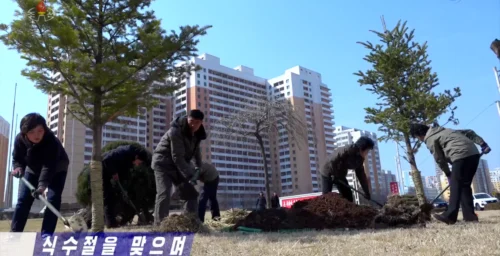
Executive Summary: A New Chapter in Pyongyang’s Environmental Strategy
North Korea has officially entered a new phase of its ambitious nationwide reforestation campaign, pledging to plant more than 1.1 billion trees over the next decade. The announcement, delivered by a Pyongyang delegation at the U.N. Convention to Combat Desertification (UNCCD) Conference of the Parties (COP17) in Ulaanbaatar, Mongolia, signals a continued commitment to rehabilitating the country’s heavily degraded landscape.
This second phase of the "Forest Restoration Project" arrives after a decade of intensive state-led efforts that officials claim have already resulted in the planting of over 5.7 billion trees since 2015. While Pyongyang frames this as a vital environmental necessity to combat soil erosion and mitigate the impact of climate change, the project also serves a critical political function, framing ecological stewardship as a "patriotic endeavor" under the leadership of Kim Jong Un.
Chronology of a Landscape in Flux
To understand the scale of the current 10-year pledge, one must examine the trajectory of North Korea’s relationship with its forests over the last several decades.
The Era of Deforestation (1990s–2010s)
Following the collapse of the Soviet Union and the subsequent economic crisis in the 1990s—often referred to as the "Arduous March"—North Korea experienced severe energy shortages. With coal and oil supplies dwindling, the rural population turned to forests as a primary source of fuel for heating and cooking. Furthermore, the push for agricultural self-sufficiency led to the conversion of steep hillsides into terraced farmland. These dual pressures triggered massive deforestation, leaving the country vulnerable to landslides, catastrophic flooding, and soil degradation.
The First Reforestation Phase (2015–2025)
In 2015, Kim Jong Un declared a "war on deforestation." This marked a turning point in state policy, as the government moved to centralize the management of forest resources. The state established centralized nurseries and mandated that local schools, military units, and collective farms participate in seasonal tree-planting campaigns. By 2026, the DPRK reported a staggering 5.7 billion seedlings planted, a figure that, if accurate, would represent one of the most aggressive reforestation projects in modern history.
The Current Mandate (2026–2036)
The announcement at the Ulaanbaatar summit confirms the launch of a second decade-long phase. This iteration seeks to move beyond mere volume, focusing on forest health, pest control, and fire prevention—areas where the first phase was often criticized for focusing on quantity over long-term survivability.
Supporting Data: By the Numbers
The scale of North Korea’s reforestation ambitions is immense, yet verifying these metrics remains a significant challenge for international observers.
- 1.1 Billion Trees: The target for the 2026–2036 period.
- 5.7 Billion Trees: The reported total planted between 2015 and 2025.
- 10 Years: The duration of the new phase.
- Integrated Management: The new framework emphasizes the monitoring of forest fires and the biological management of pests, indicating a shift toward "sustainable" forestry management (SFM).
Data provided to the UNCCD by the DPRK delegation underscores a desire to integrate into international environmental frameworks, though analysts note that the survival rate of these 5.7 billion trees remains a point of contention. In regions where saplings are planted in unsuitable soil or without proper long-term care, mortality rates can be high. Consequently, the new focus on "enhancing national forest fire monitoring capabilities" is seen by experts as an acknowledgment of the vulnerabilities identified in the previous decade.
Official Responses and Political Rhetoric
In Pyongyang, reforestation is rarely discussed as a purely scientific or ecological endeavor. Instead, it is deeply intertwined with the ideology of the state.

The "Patriotic Endeavor"
State media outlets, including the Korean Central Television (KCTV), have consistently portrayed tree planting as a moral duty. During the March 2026 planting season, reports highlighted citizens from all walks of life—from students to factory workers—transplanting seedlings as a service to the nation. This "patriotic" framing serves to mobilize labor, effectively turning the workforce into a vast, unpaid ecological restoration team.
Engagement with the UNCCD
The presence of a DPRK delegation at the Ulaanbaatar COP17 is significant. By engaging with the UNCCD, Pyongyang is signaling its intent to align its national policies with global climate objectives. This serves a diplomatic purpose: as North Korea navigates heavy international sanctions, environmental cooperation remains one of the few channels through which it can engage with the international community on a technical and policy level.
Implications: The Risks and Potential Benefits
Ecological Resilience
If successfully implemented, the 1.1 billion tree mandate could significantly reduce the risk of flash flooding, a recurring disaster for North Korea’s agricultural output. By stabilizing the mountainous terrain, the state hopes to protect the "rice bowls" of the country from the destructive sedimentation that occurs when rainfall hits barren slopes.
The Quality vs. Quantity Dilemma
Independent forestry experts have long warned that the "quantity-first" approach of the 2015–2025 period led to the planting of monocultures—forests dominated by a single species—which are less resilient to disease and climate shifts. The new pledge to focus on "pests and diseases" suggests that the government may be shifting toward a more sophisticated, albeit complex, ecological approach. However, whether the DPRK has the financial resources and scientific infrastructure to manage a complex, multi-species forest ecosystem remains unclear.
Economic Constraints
Reforestation requires more than just seeds; it requires fertilizers, modern irrigation, and human capital. Given the chronic economic stagnation and the lack of foreign investment, the state’s reliance on manual labor remains the cornerstone of its policy. While this allows for rapid mobilization, it also limits the application of advanced silviculture techniques that could increase the long-term survival rate of the saplings.
Climate Diplomacy
For the international community, the DPRK’s reforestation program is a litmus test for North Korean engagement. Participation in global climate summits suggests a desire for legitimacy and potential access to climate adaptation funds or technology transfers. However, international organizations remain cautious about the transparency of North Korean data. The burden of proof lies with Pyongyang to demonstrate that these 1.1 billion trees are not merely a statistical projection, but a tangible shift toward long-term ecological stability.
Conclusion: A Long Road to Recovery
The launch of the second phase of North Korea’s Forest Restoration Project is an ambitious undertaking that reflects the country’s ongoing struggle to reconcile its economic needs with its ecological limitations. While the goal of planting over a billion trees is a positive development for the Korean Peninsula’s environment, the success of this mission will depend on the government’s ability to transition from a policy of mass mobilization to one of sustainable, scientific management.
As the 2026–2036 decade progresses, the international community will be watching closely. Whether this initiative proves to be a genuine transformation of the North Korean landscape or another symbolic milestone in state-led propaganda will be determined by the survival of the saplings and the resilience of the forests they are intended to restore. For now, the "patriotic endeavor" continues, as the DPRK attempts to re-green its rugged mountains in the face of an increasingly unpredictable climate.



 Jia Lissa
  Neng Nana
  Evan Lee Salim
