
 By Suro Senen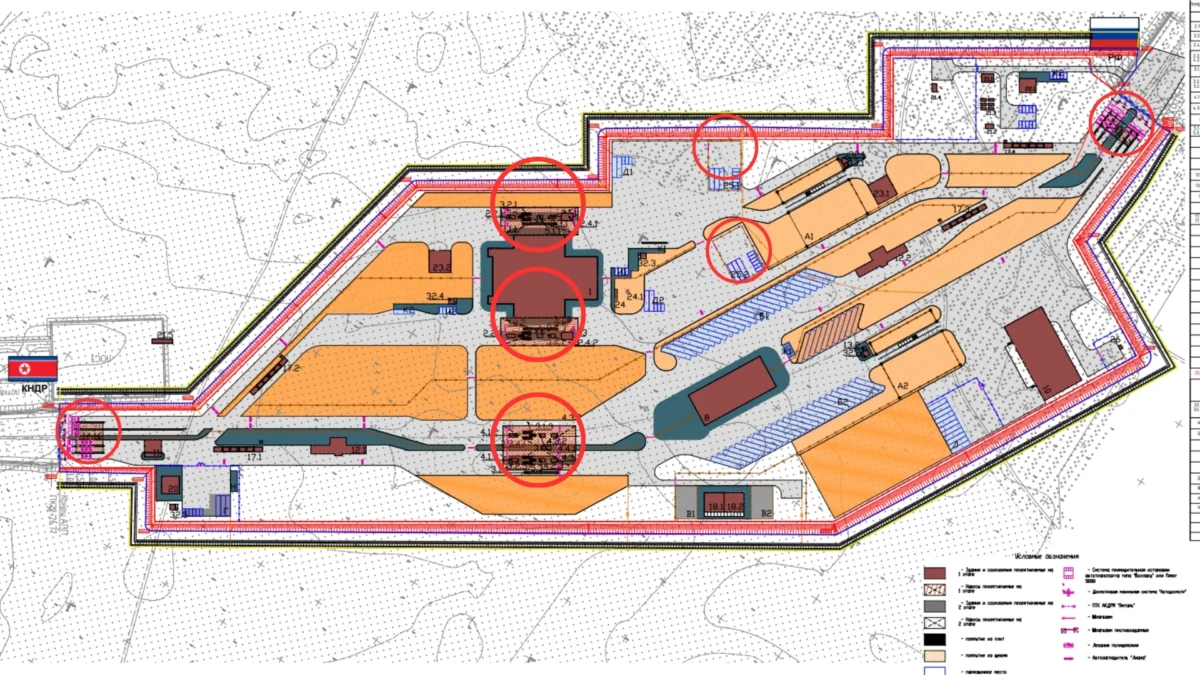
As Russia races toward an early September deadline to open its first dedicated car bridge to North Korea, the project has been marred by a dramatic escalation in costs. New procurement records indicate that the financial requirements for the border checkpoint have ballooned to at least $183 million, nearly double the original $100 million budget allocated by Moscow in early 2025. This latest fiscal expansion, driven by a series of high-cost infrastructure additions, underscores the logistical and financial complexities surrounding the high-stakes land link between the two isolated allies.
The Latest Procurement: A $6 Million Canopy Expansion
On Monday, Rosgranstroy—the Russian state agency tasked with managing the nation’s border infrastructure—published procurement records confirming the addition of seven specialized canopies to the checkpoint site. The contract, valued at approximately $5.8 million, is intended to shield vehicles and personnel from harsh weather conditions, including rain and snow, while simultaneously streamlining the inspection process.
According to project blueprints and satellite imagery analysis, these structures are slated for installation on both sides of the main administrative building, the primary vehicle inspection zone, areas designated for detained vehicles, and both the entry and exit points of the facility. These canopies represent a strategic, if costly, effort to ensure that the checkpoint remains operational year-round, despite the often-challenging climate of the Primorsky Krai region.
The decision to incorporate these structures into the largely completed modular facility highlights the reactive nature of the construction process. While the North Korean side of the bridge was finalized early in the summer, the Russian facility has remained a work in progress, with planners constantly adding supplemental infrastructure to meet stringent security and operational standards.

A Chronology of Escalation: From $100 Million to $183 Million
The trajectory of the border bridge project has been defined by a pattern of consistent budget revisions. When the Kremlin first prioritized the construction of a permanent road connection to North Korea in early 2025, the initial investment was capped at $100 million. However, the complexity of building a cross-border artery in a remote, mountainous region—combined with the urgent geopolitical need to facilitate rapid trade and personnel movement—quickly outpaced these early projections.
Timeline of Key Developments:
- Early 2025: Russia allocates $100 million for the border crossing and bridge project.
- April 2026: Russia and North Korea hold an official ceremony to link their respective sections of the cross-border bridge, marking a significant milestone in bilateral connectivity.
- June 19, 2026: The target date for the official opening, chosen to coincide with the second anniversary of the historic Putin-Kim Jong Un summit, passes without the bridge being operational.
- July 2026: Khasan-based officials indicate that the new target for the opening is early September 2026, potentially aligning with the Eastern Economic Forum in Vladivostok.
- August 2026: Satellite imagery reveals the facility is roughly 65% complete. A major contractor, TonnelYuzhStroi, faces a $1.5 million lawsuit from a materials supplier, adding legal turbulence to the project.
- September 2026: Rosgranstroy announces an additional $5.8 million for canopy construction, pushing total known costs to over $183 million.
Supporting Data: Where the Money Is Going
The $5.8 million expenditure for canopies is far from an isolated incident of "scope creep." A review of recent state procurement records reveals a flurry of secondary contracts, each adding millions to the project’s bottom line. These expenditures paint a picture of a facility that is being retrofitted for high-tech security and long-term autonomy.
Key recent contracts include:
- Security and Inspection: $500,000 for an expert analysis of the facility’s security systems.
- Logistical Support: $1.3 million allocated for the supply and installation of diesel generators and dedicated fuel storage systems.
- Infrastructure and Signage: $2.3 million for the installation of complex information and navigation signage.
- Power Stability: $500,000 for a modular electrical substation to ensure power grid independence.
- Expert Oversight: $600,000 paid to Moscow-based proprietor Pavel Zakipnykh for an "expert examination" of the modular buildings already on-site.
These figures indicate that the Russian government is prioritizing the "hardened" nature of the checkpoint, ensuring it can function independently of regional power infrastructure and maintain high-security standards for the inspection of incoming cargo and traffic.

Official Responses and Strategic Ambiguity
Despite the public availability of procurement data, official statements regarding the bridge have remained characteristically cautious. While local officials in the Khasan district have hinted at a September opening, there has been no formal announcement from the Kremlin regarding a ribbon-cutting ceremony.
The timing is critical: the Eastern Economic Forum (EEF), scheduled for September 1–4 in Vladivostok, serves as a major platform for Russian regional diplomacy. President Vladimir Putin is widely expected to attend the forum. Given the strategic importance of the Russia-DPRK relationship—a partnership that has deepened significantly since the signing of the 2024 mutual defense agreement—many analysts suggest that the bridge’s opening is being held as a symbolic centerpiece for the forum.
However, observers remain skeptical about whether the facility will be fully operational by the time the forum concludes. The persistent need for supplemental contracts, such as the recent canopy order, suggests that the project is still in a phase of final configuration rather than final testing.
Implications: A Bridge to Nowhere or a Vital Conduit?
The implications of the mounting costs and delays go beyond mere financial mismanagement. For Moscow, the bridge is a vital physical manifestation of its "pivot to the East." As Western sanctions tighten, the land bridge to North Korea provides an essential, non-maritime route for the transfer of goods, and potentially military-industrial components, between the two nations.

Geopolitical Consequences
- Supply Chain Resiliency: The focus on diesel generators and fuel storage suggests that the checkpoint is designed to remain operational even if regional power grids are strained or if the facility faces external pressures.
- Economic Integration: The scale of the facility—already costing nearly double its initial budget—indicates an expectation of high-volume traffic. This suggests that both Moscow and Pyongyang are planning for a long-term increase in bilateral trade that goes beyond symbolic gestures.
- Legal and Contractor Risks: The $1.5 million lawsuit against the primary contractor, TonnelYuzhStroi, highlights the fragility of the supply chain. If the project’s primary builders are embroiled in litigation, the speed and quality of the final construction phases could be compromised.
The "Hidden" Costs of Diplomacy
The ballooning budget also serves as a barometer for the political pressure placed on state agencies like Rosgranstroy. When a project is designated as a "national priority" by the Kremlin, the traditional constraints of fiscal discipline are often sidelined. The result is a project that is not only expensive but is also being built at a breakneck pace, increasing the likelihood of further cost overruns as unforeseen technical requirements emerge in the final stages of completion.
As the September deadline approaches, the global community will be watching to see if the bridge finally opens its gates. Whether or not it is completed in time for the Vladivostok forum, the project remains a testament to the lengths to which Moscow is willing to go to secure a land-based lifeline to Pyongyang, regardless of the price tag. The facility, which was once a $100 million proposal, has evolved into an $183 million symbol of an evolving, and increasingly expensive, military-economic alliance.
 Iffa Jayyana
  Lina Hope
  Pevita Pearce
