
 By Nila Kartika Wati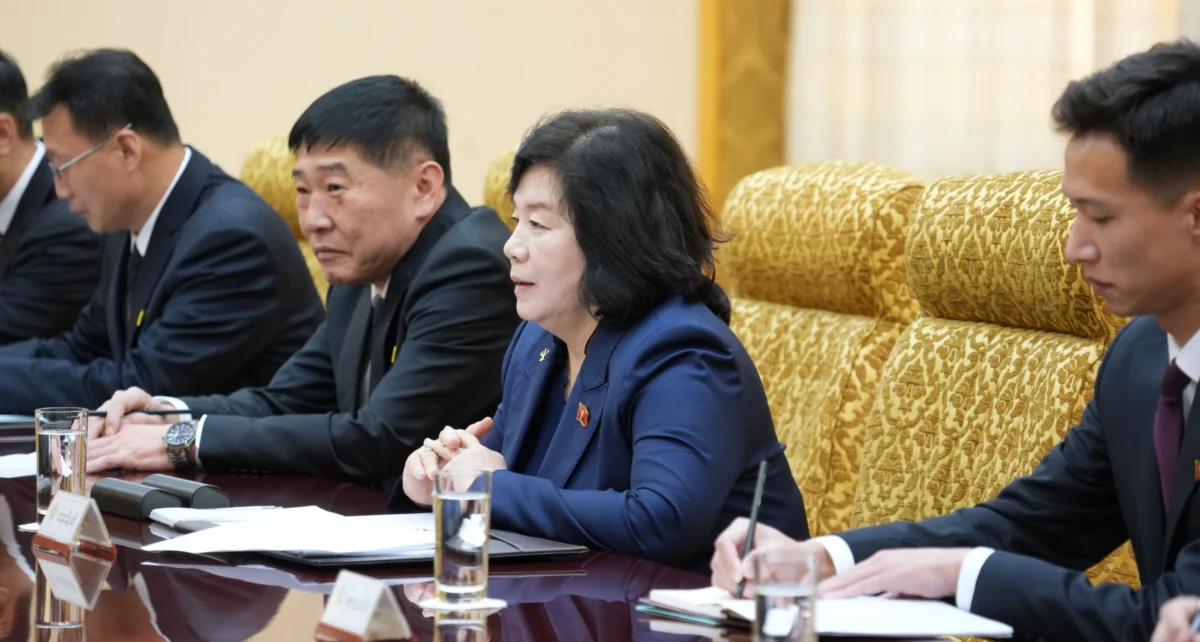
By International Affairs Desk
In a blunt dismissal of diplomatic overtures from the United States, South Korea, and Japan, North Korean Foreign Minister Choe Son Hui declared this week that the Democratic People’s Republic of Korea (DPRK) remains steadfast in its pursuit of nuclear self-reliance. The statement, issued via the state-run Korean Central News Agency (KCNA), serves as a definitive rejection of the trilateral alliance’s recent calls for a return to denuclearization talks.
Choe’s rhetoric signals a hardening of Pyongyang’s stance, framing the international pressure for disarmament not as an opportunity for dialogue, but as a justification for the expansion and modernization of the North’s nuclear arsenal.
Main Facts: A Defiant Stance on "Eternal" Nuclear Sovereignty
The core of Minister Choe Son Hui’s statement is an unequivocal rejection of the denuclearization framework that has underpinned international diplomatic efforts regarding the Korean Peninsula for decades. Choe explicitly stated that the DPRK’s determination to maintain its nuclear capabilities is "unchanged" and will persist "through all ages."
"To deny the reality is to give up the future," Choe remarked, suggesting that the international community’s insistence on a nuclear-free North Korea is a denial of the current geopolitical environment. By positioning the nuclear program as an existential necessity, Pyongyang is signaling to Washington, Seoul, and Tokyo that the era of "denuclearization-for-concessions" bargaining is effectively over.
Analysts note that this is not merely a reactionary statement but a calculated policy shift. By codifying its status as a nuclear state, the DPRK seeks to force the international community to accept North Korea as a legitimate nuclear power, effectively ending the diplomatic goal of total disarmament that has defined U.S. policy since the early 1990s.
Chronology: The Escalating Diplomatic Impasse
To understand the weight of Choe’s recent declaration, one must view it against the backdrop of an increasingly strained security environment in Northeast Asia.
- 1994–2018: The era of intermittent diplomacy, characterized by the Agreed Framework, the Six-Party Talks, and the brief, high-stakes summits between Donald Trump and Kim Jong Un.
- 2022–2023: A period of unprecedented missile testing by the DPRK, including the launch of intercontinental ballistic missiles (ICBMs) capable of reaching the U.S. mainland. During this period, the U.S., ROK, and Japan deepened their trilateral security cooperation, conducting frequent joint naval and aerial drills.
- November 2025 (Early): The U.S. Secretary of State and counterparts from Japan and the Republic of Korea issue a joint statement reiterating their commitment to the "complete denuclearization of the Korean Peninsula" and urging Pyongyang to return to the negotiating table.
- November 13, 2025: Minister Choe Son Hui attends diplomatic meetings in Laos, where she is photographed and subsequently issues her press statement.
- November 14, 2025: The DPRK officially releases the statement via KCNA, explicitly characterizing the joint calls for denuclearization as "unrealistic" and provocative.
Supporting Data: The Expanding Arsenal
North Korea’s confidence, as expressed by Choe, is backed by significant technical advancements in its strategic weapons program. Over the last three years, the DPRK has transitioned from "testing" to "deployment" of advanced delivery systems.
The Nuclear Triad
Pyongyang has made strides in developing a credible nuclear triad:

- Land-based: The Hwasong-18 solid-fuel ICBM, which offers faster launch times and greater mobility, making detection by satellite systems more difficult.
- Sea-based: The development of the Hero Kim Kun Ok, an "underwater tactical nuclear attack submarine," and ongoing efforts to perfect submarine-launched ballistic missiles (SLBMs).
- Tactical Nuclear Weapons: The regime has emphasized the deployment of "tactical" nuclear warheads, designed for battlefield use to deter, or respond to, conventional military incursions from the South.
The Economic Reality
Despite international sanctions, the DPRK’s military-industrial complex has remained resilient. Reports from the UN Panel of Experts have highlighted how Pyongyang utilizes illicit cyber activities—including cryptocurrency theft and sophisticated hacking operations—to fund its research and development programs, effectively bypassing the global financial blockade.
Official Responses: A Growing Trans-Pacific Divide
The international reaction to Choe’s statement has been one of coordinated concern.
- Washington: The U.S. Department of State has reaffirmed that its policy remains focused on the "complete denuclearization of the Korean Peninsula." Officials emphasize that the U.S. remains open to dialogue without preconditions, though they acknowledge that Pyongyang has shown no interest in such an offer.
- Seoul: The South Korean Ministry of Unification expressed "deep regret" over the statement, labeling it a threat to regional peace. President Yoon Suk-yeol’s administration has pivoted toward a "peace through strength" policy, bolstered by an enhanced U.S. nuclear umbrella and expanded joint exercises.
- Tokyo: Japan has echoed these sentiments, highlighting the threat posed by North Korea’s missile testing to the Japanese archipelago. Prime Minister’s office officials have reiterated that Tokyo will continue to work within the trilateral framework to monitor North Korean activities and maintain pressure via sanctions.
Implications: A New Cold War Architecture
The refusal of the DPRK to discuss denuclearization has profound implications for global security and regional stability.
1. The Death of the "Denuclearization" Goal
For decades, the global community—led by the U.S.—has sought a North Korea that returns to the Treaty on the Non-Proliferation of Nuclear Weapons (NPT). Minister Choe’s statement effectively renders this goal obsolete. Policymakers in Washington are now faced with a stark choice: continue to pursue an unreachable objective or pivot to a policy of "arms control" and "deterrence management."
2. The Risk of Miscalculation
As North Korea integrates nuclear weapons into its frontline tactical military doctrine, the "threshold" for nuclear use is lowered. If the DPRK believes that its survival is synonymous with its nuclear arsenal, any conventional military escalation on the peninsula carries an inherent risk of crossing into the nuclear domain.
3. The Alliance Dilemma
For South Korea and Japan, the realization that North Korea will never disarm creates a strategic dilemma. Public sentiment in Seoul has increasingly shifted toward the idea of domestic nuclear armament—a move that would fundamentally destabilize the NPT and potentially trigger a regional arms race involving Japan and Taiwan.
4. The Influence of Great Power Competition
The DRPK’s current posture is undoubtedly emboldened by the deepening alignment between Pyongyang, Moscow, and Beijing. With Russia and China often exercising their veto power at the UN Security Council to block additional sanctions against Pyongyang, the DPRK feels shielded from the consequences of its actions. This creates a "New Cold War" structure, where North Korea serves as a key player in a bloc challenging the U.S.-led international order.
Conclusion
The statement from Foreign Minister Choe Son Hui is a watershed moment in the history of the Korean Peninsula. By moving beyond the traditional diplomatic language of "denuclearization negotiations" and into an era of "permanent nuclear status," the DPRK has reset the terms of engagement.
As the international community grapples with this reality, the focus is shifting from "how to disarm North Korea" to "how to live with a nuclear-armed North Korea." The coming years will likely be defined by a delicate and dangerous game of deterrence, where the margin for error is razor-thin and the consequences of miscalculation are catastrophic. For now, Pyongyang has made its message clear: it is no longer looking for a seat at the negotiating table, but for international acknowledgment of its role as a permanent nuclear power.

 Jia Lissa
  Muslim
  Suro Senen
