
 By Sagoh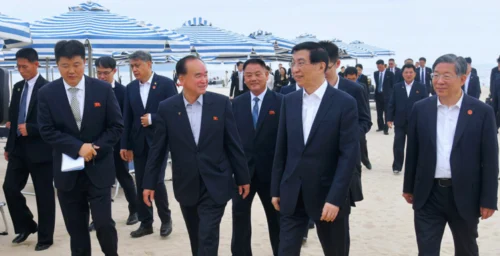
By Global Affairs Correspondent
In a high-profile display of diplomatic solidarity, Wang Huning, the fourth-highest-ranking official in the Chinese Communist Party (CCP) and the chief architect of President Xi Jinping’s political ideology, concluded an "official goodwill visit" to the Democratic People’s Republic of Korea (DPRK) this week. The tour, which culminated in a visit to the sprawling Wonsan-Kalma Coastal Tourist Zone, serves as a significant signal of renewed alignment between Beijing and Pyongyang during the 65th anniversary of their Treaty of Friendship, Cooperation, and Mutual Assistance.
However, the choice of venue—a massive, multibillion-dollar resort that remains largely shuttered to the international community—raises questions about the nature of the partnership and the economic reality of North Korea’s tourism ambitions.
I. Main Facts: The Strategic Significance of the Visit
Wang Huning’s presence in North Korea is not merely ceremonial. As the Chairman of the National Committee of the Chinese People’s Political Consultative Conference (CPPCC) and a permanent member of the Politburo Standing Committee, Wang is the primary guardian of China’s ideological trajectory. His arrival in Pyongyang, accompanied by a high-level delegation, marks the highest-ranking Chinese visit to the country in recent years.
The centerpiece of his itinerary was the Wonsan-Kalma Coastal Tourist Zone. Accompanied by Jo Yong Won, a powerful member of the Presidium of the Political Bureau of the Workers’ Party of Korea (WPK), Wang surveyed the facilities that the DPRK hopes will serve as a engine for foreign currency revenue. Despite the state-controlled media’s portrayal of a bustling, world-class resort, international observers have noted that the site remains effectively inaccessible to the average foreign tourist, serving instead as a restricted luxury enclave for the North Korean elite and a handful of vetted foreign guests.
II. Chronology: A Diplomatic Milestone
The visit unfolded over a multi-day itinerary designed to emphasize the "blood-forged" ties between the two socialist neighbors:
- July 15, 2026: Wang Huning arrives in Pyongyang. He is met with significant fanfare, underscoring the importance of the 65th anniversary of the 1961 mutual defense treaty.
- July 16, 2026: Bilateral talks commence. Wang meets with Kim Jong Un. According to state media, the leaders discussed strengthening strategic coordination, economic cooperation, and joint responses to "hostile external pressures."
- July 17, 2026: The delegation travels to the east coast. Wang and Jo Yong Won tour the Wonsan-Kalma Coastal Tourist Zone. They receive briefings on the operational capacity and the "service culture" of the facility.
- July 18, 2026: The Korean Central News Agency (KCNA) releases imagery of the tour, highlighting the camaraderie between the two nations’ leadership.
- July 19, 2026: Wang Huning returns to Beijing, concluding a mission that signals a tightening of the China-DPRK strategic embrace.
III. Supporting Data: The Wonsan-Kalma Paradox
The Wonsan-Kalma project represents the most ambitious infrastructure endeavor undertaken by Kim Jong Un’s administration. Opened in June 2025, the resort was marketed as the dawn of a new era for North Korean tourism.
Economic Context
Satellite imagery and internal reports suggest that the resort occupies thousands of hectares, featuring high-end hotels, water parks, and international-standard amenities. Yet, the facility operates in a vacuum. Under the current international sanctions regime—specifically UN Security Council resolutions aimed at curbing the DPRK’s nuclear program—the ability of the North to attract international investment and mass tourism remains severely hampered.
The "Ghost" Factor
The facility remains largely empty for most of the year. For Beijing, the visit is a diplomatic gesture meant to suggest that economic "normality" is returning to the North. However, analysts note that the resort serves as a showcase for the regime’s ability to mobilize labor and resources, even if it fails to attract the intended global clientele.

IV. Official Responses and State Media Narrative
The official narrative pushed by KCNA emphasizes "unbreakable friendship" and "shared historical destiny." The coverage of the Wonsan visit was meticulously curated to show Wang Huning in a state of admiration, viewing the North’s development projects as a testament to the success of the socialist system.
In his remarks during the trip, Wang reportedly stressed that China is committed to "deepening practical cooperation" with the DPRK. Notably, Chinese state media remained more reserved than its North Korean counterpart, focusing on the historical gravity of the treaty anniversary rather than the specific economic details of the Wonsan resort. This discrepancy suggests a calculated attempt by Beijing to maintain its diplomatic foothold without explicitly endorsing the economic viability of the North’s high-risk development projects.
V. Implications: What Lies Ahead for the Region?
The visit of China’s top strategist to the North has profound implications for regional security and the future of the Korean Peninsula.
A Renewed Strategic Partnership
Wang’s visit acts as a public reassurance to Pyongyang that it is not isolated. In an era where the United States, Japan, and South Korea have strengthened their trilateral security cooperation, Beijing’s move is a clear counter-balance. By visiting the Wonsan resort, Wang sends a signal that China is willing to provide a degree of diplomatic and economic cover for the DPRK’s survivalist strategies.
The Role of Ideology
As an ideological architect, Wang’s visit suggests that the relationship is moving beyond mere border security. There is an increased emphasis on shared governance models and party-to-party cooperation. This signals that Beijing may be helping Pyongyang refine its internal management and surveillance state, potentially stabilizing the regime against the volatility of international sanctions.
The Future of Tourism and Sanctions
For the international community, the Wonsan resort remains a symbol of North Korea’s dual-track approach: attempting to build an economy that can bypass sanctions while maintaining the regime’s strict control over information and movement. If China begins to encourage its citizens to visit Wonsan in large numbers—effectively using tourism as a form of non-sanctioned economic aid—it will represent a significant breach of the spirit of UN resolutions.
Conclusion: A Delicate Dance
Wang Huning’s visit to the Wonsan-Kalma Coastal Tourist Zone is a masterclass in symbolic diplomacy. By walking the beaches of an empty resort alongside the architect of North Korea’s internal security apparatus, Wang has signaled that China’s support for the DPRK is deeply rooted in ideological affinity and strategic necessity.
As the two nations move past the 65th anniversary of their defense treaty, the international community must grapple with a reinvigorated Pyongyang-Beijing axis. Whether this results in a genuine economic opening of the North or simply a more fortified, isolated, and ideologically aligned partnership remains the central question for the coming decade. For now, the Wonsan resort stands as a silent monument to this complex and increasingly tight-knit relationship, waiting for a future that is currently hindered by the very sanctions the two powers are working to navigate.
Methodology Note
This report is synthesized from official reports provided by the Korean Central News Agency (KCNA) and corroborated by regional geopolitical analysts. While the DPRK maintains strict control over the narrative surrounding the Wonsan-Kalma project, the diplomatic weight of Wang Huning’s presence provides the necessary context to assess the current state of China-DPRK relations.
 Ammar Sabilarrohman
  Pevita Pearce
  Nana Wu
