
 By Ammar Sabilarrohman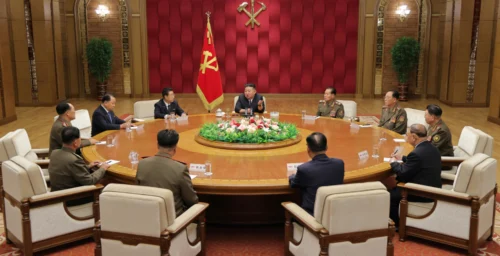
By Intelligence Desk
In a significant realignment of North Korea’s security apparatus, leader Kim Jong Un has orchestrated a sweeping shake-up of the country’s top military brass. The reorganization, confirmed by state media on Sunday, includes the appointment of a new defense minister and the return of a seasoned security heavyweight to the nation’s highest decision-making military body.
The moves, which occurred during the second meeting of the Ninth Central Military Commission (CMC) of the Workers’ Party of Korea (WPK) on Saturday, Aug. 29, 2026, signal a tactical pivot in Pyongyang’s defense posture. Analysts suggest that the reshuffle is not merely an administrative rotation but a deliberate effort to consolidate loyalty and streamline military operations amidst a complex regional geopolitical landscape.
The Core Changes: A New Defense Chief and the Return of a Veteran
The most consequential appointment announced by the Korean Central News Agency (KCNA) is the elevation of Kim Song Gi to the post of Minister of National Defense. Previously serving as the director of the Korean People’s Army (KPA) General Political Bureau, Kim Song Gi brings a background deeply rooted in ideological oversight and political control within the military.
His predecessor, No Kwang Chol—who had held the position since October 2024—was dismissed from his post. According to the KCNA report, No was also "recalled from the Party central," indicating a significant fall from grace.
Complementing this change is the return of Pak Jong Chon to the inner circle. Pak, who has long been a pivotal figure in North Korea’s artillery and missile development programs, has been reinstated as a vice chairman of the Central Military Commission. His return is widely viewed as a signal that the regime is prioritizing its conventional and nuclear strike capabilities as it navigates ongoing tensions with the United States and South Korea.
Chronology of the Leadership Transition
To understand the weight of these appointments, one must view them through the lens of recent North Korean history.
- October 2024: No Kwang Chol was appointed as Minister of National Defense, tasked with modernizing the KPA’s administrative and logistical framework. His tenure was marked by a push for greater efficiency in the procurement of dual-use technology.
- Late 2025 – Early 2026: Throughout the past year, the DPRK has accelerated its missile testing schedule, testing the patience of regional neighbors and drawing closer to the Russian Federation through enhanced military cooperation.
- August 29, 2026: Kim Jong Un convenes the second meeting of the Ninth Central Military Commission. The agenda focuses on "strengthening the ideological and combatant capabilities of the KPA."
- August 30, 2026: The KCNA formally announces the appointment of Kim Song Gi and the dismissal of No Kwang Chol, confirming the restructuring of the CMC.
Supporting Data: The Central Military Commission’s Role
The Central Military Commission is the supreme military policy-making body of the Workers’ Party of Korea. Under Article 10 of the WPK Charter, the CMC is tasked with leading the armed forces, implementing military policies, and overseeing the development of defense industries.
The reshuffle suggests a shift in the balance of power within the Commission. By appointing a former General Political Bureau chief to the defense portfolio, Kim Jong Un is emphasizing the "Party-over-Gun" principle. The General Political Bureau is the mechanism through which the Party monitors the loyalty of military commanders. By moving an official from that body into the Defense Ministry, Kim is effectively tightening his personal grip on the military’s bureaucratic machinery.
Furthermore, the return of Pak Jong Chon—a hardline strategist—suggests that the CMC intends to focus on the operational readiness of the KPA’s front-line units. Pak is a key architect of the DPRK’s "tactical nuclear operation" doctrine, and his presence on the commission ensures that this doctrine remains the cornerstone of North Korean defense policy.
Official Responses and State Media Messaging
In its coverage of the meeting, state media emphasized the need for "absolute obedience" and "total modernization" of the KPA’s combat systems. Kim Jong Un, as reported by KCNA, called for "the total unity of the army under the banner of the Party."

The tone of the official announcement was characteristically austere. There was no mention of the specific reasons for No Kwang Chol’s dismissal, a standard practice in Pyongyang to avoid public displays of internal instability. However, the language used to describe the meeting—focusing on "revolutionary discipline"—implies that the changes were deemed necessary to correct perceived sluggishness or deviations from the leader’s directives.
International analysts have noted that the speed of these changes reflects a "pressure-cooker" environment within the upper echelons of the North Korean government. Every shift in personnel is meticulously designed to project an image of a regime that is actively adapting to external threats.
Implications: What This Means for Regional Security
The reshuffle has triggered immediate alarm bells in Seoul, Tokyo, and Washington. The primary implications of this move are three-fold:
1. Hardening of the Defense Posture
With the installation of Kim Song Gi, the DPRK is likely to see an increase in ideological indoctrination within the rank-and-file, aimed at fostering a "siege mentality" necessary for prolonged standoff scenarios. The appointment suggests that the regime anticipates a period of heightened friction.
2. Streamlining Missile and Artillery Operations
The reinstatement of Pak Jong Chon is perhaps the most critical indicator of future policy. Pak is an expert in the integration of artillery and missile systems. His return to the CMC suggests that the North will prioritize the development of more sophisticated, maneuverable missile platforms capable of evading current regional missile defense systems.
3. Diplomatic Isolation and Internal Consolidation
The removal of No Kwang Chol suggests that the regime is purging elements that may have been seen as ineffective or, perhaps, too closely linked to previous administrative failures. As North Korea becomes increasingly isolated from Western diplomatic channels, the focus shifts entirely to internal loyalty. Kim Jong Un is stripping away layers of bureaucracy that do not align perfectly with his vision for a modernized, nuclear-armed state.
Conclusion: A Military Refined for Confrontation
The events of late August 2026 demonstrate that the North Korean leadership remains highly fluid and fundamentally driven by the imperatives of regime survival. By reconfiguring the CMC, Kim Jong Un has signaled that the KPA is entering a new phase of development—one that favors ideological rigidity and aggressive military modernization.
As the international community watches these developments, the central question remains: Is this reshuffle a preparation for a specific upcoming military provocation, or is it a long-term strategy to ensure the military is incapable of challenging the central leadership? Given the historical trajectory of the Kim regime, it is likely both.
The world should expect an uptick in military exercises, a more assertive tone in state media, and a continued focus on technological breakthroughs in the coming months. The era of the "Ninth Central Military Commission" has arrived, and with it, a more disciplined, more ideologically driven, and potentially more dangerous North Korean military machine.
Disclaimer: This report is based on current state media disclosures and intelligence assessments. The situation in the Democratic People’s Republic of Korea remains subject to rapid change, and further verification of military developments is ongoing.
 Pevita Pearce
  Nana Wu
