
 By Jia Lissa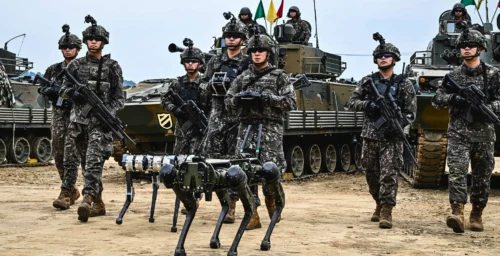
In a move that signals a profound shift in the security architecture of the Korean Peninsula, the South Korean government has unveiled plans for a record-shattering defense budget for 2027. Amidst a climate of escalating volatility, Seoul is earmarking over $53 billion to modernize its military apparatus, with a primary focus on cutting-edge naval, aerial, and missile-defense technologies. Simultaneously, the administration has placed the long-debated transfer of Wartime Operational Control (OPCON) at the forefront of its policy agenda, seeking a recalibration of its alliance with the United States.
The Financial Commitment: A New Era of Deterrence
The proposed $53 billion budget represents more than a mere incremental increase; it is a declaration of intent. As North Korea continues to refine its tactical nuclear capabilities and expand its ballistic missile inventory, Seoul is pivoting toward a "high-tech, low-personnel" military model.
The budget allocation focuses heavily on the "Three-Axis System"—a strategic framework designed to neutralize North Korean threats through preemptive strikes, interception, and retaliation. Key investments include:
- Submarine Warfare: A significant portion of the budget is earmarked for the development and procurement of nuclear-powered submarines. This capability would provide the Republic of Korea (ROK) Navy with an indefinite underwater endurance, allowing for persistent surveillance and a "second-strike" capability that is virtually immune to preemptive North Korean targeting.
- Drone Swarms and AI: Following the successful integration of manned-unmanned combined squads at the 11th Maneuver Division, the military is scaling up its investment in autonomous systems. The 2027 plan prioritizes the deployment of high-altitude surveillance drones and kamikaze-style loitering munitions to provide a asymmetrical edge in asymmetric combat scenarios.
- Integrated Missile Defense: Upgrading the Korea Air and Missile Defense (KAMD) system is a priority, with funds directed toward advanced radar arrays and interceptors capable of countering hypersonic threats, which have recently become a cornerstone of Pyongyang’s military posturing.
Chronology: The Road to the 2027 Strategic Shift
The current push for military autonomy and budgetary expansion did not occur in a vacuum. It is the culmination of years of heightened regional tensions and shifts in domestic leadership.
- August 2026: President Lee Jae Myung, in a move to solidify national security policy, taps veteran General Kang Shin-chul as the new Defense Minister. The appointment signals a desire for a leadership figure capable of navigating both the complexities of the U.S.-ROK alliance and the technical requirements of military modernization.
- July 2026: The ROK Army conducts high-profile maneuvers at the 11th Maneuver Division, demonstrating the effective integration of AI-driven drones with infantry squads. This test serves as the technical validation for the massive budget requests that followed.
- Early 2026: North Korea accelerates its ballistic missile testing cycle, successfully launching multiple intermediate-range missiles over the East Sea, forcing Seoul to rethink the speed and scale of its own defense procurements.
- Late 2025: Strategic dialogues between Washington and Seoul reach a turning point, with both sides acknowledging that the "Status Quo" on OPCON transfer requires a more aggressive timeline to account for Pyongyang’s evolving nuclear arsenal.
The OPCON Conundrum: A Question of Sovereignty
Central to the political discourse is the transfer of Wartime Operational Control (OPCON). Currently, in the event of a full-scale conflict, the commander of the ROK-U.S. Combined Forces Command—a U.S. four-star general—assumes control of South Korean forces.
General Kang Shin-chul, during his arrival at the Seoul Defense Convention Center, emphasized that he intends to push for the transfer, but with a nuanced caveat. "The transfer must be conducted in a manner that strengthens, rather than dilutes, the alliance," Kang noted. This suggests that while Seoul seeks the symbolic and practical authority of command, it remains wary of losing the logistical and intelligence-sharing advantages that come with the current U.S.-led command structure.
The challenge for Minister-nominee Kang is to demonstrate that the ROK military has achieved the "Initial Operational Capability" (IOC) and "Full Operational Capability" (FOC) benchmarks necessary to take the helm. His confirmation hearing is expected to be a crucible, as lawmakers demand to know whether the $53 billion budget is sufficient to bridge the capability gaps that have historically prevented the U.S. from signing off on the transfer.

Supporting Data: The Cost of Security
The $53 billion budget must be viewed through the lens of a shrinking demographic pool in South Korea. With a rapidly aging population and declining fertility rates, the ROK military can no longer rely on massive conscript armies.
| Sector | Investment Priority | Strategic Goal |
|---|---|---|
| Naval Modernization | Nuclear-powered submarines | Persistent deterrence/Second strike |
| Unmanned Systems | AI-enabled drone swarms | Force multiplication with fewer personnel |
| Missile Defense | KAMD enhancement | Interception of hypersonic/tactical nukes |
| C4ISR | Space-based intelligence | Real-time monitoring of North Korean silos |
The fiscal allocation represents roughly 2.8% to 3% of the nation’s GDP. While some economists raise concerns regarding the impact of such spending on social welfare programs, the consensus among the political establishment—across party lines—is that the existential threat posed by North Korea’s nuclear advancements leaves little room for fiscal austerity in defense.
Official Responses and Political Implications
The nomination of General Kang has drawn mixed reactions. Conservative factions within the National Assembly are cautious about the timeline for OPCON transfer, fearing that "rushing" the process could create a security vacuum that Pyongyang might exploit. Conversely, progressive lawmakers have lauded the move as a long-overdue assertion of national sovereignty.
From the U.S. perspective, the Biden administration has remained publicly supportive of the ROK’s push for greater self-reliance, provided that the transition remains "condition-based." Washington remains concerned that if the transfer happens prematurely, the interoperability of the two militaries—built over seven decades—could suffer.
"We are building a military that is not just reactive, but proactive," said a Ministry of National Defense spokesperson during a briefing on the budget. "The $53 billion is not just money; it is the price of maintaining peace in a neighborhood where the rules of engagement are being rewritten by the day."
Future Implications: A Regional Power Shift
If the 2027 budget passes as expected and the OPCON transfer gains momentum, the geopolitical landscape of East Asia will undergo a permanent shift.
- A More Autonomous Seoul: A South Korea that controls its own wartime forces will likely play a more assertive role in regional security dialogues, potentially acting as a mediator or a primary balancer in the U.S.-China-Japan triangular relationship.
- Technological Race: The investment in AI, drones, and nuclear-powered submarines will likely trigger a competitive response from both North Korea and, potentially, neighboring powers, leading to a localized arms race that could increase the risk of accidental escalation.
- Strengthened Alliance Dynamics: Paradoxically, by taking on more responsibility, South Korea may actually find itself with more leverage in Washington. A partner that provides its own high-end deterrence is a more valued ally in the eyes of U.S. strategic planners who are increasingly focused on Indo-Pacific challenges beyond the Korean Peninsula.
As General Kang prepares for his confirmation hearings, the message from Seoul is clear: the era of reliance on traditional, manpower-heavy defensive postures is ending. The future of South Korean security will be forged in the laboratories of its tech giants and the hulls of its next-generation submarine fleet. Whether this path leads to a more stable peninsula or a more dangerous, high-stakes standoff remains the defining question of the next decade.


 Ammar Sabilarrohman
  Pevita Pearce
  Nana Wu
