
 By Azzam Bilal Chamdy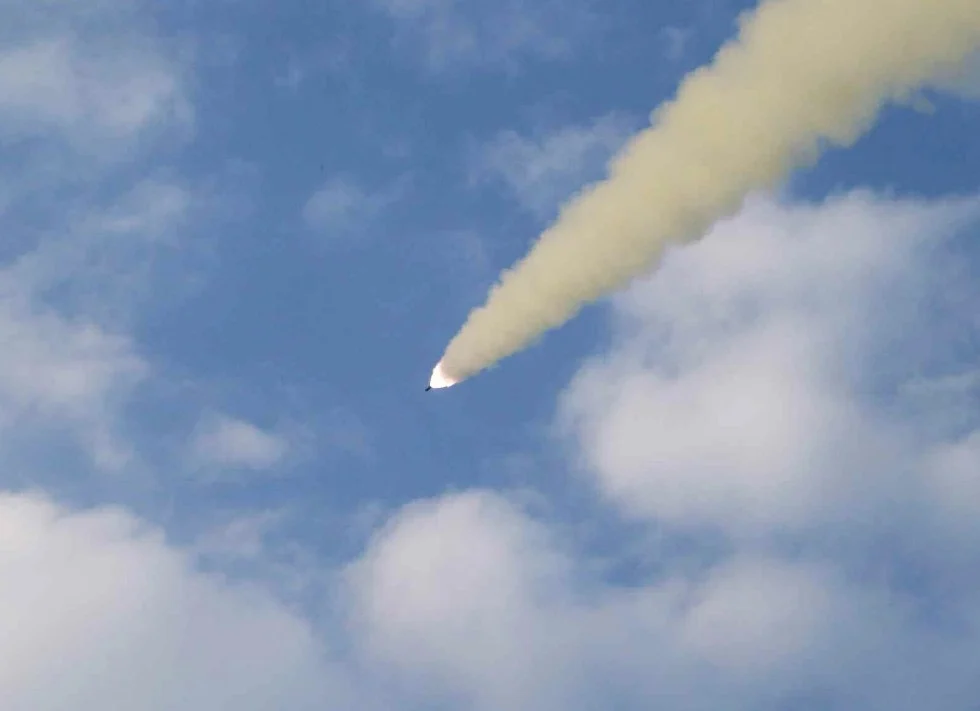
SEOUL — The Korean Peninsula has once again been thrust into a state of high alert following a significant display of military force by the Democratic People’s Republic of Korea (DPRK). On Thursday, North Korean forces launched a salvo of at least 10 short-range ballistic missiles from the vicinity of Pyongyang, marking the third such provocation this month.
The launch, which occurred at approximately 5:00 p.m. KST, served as a volatile backdrop to a high-level diplomatic meeting in Seoul between China’s top diplomat, Wang Yi, and South Korean officials. The synchronized nature of the missile test and the ongoing regional diplomatic engagements underscores the deteriorating security environment in Northeast Asia.
I. The Incident: A Tactical Barrage
Military authorities in both Seoul and Tokyo confirmed the detection of multiple short-range ballistic missiles (SRBMs) fired in a northeastern direction. The Japanese Ministry of Defense, acting through its Coast Guard, issued an emergency maritime alert at 5:08 p.m., warning vessels in the region to exercise extreme caution and report any debris.
Early telemetry suggests that the missiles were launched using a mobile platform, likely the 600mm multiple launch rocket system (MLRS) that has become a staple of Kim Jong Un’s tactical nuclear weapon delivery systems. Unlike long-range intercontinental ballistic missile (ICBM) tests, which are designed to project power toward the U.S. mainland, this barrage appears to be a calculated demonstration of "saturation strike" capabilities—designed to overwhelm regional missile defense systems by firing multiple projectiles simultaneously.
II. Chronology of Escalation
The Thursday launch is not an isolated event but rather the latest spike in a month-long trend of heightened military posturing.
- Early May: The month began with a series of technical engine tests and small-scale tactical drills, signaling a shift toward more aggressive testing schedules.
- Mid-May: Pyongyang ramped up its rhetoric, with Kim Yo Jong, the influential sister of the DPRK leader, issuing scathing condemnations of the U.S.-ROK security alliance, labeling joint military exercises as a "rehearsal for invasion."
- Late May: The frequency of launches intensified. A massive 18-missile salvo was observed and touted by state media, the Rodong Sinmun, featuring Kim Jong Un personally observing the deployment of mobile artillery units.
- Thursday, May 31: The current series culminated in this 10-missile launch, occurring precisely as China’s Wang Yi arrived in Seoul to discuss regional stability, effectively overshadowing the diplomatic agenda.
III. Supporting Data: The Capability Gap
Security analysts have noted a shift in North Korea’s procurement and testing strategy. By focusing on short-range systems like the KN-25 (the 600mm MLRS), Pyongyang is prioritizing tactical usability over strategic signaling.
According to data compiled by regional intelligence services:
- Increased Frequency: The DPRK has conducted more missile tests in the first half of this year than in the entire previous calendar year.
- Technological Maturity: The transition from liquid-fuel to solid-fuel systems has significantly reduced the "warning time" for South Korean and U.S. interceptors, as solid-fuel missiles can be launched with minimal pre-fire preparation.
- The "Saturation" Factor: By firing 10 or more missiles in a single volley, the North aims to test the limits of the Patriot (PAC-3) and THAAD batteries deployed in South Korea, hoping to find gaps in the defensive umbrella.
IV. Official Responses: A Divided Reaction
The launch has triggered a cascade of diplomatic activity across the Pacific.
South Korea
The ROK Joint Chiefs of Staff (JCS) condemned the act as a "clear violation of UN Security Council resolutions" and a "grave threat to peace and stability." In Seoul, the government held an emergency National Security Council (NSC) meeting. President Lee Jae Myung, who was in the middle of discussions with China’s Wang Yi, reportedly used the incident to pivot the conversation toward the necessity of Chinese influence in curbing Pyongyang’s behavior.
The United States
Washington remains in a complicated position. With President Donald Trump publicly floating the possibility of another summit with Kim Jong Un—despite Pyongyang’s recent denial of backchannel communications—the U.S. State Department issued a measured statement. They reaffirmed the "ironclad" commitment to the defense of the ROK and Japan, while simultaneously emphasizing that the door to "unconditional dialogue" remains open.

The People’s Republic of China
Wang Yi’s presence in Seoul during the launch put Beijing in a difficult spot. Historically, China has advocated for "restraint on all sides," a policy that essentially blames U.S.-ROK military exercises for provoking the North. Wang stated that "all parties should avoid escalating actions," a subtle nod to the ongoing joint military drills, which Beijing views as an encroachment on its regional security interests.
V. Implications: A Region on the Brink
The implications of this latest barrage are profound and multi-faceted.
The Collapse of the "Quiet Period"
For years, the international community hoped that economic sanctions would force a permanent freeze in testing. The current reality suggests that the DPRK has effectively transitioned into a permanent "testing state." Pyongyang no longer views these tests as bargaining chips, but as essential components of their military readiness.
The Trump Variable
The political landscape is further complicated by the U.S. election cycle. President Trump’s stated desire to meet with Kim Jong Un creates a dichotomy in American foreign policy: a desire for personal diplomacy versus the institutional reality of deterrence. If the U.S. pursues a summit while the North continues to test, critics argue it will embolden Pyongyang, validating their "nuclear-first" strategy.
The Security Dilemma
The U.S.-ROK joint military exercises are intended to be defensive. However, the North’s interpretation of these exercises as existential threats creates a classic security dilemma. Every defensive measure taken by Seoul is met with an offensive escalation by Pyongyang, leading to an arms race that threatens to spiral out of control.
Future Outlook
As the dust settles, the immediate future looks bleak for de-escalation. Military experts anticipate that if the current rate of testing continues, the North will likely move toward a seventh nuclear test, further raising the stakes.
The international community is now left with few levers. With the UN Security Council effectively paralyzed by divisions between the P5 nations, regional powers—specifically South Korea and Japan—are increasingly looking toward independent defense strategies, including the potential development of indigenous nuclear capabilities.
In conclusion, the events of Thursday serve as a stark reminder that the Korean Peninsula remains one of the most volatile regions in the world. As diplomacy struggles to keep pace with the rapid advancement of North Korean ballistic technology, the window for a peaceful, negotiated resolution appears to be closing, replaced by a tense, fragile status quo defined by the constant threat of a missile launch.
This report is based on information provided by the Korea Risk Group. All rights reserved. No part of this content may be reproduced, distributed, or used for commercial purposes without prior written permission.


 Ammar Sabilarrohman
  Pevita Pearce
  Nana Wu
