 By Pevita Pearce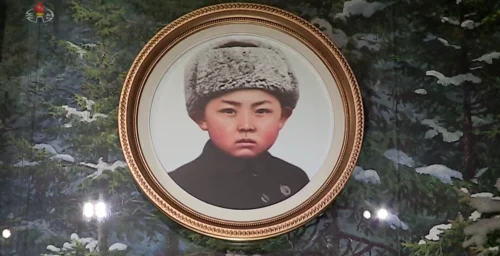
In a startling discovery that challenges the meticulously crafted hagiography of the Kim dynasty, researchers have unearthed a rare piece of North Korean material that inadvertently reveals a secret Pyongyang has spent decades attempting to bury: the Russian-derived childhood name of former leader Kim Jong Il.
The evidence, found within the text of a decades-old children’s poem, confirms that the man who would later become the "Dear Leader" was known in his youth as Kim Yu Ra—a name that bears the unmistakable mark of his early life in the Soviet Union. This discovery provides the first tangible proof outside the Democratic People’s Republic of Korea (DPRK) that the regime’s propaganda machine once failed to fully purge the Russian identity of its second-generation ruler.
The Genesis of a Myth: Yuri Irsenovich Kim
Long before the global stage recognized him as the architect of North Korea’s nuclear program, the man who would lead the DPRK for 17 years was a child of the Soviet Far East. Born in the village of Vyatskoye in the Khabarovsk Krai region of the USSR, he was registered at birth under a name that explicitly honored his father’s connection to the Soviet military establishment.
His birth certificate, long treated as a state secret, identified him as Yuri Irsenovich Kim. Under Russian naming conventions, "Yuri" served as his given name, while "Irsenovich" acted as a patronymic derived from his father, Kim Il Sung, whose Russian-language moniker was "Irsen."
For the North Korean state, which bases its ideological legitimacy on the concept of Juche—or self-reliance—the reality of the leader’s Soviet upbringing has always been an existential inconvenience. By acknowledging his birth as a Soviet citizen, the regime risks undermining the narrative that the Kims were born of the pure, revolutionary bloodline of the Korean anti-Japanese struggle. Consequently, the name "Yuri" was systematically scrubbed from official records, replaced by the Korean-sanitized "Kim Jong Il."
Chronology: From Vyatskoye to Pyongyang
The trajectory of Kim Jong Il’s life can be divided into distinct periods, each reflecting the regime’s shifting needs for historical revisionism.
- 1941–1945: The Soviet Era. Kim Jong Il lives in the Vyatskoye military camp. He is known to Soviet officials and local peers as Yuri Irsenovich Kim. He spends his formative years in the shadow of the Red Army.
- 1945–1946: The Return. Following the liberation of Korea, the family returns to the peninsula. The transition from "Yuri" to "Kim Jong Il" begins as the family integrates into the burgeoning communist power structure in Pyongyang.
- 1960s–1980s: The Erasure. As Kim Jong Il begins his ascent to power, official biographies are drafted. All references to his Soviet birth and his childhood name are excised. The narrative shifts to emphasize a birth on the sacred Mount Paektu, complete with supernatural portents.
- 2026: The Discovery. Decades after the "Paektu myth" was finalized, a scholarly investigation into a children’s publication from the post-war era surfaces, containing a poem that uses the name "Kim Yu Ra"—the Koreanized version of "Yuri."
Supporting Data: The Linguistic Smoking Gun
The discovery of the poem is significant because it provides a bridge between the forbidden Russian past and the sanitized Korean present. "Kim Yu Ra" serves as a phonetic hybrid. While "Kim" remains the surname, "Yu Ra" is a direct Korean transliteration of the Russian "Yuri."
Historical experts note that in the immediate aftermath of the Korean War, the ideological control over media was not yet as absolute as it would become under the mature Kim Jong Il regime. In those early days, remnants of the leader’s childhood identity occasionally slipped through the cracks of the editorial process. This poem, likely intended for youth indoctrination, was written before the state had fully standardized the "Paektu myth," allowing the childhood nickname to persist in print.
The existence of this material suggests that for those who knew the young Kim in the late 1940s, "Yu Ra" was not a secret, but a common descriptor. It was only through the deliberate, decades-long efforts of the Propaganda and Agitation Department that the name was successfully rendered a historical anomaly.

Official Responses and the Culture of Silence
Predictably, the North Korean state has offered no comment on the discovery. In Pyongyang, the "Paektu" narrative is not merely a historical account; it is a pillar of state legitimacy. To admit that the leader was a Soviet-born child named Yuri is to admit that the foundational story of the Kim family is a work of fiction.
When queried about such discrepancies in the past, North Korean diplomats have historically dismissed them as "imperialist fabrications" or "slanderous attempts to defame the supreme leadership." The regime’s silence in the face of this new evidence is consistent with its broader policy of information control: if a fact cannot be suppressed, it must be ignored.
Analysts suggest that the regime is unlikely to acknowledge this discovery even internally. Instead, researchers anticipate that if any physical copies of the original poem exist within North Korea, they will be quietly recalled and destroyed by the state security apparatus, ensuring that the "Yuri" identity remains a historical ghost.
Implications: Why Identity Matters in the DPRK
The revelation of the name "Kim Yu Ra" carries profound implications for our understanding of the North Korean political system.
1. The Fragility of the Narrative
The fact that evidence of the leader’s "true" identity has survived for over 80 years suggests that the North Korean propaganda machine, while formidable, is not omnipotent. Small, archival inconsistencies continue to surface, serving as reminders that the official history is a construction rather than a record.
2. The Soviet Influence
The Soviet Union played a critical role in the installation and survival of the Kim family. By erasing the Russian name, the regime effectively minimized the extent to which the DPRK was a product of Soviet Cold War engineering. Acknowledging "Yuri" would force the state to grapple with its origins as a client state of Moscow, a narrative that clashes with the current focus on total independence.
3. Historical Integrity
For historians, this discovery is a victory for the preservation of truth. It allows for a more nuanced look at the life of Kim Jong Il, stripping away the layers of myth to reveal a man who, like many of his generation, lived through the tumultuous transition from the Soviet sphere to the realities of the Cold War.
Conclusion
The story of "Kim Yu Ra" is a microcosm of the North Korean experience—a battle between the reality of the past and the demands of the present. While the regime continues to build monuments to the "immortal" nature of the Kim family, the accidental survival of a simple children’s poem reminds us that history has a way of outlasting even the most restrictive dictatorships.
As researchers continue to digitize and analyze long-forgotten archives, it is likely that more fragments of the "Yuri" identity will emerge. Each one serves as a quiet challenge to the state’s monolithic history, reminding the world that behind the propaganda and the myths, there remains the persistent, often inconvenient truth of human history. For the Kim dynasty, the name "Yuri" is a ghost that refuses to be exorcised—a reminder of a time before the myth, when the future leader was just a boy with a Russian name.
 Ammar Sabilarrohman
  Nana Wu
