
 By Iffa Jayyana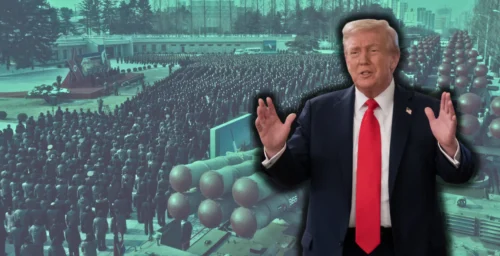
In a moment of characteristic spontaneity, U.S. President Donald Trump ignited a firestorm of speculation on Wednesday when he publicly identified the size of North Korea’s nuclear stockpile with a level of precision rarely seen in presidential discourse. Addressing reporters during a White House briefing, Trump asserted that Pyongyang possesses exactly 57 nuclear weapons.
The figure, while seemingly precise, has left intelligence analysts, regional security experts, and diplomatic observers scrambling to decode its origin. By providing a specific integer rather than a range, the President has inadvertently highlighted the profound "fog of war" that continues to shroud the Democratic People’s Republic of Korea’s (DPRK) actual nuclear capability. The subsequent, significantly higher estimate provided by Seoul only served to widen the gap between allied perceptions, raising critical questions about intelligence sharing, verification, and the true scale of the threat posed by Kim Jong Un’s regime.
The Main Facts: A President’s Specificity vs. Analytical Consensus
President Trump’s claim of 57 warheads is, on its face, a "broad fit" for several open-source intelligence estimates that have circulated in the Washington policy community over the past year. Most independent think tanks and non-proliferation organizations—such as the Federation of American Scientists (FAS) and the Stockholm International Peace Research Institute (SIPRI)—have placed the DPRK’s inventory in the range of 50 to 60 warheads.
However, the specificity of the number "57" is what drew immediate scrutiny. In the intelligence community, such a number usually implies either a highly granular assessment of fissile material production or, conversely, a rhetorical simplification that may lack a deep technical foundation. When asked for the source of his information, the President remained silent, leaving the public to wonder: Is this an operational tally of ready-to-launch warheads, a count of total fissile cores currently in existence, or a political figure designed to convey a sense of mastery over the North Korean file?
The ambiguity is compounded by the fact that counting nuclear weapons in a closed, secretive state like North Korea is an exercise in educated guessing. Analysts must rely on satellite imagery of the Yongbyon nuclear complex, estimates of plutonium and highly enriched uranium (HEU) production, and interpretations of Pyongyang’s own propaganda regarding their "tactical nuclear" capabilities.
Chronology of a Growing Arsenal
To understand why the number 57 is significant—or potentially misleading—one must look at the historical trajectory of North Korea’s nuclear program.
- 2006–2017 (The Testing Phase): North Korea conducted six nuclear tests during this period, steadily increasing the yield of its devices. During this time, the consensus was that Pyongyang possessed a "handful" of crude weapons.
- 2018–2019 (The Diplomacy Hiatus): Despite the high-profile summits between President Trump and Kim Jong Un, evidence suggested that North Korea never ceased its production of fissile material. Intelligence reports from this era began to suggest that the arsenal had likely grown into the double digits.
- 2021–2023 (The Tactical Shift): Kim Jong Un formally shifted the state’s nuclear doctrine toward the use of "tactical nuclear weapons." This period saw the development of 600mm super-large multiple rocket launchers (MLRS), which are specifically designed to carry smaller, battlefield-ready nuclear warheads.
- 2025–2026 (The Current Standpoint): As of August 2026, the proliferation of these delivery systems—including cruise missiles and hypersonic glide vehicles—has forced analysts to revise their estimates upward. The "57" figure suggests a pivot from counting only "strategic" bombs to including a new, growing class of battlefield nuclear munitions.
Supporting Data: Why the Discrepancy Exists
The confusion surrounding the size of the DPRK’s arsenal is largely a function of how one defines a "nuclear weapon." There are three primary variables that cause numbers to fluctuate:
1. Fissile Material vs. Assembled Weapons
A country can possess enough plutonium or uranium to create 100 bombs without having assembled those bombs into warheads. Intelligence estimates often diverge because some count the "potential" arsenal (based on fuel stockpiles), while others count only the "verified" arsenal (based on weaponization activities).
2. The Tactical Arsenal
The emergence of tactical nuclear weapons—smaller, lighter warheads designed for battlefield use—has complicated the count. If the U.S. is counting only large, long-range strategic warheads intended for ICBMs, the number might be lower. If the count includes every tactical warhead, cruise missile warhead, and gravity bomb, the number might be significantly higher.
3. The Seoul Factor
Only hours after President Trump’s remarks, officials in Seoul offered a conflicting assessment. While the South Korean Ministry of National Defense did not provide a counter-integer, their public messaging hinted at a figure closer to 80–100. This disparity suggests that South Korean intelligence, which has a deeper focus on regional delivery systems like the 600mm MLRS, may be accounting for a wider range of weapon types than the U.S. intelligence community, which traditionally focuses on intercontinental threats to the American homeland.

Official Responses and the Intelligence Gap
The White House has not yet clarified whether the President’s number was a slip of the tongue, a strategic signal, or a classified data point shared in a briefing. However, the lack of coordination between Washington and Seoul regarding this public figure is telling.
Spokespeople for the South Korean government have been careful not to openly contradict the U.S. President, sticking to the standard line that "the ROK-U.S. alliance continues to share and evaluate intelligence regarding the DPRK’s nuclear developments." Yet, the underlying tension is palpable. For Seoul, which sits within range of North Korea’s entire tactical arsenal, the difference between 57 and 100 weapons is not just a statistical discrepancy—it is a matter of existential survival.
Experts in Washington have suggested that the President’s specificity might be intended to exert pressure on North Korea by demonstrating that the U.S. "knows" exactly what they are doing. However, critics argue that such claims can be counterproductive. If the DPRK leadership believes their secret count is being tracked with such precision, they may accelerate their concealment programs or increase the pace of production to prove the intelligence wrong.
Implications: Strategic Ambiguity in a High-Stakes Environment
The implications of this public discrepancy are significant for regional security:
Erosion of Trust
When the leaders of the U.S. and South Korea publicly present different assessments of a common threat, it creates a vacuum that Pyongyang can exploit. North Korean state media is likely to frame this as proof that the U.S. and South Korea are not aligned, potentially testing the alliance through increased provocations.
The Problem of Verification
The 57-warhead figure reminds us that we are currently operating in a post-verification era. With no active inspections or nuclear deals in place, the world is forced to rely entirely on "National Technical Means" (satellite imagery, signals intelligence, and seismic monitoring). This is an inherently flawed process. Without the ability to physically inspect storage facilities, any number—whether it is 57, 100, or 200—remains a theoretical projection.
The Tactical Danger
The real concern for the international community is not the exact count, but the type of weapons being produced. The transition from large, easily trackable strategic warheads to smaller, mobile, and modular tactical weapons makes the DPRK’s arsenal more survivable and more "usable" in a conflict. If the North Korean military believes they have a sufficient number of tactical weapons to overwhelm South Korean and U.S. defenses, the threshold for nuclear use during a conventional conflict lowers significantly.
Conclusion: Beyond the Numbers
Whether North Korea has 57, 75, or 100 nuclear weapons, the fundamental reality remains unchanged: the DPRK has successfully transitioned into a full-fledged, permanent nuclear state. President Trump’s choice to use a specific, low-to-mid-range number may have been an attempt to simplify a complex reality for a domestic audience, but it has served to highlight the limits of current intelligence.
As the international community moves forward, the focus must shift away from the "numbers game" and toward the more difficult task of crisis management. The uncertainty surrounding Pyongyang’s arsenal is a feature, not a bug, of Kim Jong Un’s strategy. By keeping his exact count a mystery, he creates a persistent strategic headache for his adversaries.
Ultimately, the confusion following the President’s remarks is a sobering reminder that in the high-stakes world of nuclear brinkmanship, the most dangerous weapon is often not the one you can count, but the one you cannot see. Until there is a return to substantive, verifiable diplomatic engagement, the world will likely continue to debate the "57" figure, while North Korea continues to produce more, regardless of what is said in Washington or Seoul.

 Ammar Sabilarrohman
  Pevita Pearce
  Nana Wu
