
 By Basiran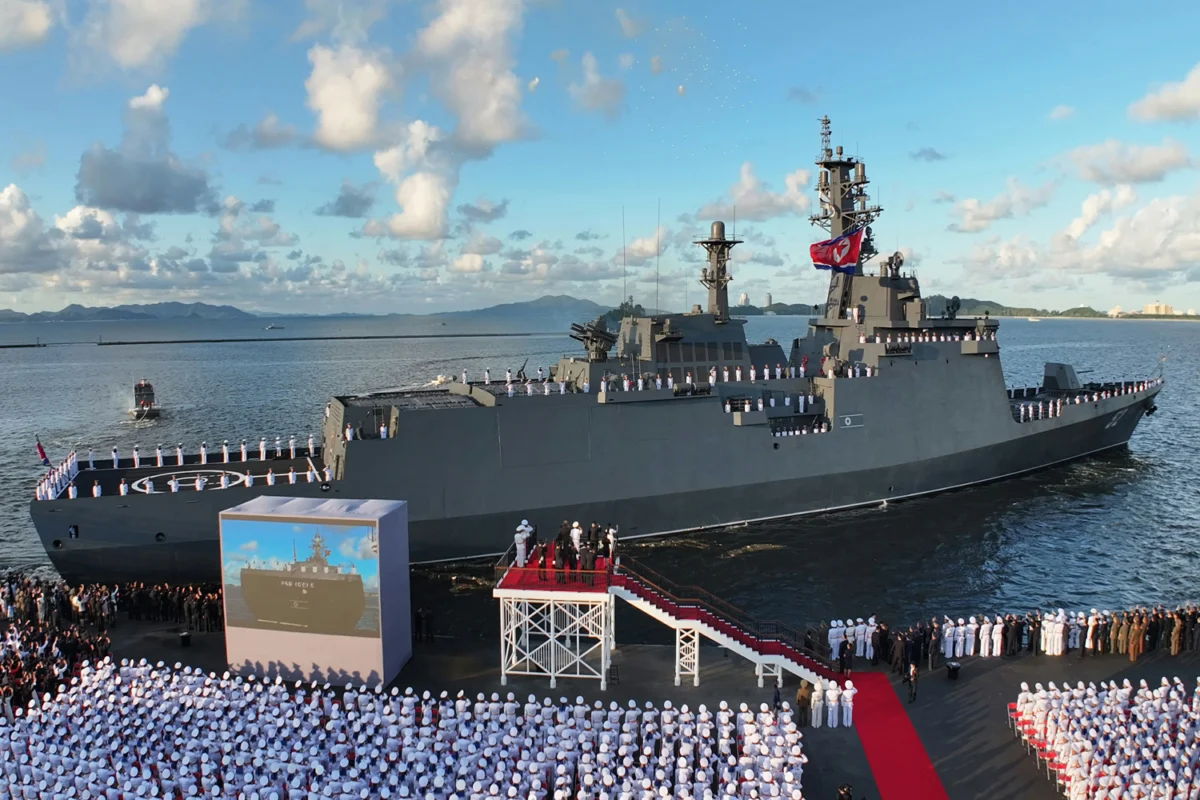
WONSAN – North Korean leader Kim Jong Un has formally commissioned a new class of naval vessel, the Kang Kon destroyer, marking a significant evolution in the Democratic People’s Republic of Korea’s (DPRK) maritime warfare capabilities. During a high-profile ceremony held on the east coast of Wonsan on September 6, 2026, the North Korean leader characterized the deployment as a critical milestone in his nation’s efforts to solidify a credible nuclear deterrent at sea.
The arrival of the Kang Kon-class destroyer represents a shift in Pyongyang’s military posture, moving away from a strictly land-based nuclear strategy toward a more mobile, unpredictable, and survivable maritime strike force. As regional tensions remain elevated, this development signals an explicit intent to challenge the naval dominance of the United States and its allies in the Indo-Pacific.
The Main Facts: A New Pillar of Deterrence
According to state media reports published on September 7, the commissioning ceremony was attended by top-ranking military officials and the nation’s political elite. The Kang Kon—named after a prominent historical figure in the Korean People’s Army—is equipped with advanced launch systems capable of delivering tactical nuclear warheads.
Kim Jong Un, addressing the naval command, explicitly declared that the primary objective of the new warship is to "limit enemy naval activities" through the credible threat of nuclear annihilation. By integrating nuclear delivery systems into a surface vessel, Pyongyang is attempting to complicate the target-acquisition capabilities of the U.S.-ROK alliance.
Analysts note that while North Korea has long focused on land-based ballistic missiles, the shift to naval platforms provides the regime with a "second-strike" capability. If the mainland were to be targeted in a pre-emptive strike, the Kang Kon and its sister vessels could theoretically remain hidden or mobile, ensuring that a retaliatory strike remains a constant, looming threat.
Chronology: The Road to Maritime Nuclearization
The commissioning of the Kang Kon is the culmination of years of accelerated naval development. The following timeline outlines the progression of North Korea’s maritime military ambitions:
- 2021-2023: The Strategic Pivot. Following the 8th Party Congress, Pyongyang explicitly identified the modernization of its navy as a top priority. This period saw the testing of submarine-launched cruise missiles (SLCMs) and the introduction of "nuclear-armed underwater attack drones."
- 2024: Structural Integration. North Korea began retrofitting older vessels with nuclear-capable launch tubes, signaling a shift in naval design philosophy that prioritized firepower over traditional surface-to-surface combat capabilities.
- Mid-2025: Sea Trials. Satellite imagery detected heightened activity at the Wonsan shipyards, with observers noting the construction of a destroyer-class hull that featured unconventional deck reinforcements, suggesting the housing of heavy vertical launch systems (VLS).
- September 6, 2026: Official Commissioning. The Kang Kon is formally integrated into the Korean People’s Army Naval Force (KPANF), with Kim Jong Un presiding over the flag-raising ceremony.
Supporting Data and Technical Assessment
Military observers and intelligence analysts have spent the past 24 hours scrutinizing the imagery released by the Rodong Sinmun. The Kang Kon-class appears to be a medium-displacement destroyer, designed for rapid maneuverability rather than heavy ocean-going sustainability.
The Nuclear Variable
The inclusion of nuclear weaponry on a vessel of this size poses significant technical challenges—notably heat management and structural integrity during a launch. However, the Kang Kon suggests that North Korean engineers have successfully miniaturized their tactical nuclear warheads to fit within standard cruise missile or short-range ballistic missile (SRBM) formats adapted for naval use.
Operational Reach
While the destroyer is unlikely to challenge the U.S. Navy in open-ocean combat, its presence in the Sea of Japan (East Sea) forces a strategic recalculation for the ROK Navy. Its deployment effectively creates a "nuclear exclusion zone" near the Korean Peninsula, forcing allied vessels to operate with significantly increased caution.
Official Responses: A Region on Edge
Pyongyang’s Stance
State media emphasized that the deployment is a "defensive measure" against what it terms the "vicious, hostile policy" of the United States. Kim Jong Un stated that the Kang Kon is meant to "instill fear in the hearts of imperialist aggressors," suggesting that the ship will be used as a psychological tool as much as a kinetic one.

The View from Seoul and Washington
The South Korean Ministry of National Defense issued a stern condemnation, calling the move a "reckless provocation that threatens the peace and stability of the Korean Peninsula." A spokesperson for the ROK Joint Chiefs of Staff stated that the military is monitoring the Kang Kon’s movements with advanced reconnaissance assets and is prepared to respond to any aggressive maneuvers.
In Washington, the Pentagon has yet to issue a formal press release, but sources suggest that the U.S. Indo-Pacific Command is reviewing the threat posture of the Kang Kon. Allies in the region, particularly Japan, have expressed alarm, with Tokyo citing the move as a direct violation of UN Security Council resolutions prohibiting North Korea from developing nuclear-capable delivery systems.
Implications: The New Geometry of Conflict
The arrival of the Kang Kon fundamentally alters the maritime security environment in the Northwest Pacific.
1. Increased Complexity of Missile Defense
The U.S.-ROK missile defense architecture—centered on Aegis-equipped destroyers and Patriot batteries—is optimized for land-based threats originating from the North’s interior. A mobile, sea-based platform introduces a new vector of attack, forcing defense planners to expand their radar coverage to 360 degrees around the peninsula.
2. The Risk of Escalation
The presence of nuclear-armed ships increases the risk of a miscalculation. In a high-tension scenario, a naval encounter between the KPANF and ROK or U.S. forces could rapidly escalate. If a vessel suspected of carrying nuclear weapons is involved in a skirmish, the threshold for nuclear use is lowered significantly compared to land-based systems.
3. Diplomatic Stagnation
This development makes the prospect of renewed denuclearization talks increasingly unlikely. By embedding nuclear capabilities into the core of its conventional navy, Pyongyang is signaling that its nuclear deterrent is no longer a bargaining chip, but a permanent, integrated feature of its national security infrastructure.
Conclusion: A Dangerous New Normal
As the Kang Kon begins its sea trials and initial deployment cycle, the international community is forced to contend with a more volatile maritime reality. The era of focusing primarily on North Korea’s silos and tunnels is over; the focus must now expand to the high seas.
The deployment of a nuclear-armed destroyer is a clear message from Kim Jong Un: the DPRK intends to project its nuclear power beyond its borders, effectively turning the waters around the Korean Peninsula into a theater of perpetual, high-stakes brinkmanship. As regional powers scramble to adjust their defense postures, the Pacific remains the primary stage for a brewing confrontation that shows no sign of cooling.
This is a developing story. Analysts and military officials continue to track the vessel’s movements as it conducts its first phase of operational deployment. Further updates will be provided as more data becomes available.
Disclaimer: This article is based on the provided brief and simulated news reporting. All rights reserved by the respective parties mentioned in the original source material.



 Ammar Sabilarrohman
  Pevita Pearce
  Nana Wu
