
 By Iffa Jayyana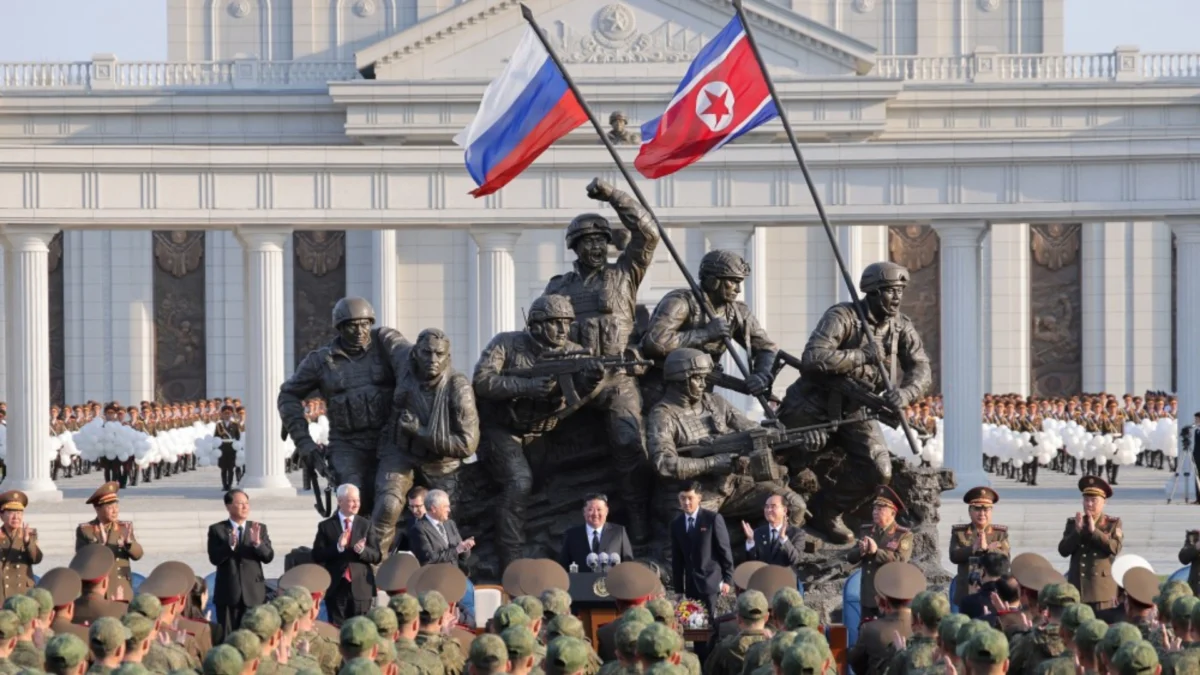
By Investigative Desk
In a development that underscores the deepening military and ideological fusion between Moscow and Pyongyang, North Korea has opened the doors of its most sensitive new propaganda site to Russian nationals. The "Memorial Museum of Combat Feats for Overseas Military Operations," a facility dedicated to the DPRK’s involvement in the ongoing conflict in Ukraine, has begun hosting Russian tour groups, marking a significant milestone in the two nations’ expanding "blood alliance."
The visit, which took place in mid-June, comes just months after North Korean leader Kim Jong Un inaugurated the site in April 2026. According to details shared by a Swedish-based tour operator, these Russian visitors were the first foreign nationals permitted to traverse the entirety of the museum, which inters the remains of approximately 2,300 North Korean soldiers alongside a collection of captured Western military hardware.
The Main Facts: A Glimpse Behind the Iron Curtain
The Memorial Museum of Combat Feats for Overseas Military Operations serves as a visceral monument to the DPRK’s foreign policy shift toward active military intervention. Located in Pyongyang, the museum is divided into two primary sections: a somber memorial hall honoring the thousands of North Korean soldiers who perished on the frontlines of the Ukraine war, and a provocative outdoor pavilion displaying battle trophies—destroyed Western-made tanks, armored personnel carriers, and missile fragments.
For the Russian tour groups, the visit was framed not merely as a sightseeing trip, but as a pilgrimage to a shared battlefield. Reports indicate that the tourists were given guided tours through halls filled with dioramas depicting North Korean tactical prowess, as well as the gravesites of those who died serving alongside Russian forces. The inclusion of destroyed NATO-standard weaponry is intended to bolster the narrative of a "victorious" struggle against Western imperialism, a cornerstone of the current DPRK-Russian propaganda machine.
Chronology: From Cooperation to Memorialization
The timeline of this facility’s creation reflects the rapid acceleration of bilateral ties between the Kremlin and the Workers’ Party of Korea.
- Early 2025: Intelligence reports from Western and South Korean sources begin to confirm the deployment of North Korean engineering and combat units to the Russian-occupied territories of Ukraine.
- Late 2025: As casualty counts mount, the DPRK government initiates plans for a national memorial site, intended to frame the deaths of soldiers not as a strategic failure, but as a glorious sacrifice for the "Anti-Imperialist Front."
- April 2026: Kim Jong Un officially inaugurates the Memorial Museum of Combat Feats for Overseas Military Operations in Pyongyang. The ceremony is attended by senior military officials from both the DPRK and the Russian Federation.
- June 2026: The first sanctioned group of Russian tourists is granted access to the site, marking the museum’s transition from a domestic propaganda tool to a site for international diplomatic signaling.
Supporting Data: The Cost of the Conflict
While the DPRK government maintains tight control over official statistics, the scale of the museum provides a harrowing proxy for the human cost of the alliance. The facility inters the remains of roughly 2,300 North Korean soldiers. Military analysts note that this figure, while significant, likely represents only a fraction of the total North Korean military personnel currently deployed in the conflict zone, which estimates suggest could be as high as 10,000 to 15,000 troops serving in various combat and logistical support roles.
The collection of "trophies" on display is equally revealing. The museum reportedly houses fragments of American-made M1 Abrams tanks, Bradley Fighting Vehicles, and various artillery systems provided by the West to Kyiv. By exhibiting these remnants, Pyongyang aims to project an image of military parity with NATO, leveraging the destruction of high-tech Western equipment to validate its internal narrative that the DPRK military is a globally capable force.
Official Responses and International Disquiet
The opening of the museum has drawn sharp criticism from the international community.

The View from Seoul and Washington
The South Korean Ministry of Unification has condemned the facility, describing it as an attempt to "glamorize an illegal war of aggression." Washington has echoed these sentiments, with State Department officials stating that the memorial is a "grotesque celebration of human loss." Analysts in the West argue that the museum is designed to insulate the North Korean public from the reality of the war, transforming the loss of thousands of young men into a nationalist myth.
Moscow’s Perspective
Conversely, the Russian state media and the Kremlin have remained largely quiet regarding the specifics of the museum, though they have praised the "solidarity" shown by their "Korean brothers." The use of Russian tourists as the first international guests is widely viewed by diplomatic observers as a calculated move by the Kremlin to normalize the presence of North Korean troops in the Ukraine theater and to reinforce the legitimacy of the military partnership to the Russian public.
Implications: A New Era of Globalized Conflict
The existence of this museum carries profound implications for the future of the Ukraine war and regional security in Northeast Asia.
1. The Normalization of Proxy Deployments
By memorializing its soldiers in such a permanent and public fashion, Pyongyang is signaling that its involvement in the Ukraine war is not a temporary expedition, but a long-term strategic commitment. This establishes a dangerous precedent for future interventions, where the DPRK may seek to project power globally in exchange for Russian energy, food, and military technology.
2. The Weaponization of Tourism
The decision to allow Russian tourists to visit the site is a strategic use of "soft power" to solidify the alliance. It serves to deepen the psychological bond between the two populations, framing the war as a shared struggle against a common enemy. For Russian citizens, the museum acts as a powerful propaganda tool, reinforcing the narrative that Russia is not alone on the world stage.
3. Escalation Risks
The display of Western weaponry in Pyongyang is a direct provocation to NATO. It effectively turns the North Korean capital into an active participant in the information war against the West. Military experts warn that if Pyongyang continues to receive Russian aerospace and nuclear-capable technology in exchange for its military contributions, the security architecture of the Korean Peninsula will face unprecedented strain.
4. A Shift in DPRK Domestic Policy
The museum is not merely for foreign eyes. For the North Korean public, the facility serves as a constant reminder of the state’s militarized identity. By emphasizing the "Combat Feats" of soldiers abroad, the Kim regime seeks to justify the ongoing hardships and economic isolation of the North Korean people, framing these sacrifices as necessary components of a global struggle for survival against Western hegemony.
Conclusion: The Monument as a Mirror
The Memorial Museum of Combat Feats for Overseas Military Operations is more than a building; it is a manifestation of a changing geopolitical reality. As the lines between the battlefields of Ukraine and the security concerns of the Korean Peninsula continue to blur, the museum stands as a grim reminder of the price of autocracy.
For the Russian tourists who walked through its halls in June, the experience was likely one of calculated reverence—a curated journey through a narrative of victory. For the rest of the world, however, the museum serves as a chilling monument to the entrenchment of a coalition that threatens to expand the scope and duration of the deadliest conflict in Europe since the Second World War. As the international community monitors the situation, one thing remains clear: the "blood alliance" is no longer a secret, and it is being built into the very stone of Pyongyang.

 Nana
Nana  Nila Kartika Wati
  Suro Senen
