
 By Neng Nana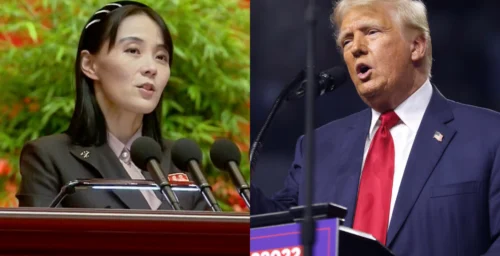
By Editorial Staff
August 2026
Kim Yo Jong, the powerful sister of North Korean leader Kim Jong Un and a senior official within the Workers’ Party of Korea (WPK), has issued a sharp rebuttal to recent claims made by U.S. President Donald Trump regarding active communication between Washington and Pyongyang. In a statement released late Wednesday via the state-run Korean Central News Agency (KCNA), the influential official dismissed reports of a thaw in relations, asserting that she has "absolutely no knowledge" of any ongoing dialogue between the two heads of state.
The rejection serves as a cold shower to the diplomatic optimism radiating from the White House earlier this week, when President Trump touted his "very good" relationship with the North Korean leader and suggested that the two sides were in contact.
The Core Conflict: A Discrepancy in Diplomacy
The diplomatic tension centers on the nature of the current U.S.-DPRK relationship. On Sunday, President Trump, speaking to the press, hinted at a potential breakthrough or at least a sustained line of communication with Pyongyang. This claim was accompanied by an announcement of a reduction in the scale of U.S.-South Korea military drills, a move framed by the administration as a gesture of goodwill intended to lower tensions on the Korean Peninsula.
However, Kim Yo Jong’s statement serves as a blunt instrument of denial. "Perhaps it is the only matter I do not know about in relation to our supreme leadership’s foreign policy," she stated, using a tone of icy sarcasm that has become a hallmark of her diplomatic interventions. By explicitly distancing herself from any knowledge of these communications, she is effectively signaling that if such contacts exist, they are not currently being sanctioned or recognized by the central apparatus of the North Korean government.
The Significance of the Denial
Analysts suggest that Kim Yo Jong’s intervention is not merely a clarification but a tactical maneuver. By publicly contradicting the U.S. President, Pyongyang is reasserting its autonomy. For the North Korean leadership, the optics of "waiting" for American engagement are often viewed as a sign of weakness; by denying the contact, Kim Yo Jong is maintaining the narrative that Washington is the party desperate for engagement, while Pyongyang remains unbothered by the state of bilateral relations.
Chronology of Recent Tensions
To understand the current impasse, one must look at the sequence of events that has defined the summer of 2026:
- Mid-July 2026: Increased rhetoric from Washington regarding the "denuclearization of the Korean Peninsula" resurfaces in mainstream political discourse.
- August 12, 2026: President Trump publicly praises his personal rapport with Kim Jong Un, suggesting that the "very good" relationship has yielded private lines of communication.
- August 13, 2026: The White House confirms a reduction in the scope of planned joint military exercises with the Republic of Korea (ROK), citing a desire to foster a "conducive atmosphere for diplomacy."
- August 15, 2026: Kim Yo Jong releases a formal statement via KCNA, dismissing the U.S. claims of contact and rejecting the premise that the reduction in military drills is a meaningful concession.
Supporting Data: The Military Calculus
Beyond the diplomatic squabbling, the reality on the ground remains volatile. While the U.S. has signaled a "scale back" of military exercises—a traditional North Korean grievance—the move has been met with skepticism by experts in regional security.
North Korea’s military posture has remained aggressive throughout the year. Satellite imagery analyzed by independent think tanks shows continued activity at key testing sites, and intelligence reports indicate that the DPRK has been expanding its production of mobile missile launchers.
The Kyiv Connection
The article also touches upon recent allegations emanating from Kyiv. Ukrainian officials have alleged that North Korea is deploying personnel or material support to assist Russia in its ongoing conflict. Kim Yo Jong’s statement addressed these claims with characteristic vitriol, labeling them "absurd fabrications" designed to isolate the DPRK on the international stage.

The denial of these deployments is critical. If Pyongyang were to acknowledge military cooperation with Moscow in the context of the Ukraine war, it would invite a new tier of international sanctions and further isolate the regime from any potential European or U.S.-led diplomatic off-ramps. By denying both the U.S. outreach and the allegations regarding the Ukraine front, Kim is maintaining a "fortress" information policy.
Official Responses and International Reaction
The White House Perspective
The U.S. administration appears caught in a messaging bind. Internally, the White House continues to emphasize "strategic patience" mixed with "personal diplomacy." When asked about Kim Yo Jong’s denial, White House press officials have declined to provide specific evidence of the communications, citing the sensitivity of "back-channel diplomacy." This ambiguity leaves observers to wonder whether the contact is a genuine, albeit quiet, diplomatic effort, or a mischaracterization by the President intended to bolster his domestic political standing.
The Seoul Response
The ROK government has adopted a cautious stance. Seoul is caught between its reliance on the U.S. security umbrella and its desire for inter-Korean stability. The Blue House has issued a standard statement calling for "the resumption of meaningful, transparent dialogue between Washington and Pyongyang," while avoiding direct comment on the veracity of the U.S. President’s claims.
Implications: Where Does Diplomacy Go From Here?
The immediate implication of this public spat is the further erosion of trust. When a state official of Kim Yo Jong’s caliber publicly calls out the U.S. President for lying—or at best, hallucinating—the space for quiet diplomacy shrinks.
1. The Death of the "Top-Down" Approach
The 2018-2019 era of "summitry" relied heavily on the personal chemistry between Trump and Kim. However, as the years have passed, it has become evident that personal rapport is not a substitute for the structural alignment of interests. The current rejection suggests that North Korea is no longer interested in the "top-down" approach if it does not lead to the immediate, tangible lifting of economic sanctions.
2. A Hardening of Military Posture
By dismissing the U.S. gesture regarding military drills as insufficient, Pyongyang is signaling that the bar for negotiation has moved. North Korea likely views the U.S. offer as an attempt to "manage" rather than "resolve" the conflict. Consequently, the regime may feel emboldened to conduct further weapons tests to demonstrate that its security is not contingent on American goodwill.
3. The Risk of Miscalculation
Perhaps the most dangerous implication is the potential for miscalculation. If the U.S. believes it has an open channel that does not exist, and Pyongyang believes the U.S. is merely posturing to domestic audiences, the likelihood of a provocation being met with an unplanned, escalatory response increases. The lack of a verified "hotline" or functional diplomatic channel means that both sides are operating in an information vacuum.
Conclusion
As the dust settles on this latest round of rhetoric, one thing remains clear: the path to any meaningful resolution on the Korean Peninsula remains as obstructed as ever. Kim Yo Jong’s firm denial of engagement is not just a diplomatic snub; it is a declaration of the regime’s current geopolitical stance. North Korea is signaling that it is prepared to weather the storm of isolation, prioritizing its internal stability and nuclear deterrent over the ephemeral promises of a distant American administration.
For the international community, the lesson of this week is a familiar one: in the high-stakes game of Korean diplomacy, actions continue to speak far louder than the words of leaders, and currently, those actions are pointing toward a continued, and perhaps deepening, deadlock.
 Ammar Sabilarrohman
  Pevita Pearce
  Nana Wu
