
 By Evan Lee Salim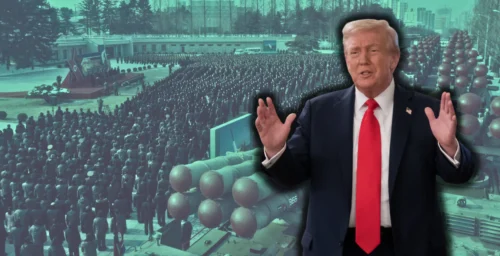
The landscape of nuclear proliferation remains one of the most opaque and high-stakes arenas of international diplomacy. On Wednesday, U.S. President Donald Trump injected a new layer of uncertainty into this theater by offering an unusually precise figure regarding the Democratic People’s Republic of Korea’s (DPRK) nuclear stockpile: 57 warheads.
The statement, delivered during an impromptu exchange with reporters, was notable not only for its specificity but for the lack of context provided by the administration. In an era where intelligence communities rely on nuanced ranges rather than single-digit totals, Trump’s declaration has triggered a firestorm of analysis among non-proliferation experts, defense analysts, and policymakers in Seoul and Washington.
The Main Facts: A Number in Question
When President Trump asserted that Pyongyang possesses exactly 57 nuclear weapons, he effectively bypassed the traditional "intelligence hedge"—the practice of providing ranges (e.g., 40 to 60) to account for the clandestine nature of North Korea’s enrichment programs.
The immediate reaction from the international security community was one of skepticism mixed with curiosity. If the figure is accurate, it suggests that the U.S. intelligence community has achieved an unprecedented level of granularity in tracking North Korean fissile material production and warhead assembly. However, if the figure is an arbitrary estimate or a political tool, it risks undermining the credibility of U.S. assessments.
Crucially, the President did not clarify whether these 57 weapons refer to fully assembled, deployable warheads, or if the count includes "nuclear-capable" devices in various stages of completion. Furthermore, the claim ignores the reality of the DPRK’s dual-track development: the production of highly enriched uranium (HEU) and plutonium, both of which serve as the lifeblood of their growing arsenal.
A Chronology of Escalation and Estimation
To understand the weight of the "57" figure, one must look back at the trajectory of North Korea’s nuclear program over the past two decades.
- 2006: North Korea conducts its first nuclear test, signaling a shift from a deterrent aspiration to a demonstrated reality.
- 2017: The "Fire and Fury" period, characterized by the successful testing of a hydrogen device and ICBMs capable of reaching the U.S. mainland. During this time, estimates of the North’s arsenal fluctuated wildly, ranging from 15 to 30 weapons.
- 2023: Recent satellite imagery analysis of the Yongbyon Nuclear Scientific Research Center and other clandestine sites suggested that Pyongyang had increased its centrifuge capacity. Experts began adjusting their forecasts upward.
- August 2025: High-level imagery shows increased activity involving North Korea’s 600mm super-large multiple rocket launcher systems, which are explicitly designed to carry tactical nuclear warheads.
- August 2026 (The Present): President Trump cites the figure of 57, a number that sits at the high end of mid-range academic estimates but falls short of more aggressive "worst-case scenario" projections.
Supporting Data: The Discrepancy with Seoul
The credibility of the "57" figure was immediately tested by the Republic of Korea (ROK). Just hours after President Trump’s remarks, officials in Seoul offered a notably higher assessment. While the South Korean Ministry of National Defense did not provide a precise counter-number, their briefings alluded to a capacity that could support an arsenal significantly larger than the one cited by the White House.
This gap is not merely a matter of bookkeeping; it reflects a fundamental difference in intelligence-gathering methodologies. The U.S. relies heavily on satellite imagery, signals intelligence (SIGINT), and long-range seismic monitoring. South Korea, conversely, benefits from human intelligence (HUMINT) and a closer, albeit still limited, proximity to the DPRK’s internal logistics and supply chains.
When these figures diverge, it suggests that there is no consensus on the efficiency of North Korea’s nuclear program. How much plutonium can they extract from a single cycle of their reactors? How many warheads can they manufacture from a kilogram of HEU? The answers to these questions remain the "known unknowns" of the Korean Peninsula.
Official Responses and Diplomatic Fallout
The White House has remained tight-lipped regarding the origin of the 57-count figure. Press Secretary briefings have largely deflected inquiries, suggesting that the President’s statement was a reflection of "the most current and comprehensive data available."

Meanwhile, the response from Pyongyang has been characteristically defiant. North Korean state media has neither confirmed nor denied the specific number, opting instead to mock the "confusion and desperation" of the U.S. intelligence apparatus. By refusing to validate or refute the number, Kim Jong Un’s regime successfully maintains the "strategic ambiguity" that is central to its nuclear deterrence strategy—a strategy that relies on the enemy fearing the worst.
In the halls of Congress, the reaction has been polarized. Some lawmakers have called for an immediate classified briefing to determine if the President’s disclosure was based on a sensitive source or if it was a lapse in operational security. Others argue that the number is a necessary signal of transparency, intended to force a more honest conversation about the reality of a nuclear-armed North Korea.
The Implications: Why the Number Matters
The obsession with the specific number—57—masks deeper, more concerning implications for regional stability.
1. The Tactical vs. Strategic Shift
The focus on the total count often obscures the type of weapons being produced. If the majority of those 57 warheads are tactical, low-yield devices designed for short-range delivery systems (like the super-large MLRS mentioned in recent reports), the threat profile changes. It suggests that Pyongyang is moving away from purely deterrent-focused, long-range weapons toward battlefield-ready nuclear capabilities. This lowers the threshold for nuclear use, making a regional conflict significantly more dangerous.
2. The Credibility of Denuclearization
If the U.S. is operating under the assumption that North Korea has 57 weapons, any future diplomatic framework must account for that specific total. Previous negotiations failed largely because both sides disagreed on the baseline of the arsenal. If Washington and Seoul cannot agree on the current number, the likelihood of a successful verification regime—a requirement for any sanctions relief—becomes virtually non-existent.
3. The Arms Race in East Asia
A specific, and high, estimate of the North’s nuclear arsenal serves as a catalyst for regional military expansion. Japan and South Korea have both faced increased domestic pressure to bolster their own defense capabilities in response to the DPRK’s growth. By highlighting a specific figure, the U.S. President may be inadvertently justifying a push for indigenous nuclear programs or the permanent deployment of tactical U.S. nuclear assets in the region, further destabilizing the status quo.
Conclusion: Living with the Uncertainty
The "57 nukes" claim is a microcosm of the broader struggle to manage the North Korean threat. Whether the number is a product of sophisticated intelligence, a strategic communication tactic, or an outlier, its existence highlights the limitations of the current international framework.
In the pursuit of denuclearization, the world has spent decades chasing numbers, hoping that if the count reaches zero, the threat will vanish. However, the reality of the DPRK’s nuclear program is that it is no longer just about the quantity of warheads. It is about the technology, the delivery systems, and the ideological commitment of the regime to maintain its status as a nuclear power.
As the international community grapples with the fallout of this latest claim, the path forward remains obscured. The uncertainty surrounding the 57 warheads is not just a statistical discrepancy—it is a reminder that in the high-stakes game of nuclear brinkmanship, the most dangerous weapon is often the one you cannot accurately count. Until there is a fundamental shift in the diplomatic architecture of the region, the world will likely continue to debate these figures, all while the stockpile, whatever its true size, continues to grow.

 Ammar Sabilarrohman
  Pevita Pearce
  Nana Wu
